

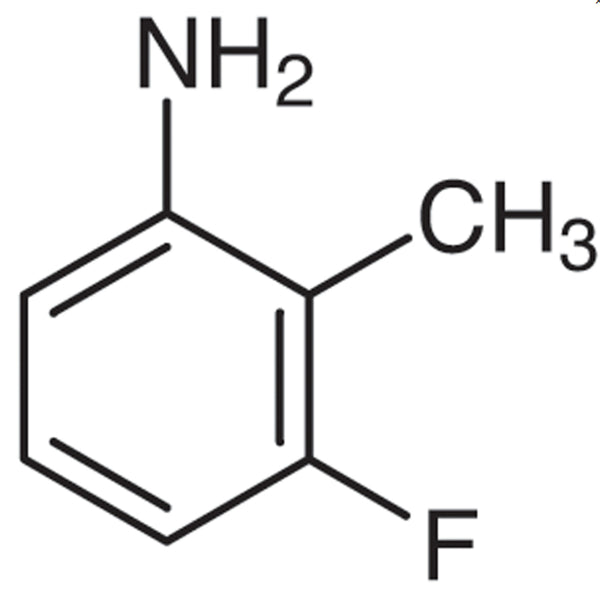
3-Fluoro-2-methylaniline is a chemical compound widely used in organic synthesis reactions within laboratory settings. It belongs to the category of fluorinated building blocks and is valued for its ability to participate in various chemical transformations. This compound features an aromatic ring with both fluorine and methyl substituents, making it a versatile reagent for synthetic chemists. Its structural complexity allows it to serve as a key intermediate in the development of complex molecules. Due to its reactivity, it is frequently employed in research involving nucleophilic substitution, condensation, and other organic reaction mechanisms.
The compound’s chemical properties make it a preferred choice for researchers seeking a flexible and reactive building block. It exhibits stability under certain conditions, yet remains sensitive to oxidation and light exposure, which requires careful handling. Its ability to form various derivatives and its compatibility with a range of reagents make it highly adaptable in synthetic pathways. The presence of fluorine in its structure also influences its reactivity and solubility, which are critical factors in its application. These characteristics make it a valuable tool for chemists working on drug development and industrial chemical synthesis.
In Indonesian laboratories, 3-Fluoro-2-methylaniline is commonly used in organic chemistry research, particularly in the development of pharmaceutical compounds, industrial chemicals, and complex reaction intermediates. Its availability in small pack sizes, such as 5 grams, facilitates its use in both academic and industrial research settings. Researchers in Indonesia rely on this compound for its reliability and performance in a variety of synthetic processes, making it an essential component of their chemical toolkit.
TCI brochures (PDF)
- Fluorination Reagents, Fluorinated Building Blocks 2026-03-18 · p. 17
- Organic synthesis research benefits from 3-Fluoro-2-methylaniline due to its reactivity and ability to form diverse derivatives, making it ideal for synthesizing complex molecules.
- Pharmaceutical development utilizes this compound as a building block for creating drug candidates, leveraging its structural versatility and chemical stability.
- Industrial chemical production incorporates this material for its role in creating specialized compounds used in various manufacturing processes.
- Academic research in chemistry relies on this compound for its role in teaching and experimental studies involving fluorinated building blocks.
- Complex reaction intermediates are often synthesized using this compound because of its ability to participate in multiple reaction types, enhancing synthetic flexibility.
| Brand | TCI |
|---|---|
| CAS number | 443-86-7 |
| Molecular formula | — |
| Purity | — |
| Category | Chemistry > Building Blocks > Fluorinated Building Blocks |
| Pack sizes | 5 grams |
| Physical form | Solid |
| Storage | Store in a cool, dark place away from light and oxidizing agents |
3-Fluoro-2-methylaniline should be stored in a cool, dark environment to prevent degradation due to light exposure. It is recommended to keep the compound in a tightly sealed container to minimize exposure to air and moisture. Suitable storage containers include glass or high-density polyethylene vessels that are resistant to chemical reactions. Due to its sensitivity to oxidation, it is important to avoid contact with strong oxidizing agents. In laboratory settings, proper ventilation and personal protective equipment should be used when handling this compound to ensure safety. Regular monitoring of storage conditions is advised to maintain the compound's integrity and effectiveness for research applications.
—
Produk Terkait
-
2-Fluoro-6-methylaniline TCI F0817
Regular price From Rp 505.050,00Regular price -
2-Fluoro-3-methylaniline TCI F0554
Regular price From Rp 717.150,00Regular price -
2-Fluoro-4-methylaniline TCI F0529
Regular price From Rp 530.250,00Regular price -
2-Fluoro-5-methylaniline TCI F0528
Regular price From Rp 505.050,00Regular price -
2-Fluoro-N-methylaniline TCI F0449
Regular price From Rp 1.008.000,00Regular price -
5-Fluoro-2-methylaniline TCI F0232
Regular price From Rp 452.550,00Regular price -
2-Bromo-4'-fluoro-3'-(trifluoromethyl)acetophenone TCI B5213
Regular price From Rp 505.050,00Regular price -
4-Bromo-2-fluoro-N-methylbenzamide TCI B5074
Regular price From Rp 1.035.300,00Regular price


