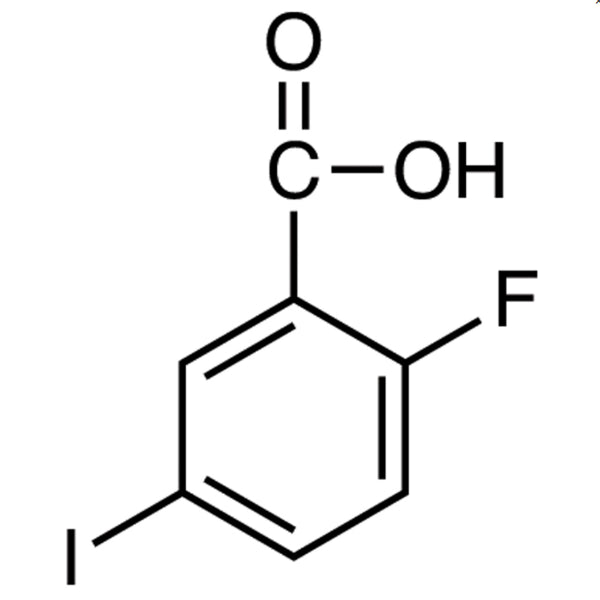
TCI F0786 2-Fluoro-5-iodobenzoic Acid is a benzoic acid derivative that carries two different halogens on its aromatic ring — a fluorine atom and an iodine atom — alongside the carboxylic acid group. This combination of three functional handles on a single small aromatic scaffold makes it a highly valued building block in modern organic synthesis laboratories. The iodine atom serves as the site for transition-metal-catalysed cross-coupling, the fluorine atom contributes electronic character and metabolic stability, and the carboxylic acid group opens routes toward amides, esters, and a wide range of heterocyclic frameworks.
The principal advantage of this compound lies in the difference in reactivity between its two halogens. The carbon–iodine bond is considerably weaker than the carbon–fluorine bond, so the iodine position can be activated selectively in Suzuki, Sonogashira, Heck, and Buchwald–Hartwig coupling reactions without disturbing the fluorine substituent. This property allows researchers to construct target molecules in a stepwise, controlled manner from a single starting material. The carboxylic acid group positioned adjacent to the fluorine atom can also direct certain reactions and offers the possibility of forming lactone or lactam rings through intramolecular cyclisation after a selective coupling step.
In Indonesian laboratories, this reagent is typically used in university research groups, pharmaceutical and agrochemical discovery programmes, and contract synthesis facilities that build fluorinated intermediates. It suits workflows where a chemist needs a reliable, orthogonally functionalised aromatic core for route scouting on a small scale before committing to larger preparations. Being supplied by TCI, it fits well into method-development work, postgraduate thesis projects, and analytical reference preparation where consistent, well-characterised starting materials are required.
TCI brochures (PDF)
- Iodinated Phenol/Benzoic Acid/Benzaldehyde Building Blocks 2024-11-15 · p. 2
- Fluorination Reagents, Fluorinated Building Blocks 2026-03-18 · p. 20
Related TCI products
- TCI F1113 52548-63-7 5-Fluoro-2-iodobenzoic Acid
- TCI F0796 111771-08-5 2-Fluoro-6-iodobenzoic Acid
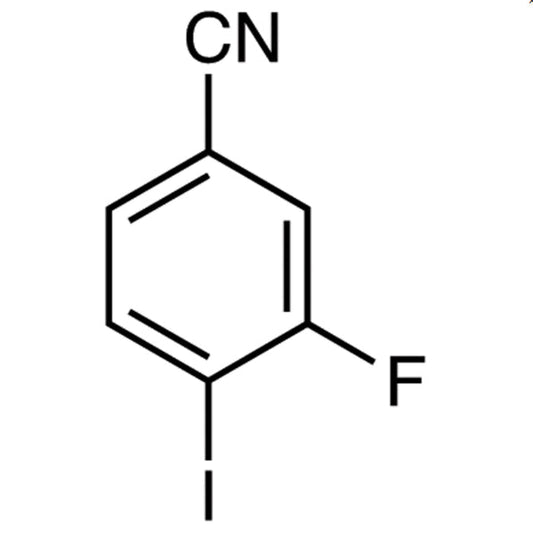
- TCI F1093 887266-99-1 3-Fluoro-4-iodobenzonitrile
- TCI F0660 79544-29-9 2-Fluoro-6-iodobenzonitrile
- TCI B5213 537050-14-9 2-Bromo-4'-fluoro-3'-(trifluoromethyl)acetophenone
- TCI B5074 749927-69-3 4-Bromo-2-fluoro-N-methylbenzamide
- Suzuki–Miyaura cross-coupling: the reactive carbon–iodine bond couples cleanly with boronic acids while the fluorine substituent stays untouched, giving controlled biaryl construction.
- Sonogashira coupling: the iodine position readily accepts terminal alkynes, allowing chemists to install rigid linear linkers onto a fluorinated aromatic core.
- Heck and Buchwald–Hartwig reactions: selective activation at iodine enables alkenylation or carbon–nitrogen bond formation without competing reaction at the fluorine site.
- Amide and ester synthesis: the carboxylic acid group provides a direct route to amide or ester derivatives, expanding the compound into larger molecular libraries.
- Heterocycle and lactam construction: after selective coupling, the carboxyl group adjacent to fluorine supports intramolecular cyclisation into lactone or lactam ring systems.
| Brand | TCI |
|---|---|
| CAS number | 124700-41-0 |
| Molecular formula | — |
| Purity | — |
| Category | Chemistry > Building Blocks > Fluorinated Building Blocks |
| Pack sizes | available in the standard TCI catalogue packaging options for this item |
| Physical form | as supplied by TCI; refer to the product label and accompanying documentation |
| Storage | keep in a tightly closed container in a cool, dry, well-ventilated place |
Store the container tightly closed in a cool, dry, well-ventilated area, away from direct sunlight, moisture, and incompatible materials. The original supplier packaging is the most suitable container; if transferring, use clean, chemically resistant glass or an appropriate sealed vessel that is clearly labelled with the product name and CAS number. Handle in a fume hood using safety goggles, gloves, and a laboratory coat, and avoid generating or inhaling dust. Keep the container closed when not in use to limit moisture uptake, return it promptly to its designated storage location, and always consult the manufacturer's safety data sheet before first use and before disposal.
—
Produk Terkait
-
5-Fluoro-2-iodobenzoicAcid TCI F1113
Regular price Rp 2.147.250,00Regular price -
2-Fluoro-6-iodobenzoicAcid TCI F0796
Regular price From Rp 823.200,00Regular price -
3-Fluoro-4-iodobenzonitrile TCI F1093
Regular price Rp 1.298.850,00Regular price -
2-Fluoro-6-iodobenzonitrile TCI F0660
Regular price From Rp 505.050,00Regular price -
2-Bromo-4'-fluoro-3'-(trifluoromethyl)acetophenone TCI B5213
Regular price From Rp 505.050,00Regular price -
4-Bromo-2-fluoro-N-methylbenzamide TCI B5074
Regular price From Rp 1.035.300,00Regular price -
2-Bromo-4-fluoro-6-nitroaniline TCI B4872
Regular price Rp 1.140.300,00Regular price -
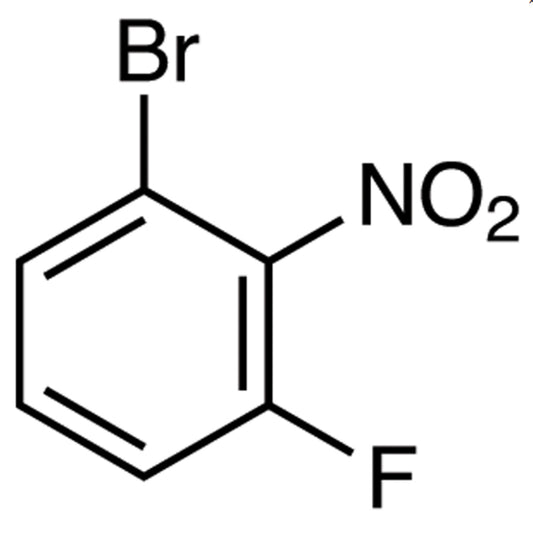
1-Bromo-3-fluoro-2-nitrobenzene TCI B4842
Regular price From Rp 1.273.650,00Regular price