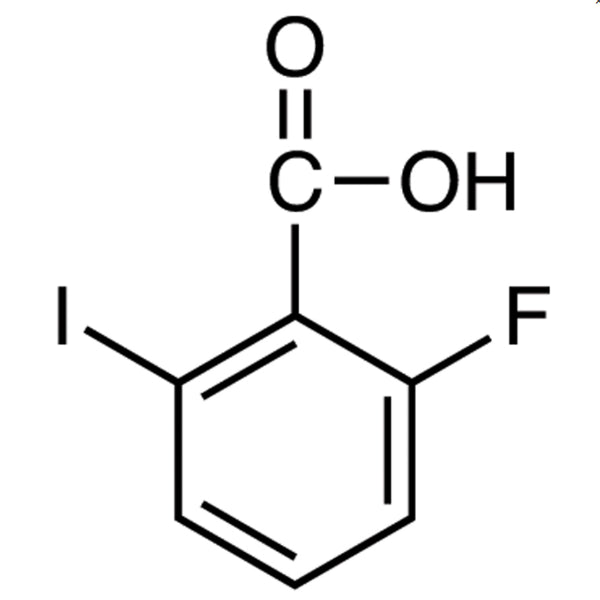
TCI F0796 2-Fluoro-6-iodobenzoic Acid is a doubly substituted benzoic acid carrying a fluorine atom and an iodine atom at both ortho positions relative to the carboxylic acid group. This arrangement makes it a high-value intermediate in organic synthesis because it provides three distinct reactive points within a single molecule. The carboxylic acid group can be converted to amides or esters, the iodine atom serves as a handle for transition-metal-catalysed cross-coupling reactions, while the fluorine atom contributes electronic influence and can also participate in nucleophilic aromatic substitution reactions.
The most notable property of this compound is the carbon–iodine bond, which is relatively weak and highly reactive toward oxidative addition at palladium catalysts. For this reason, the compound is readily incorporated into Suzuki–Miyaura, Sonogashira, Heck, and Ullmann coupling reactions without requiring unduly harsh conditions. The combination of a halogen and an adjacent carboxylic acid group also facilitates cyclisation strategies toward lactone, isocoumarin, and various fused heterocyclic frameworks. The compound is generally supplied as a white to almost white crystalline solid that remains stable under normal storage conditions.
In Indonesian laboratories, this fluorinated building block is typically used in university and institutional research groups working on medicinal chemistry, materials chemistry, and methodology development. It commonly appears in multi-step synthetic routes where a chemist needs an aromatic scaffold that can be elaborated selectively at more than one position. Its availability in research-scale packaging suits laboratories that run exploratory syntheses rather than large-volume production work.
TCI brochures (PDF)
- Iodinated Phenol/Benzoic Acid/Benzaldehyde Building Blocks 2024-11-15 · p. 1
- Fluorination Reagents, Fluorinated Building Blocks 2026-03-18 · p. 17
Related TCI products
- TCI F1113 52548-63-7 5-Fluoro-2-iodobenzoic Acid
- TCI F0786 124700-41-0 2-Fluoro-5-iodobenzoic Acid
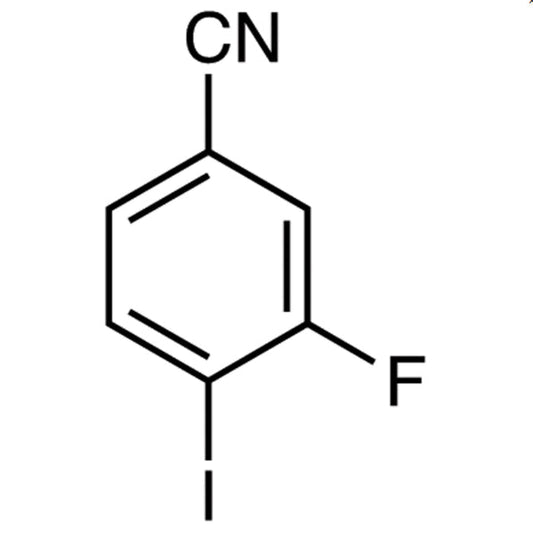
- TCI F1093 887266-99-1 3-Fluoro-4-iodobenzonitrile
- TCI F0660 79544-29-9 2-Fluoro-6-iodobenzonitrile
- TCI B5213 537050-14-9 2-Bromo-4'-fluoro-3'-(trifluoromethyl)acetophenone
- TCI B5074 749927-69-3 4-Bromo-2-fluoro-N-methylbenzamide
- Suzuki–Miyaura cross-coupling: the reactive carbon–iodine bond undergoes oxidative addition at palladium readily, allowing biaryl construction under comparatively mild reaction conditions.
- Sonogashira coupling: the aryl iodide handle couples efficiently with terminal alkynes, giving access to arylalkyne intermediates useful for further cyclisation chemistry.
- Heck reaction: the iodinated aromatic ring participates in palladium-catalysed olefination, letting chemists install alkenyl substituents at a well-defined position on the ring.
- Ullmann coupling and heterocycle synthesis: the halogen paired with the neighbouring carboxylic acid group supports cyclisation routes toward lactones, isocoumarins, and fused heterocyclic scaffolds.
- Amide and ester derivatisation: the carboxylic acid group can be amidated or esterified independently of the halogens, enabling library preparation from a single common intermediate.
| Brand | TCI |
|---|---|
| CAS number | 111771-08-5 |
| Molecular formula | — |
| Purity | — |
| Category | Chemistry > Building Blocks > Fluorinated Building Blocks |
| Pack sizes | available in standard TCI research-scale packaging; please confirm the size options when ordering. |
| Physical form | white to almost white crystalline solid |
| Storage | stable under normal storage conditions in a closed container |
Store the material in its original tightly closed container, kept in a cool, dry, and well-ventilated area away from direct sunlight, moisture, and incompatible substances. Amber glass or the supplier's original packaging is suitable for protecting the solid from light and humidity. Handle the compound in a fume hood using standard laboratory personal protective equipment, including safety glasses, gloves, and a laboratory coat, and avoid generating dust during weighing and transfer. Always close the container promptly after use, label any secondary containers clearly, and consult the manufacturer's safety data sheet before handling, disposal, or transport.
—
Produk Terkait
-
5-Fluoro-2-iodobenzoicAcid TCI F1113
Regular price Rp 2.147.250,00Regular price -
2-Fluoro-5-iodobenzoicAcid TCI F0786
Regular price From Rp 955.500,00Regular price -
3-Fluoro-4-iodobenzonitrile TCI F1093
Regular price Rp 1.298.850,00Regular price -
2-Fluoro-6-iodobenzonitrile TCI F0660
Regular price From Rp 505.050,00Regular price -
2-Bromo-4'-fluoro-3'-(trifluoromethyl)acetophenone TCI B5213
Regular price From Rp 505.050,00Regular price -
4-Bromo-2-fluoro-N-methylbenzamide TCI B5074
Regular price From Rp 1.035.300,00Regular price -
2-Bromo-4-fluoro-6-nitroaniline TCI B4872
Regular price Rp 1.140.300,00Regular price -
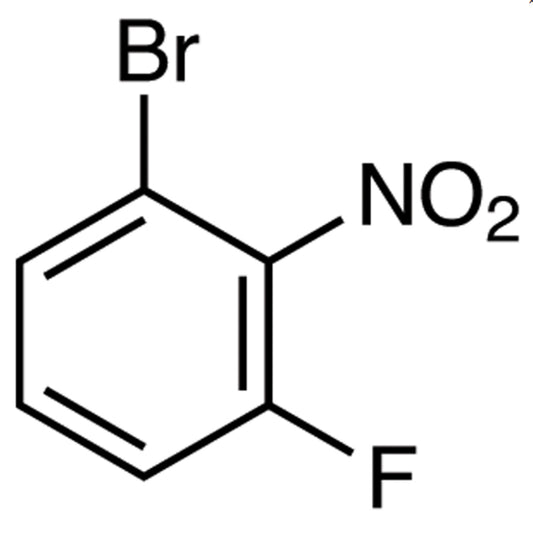
1-Bromo-3-fluoro-2-nitrobenzene TCI B4842
Regular price From Rp 1.273.650,00Regular price