

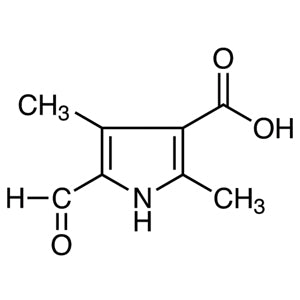
5-Formyl-2,4-dimethyl-3-pyrrolecarboxylic Acid is a versatile chemical compound widely used in laboratory settings for the synthesis of heterocyclic compounds. As a key building block in organic chemistry, it plays a crucial role in the development of complex molecular structures. Its unique molecular structure, which combines a pyrrole ring with a formyl group, makes it an essential tool for chemists working on drug discovery, material science, and environmental chemistry. This compound is particularly valued for its ability to participate in various chemical reactions, including condensation, substitution, and redox processes.
The compound's chemical properties make it a preferred choice for researchers. It exhibits stability under controlled conditions, although it is sensitive to moisture and oxidative environments. Its reactivity allows for the formation of a wide range of derivatives, which can be tailored for specific applications. The compound’s structural versatility supports its use in both academic and industrial research, making it a reliable and effective reagent in modern chemical laboratories.
In Indonesian laboratories, this compound is extensively used in both fundamental and applied research. It is commonly found in university research centers and industrial laboratories, where it contributes to the development of new pharmaceuticals, advanced materials, and environmental solutions. Its availability supports the growing needs of local scientific communities, enabling researchers to explore innovative chemical pathways and applications.
Related TCI products
- TCI E1051 2199-59-9 Ethyl 5-Formyl-2,4-dimethyl-3-pyrrolecarboxylate
- TCI M2161 6973-60-0 1-Methyl-2-pyrrolecarboxylic Acid
- TCI M1145 40611-85-6 Ethyl 4-Methyl-2-pyrrolecarboxylate
- TCI M1119 1192-58-1 1-Methyl-2-pyrrolecarboxaldehyde
- TCI E0843 2199-44-2 Ethyl 3,5-Dimethyl-2-pyrrolecarboxylate
- TCI D3950 2199-58-8 3,5-Dimethyl-2-pyrrolecarboxaldehyde
- Drug synthesis and pharmaceutical development due to its role in constructing complex heterocyclic structures essential for medicinal chemistry.
- Organic synthesis of novel materials where its reactivity and structural versatility enable the creation of functional compounds.
- Environmental chemistry research for the development of compounds used in pollution control and remediation processes.
- Academic research in chemical synthesis and reaction mechanisms due to its ability to participate in various chemical transformations.
- Industrial chemical production where its use in building blocks supports the creation of specialized chemical products.
| Brand | TCI |
|---|---|
| CAS number | 253870-02-9 |
| Molecular formula | — |
| Purity | — |
| Category | Chemistry > Building Blocks > Heterocyclic Building Blocks |
| Pack sizes | Available in various quantities as per standard supplier offerings |
| Physical form | Solid, crystalline appearance |
| Storage | Store in a cool, dry place away from moisture and oxidizing agents |
This compound should be stored in a cool, dry environment to maintain its chemical stability. It is recommended to keep it in airtight containers to prevent exposure to moisture and oxidation, which can degrade its properties. Due to its sensitivity, it should be handled in a well-ventilated area, and appropriate personal protective equipment should be worn when working with it. Avoid contact with strong oxidizing agents or moisture to ensure safety and maintain its effectiveness in laboratory applications. Proper storage and handling are essential to preserve its chemical integrity and ensure safe usage in research settings.
—
Produk Terkait
-
Ethyl5-Formyl-2,4-dimethyl-3-pyrrolecarboxylate TCI E1051
Regular price From Rp 1.405.950,00Regular price -
1-Methyl-2-pyrrolecarboxylicAcid TCI M2161
Regular price Rp 1.829.100,00Regular price -
Ethyl4-Methyl-2-pyrrolecarboxylate TCI M1145
Regular price From Rp 6.281.100,00Regular price -
1-Methyl-2-pyrrolecarboxaldehyde TCI M1119
Regular price From Rp 1.326.150,00Regular price -
Ethyl3,5-Dimethyl-2-pyrrolecarboxylate TCI E0843
Regular price From Rp 2.439.150,00Regular price -
3,5-Dimethyl-2-pyrrolecarboxaldehyde TCI D3950
Regular price From Rp 1.565.550,00Regular price -
3-Formyl-6-methoxychromone TCI F1115
Regular price Rp 769.650,00Regular price -
3-Formyl-6-methylchromone TCI F1005
Regular price From Rp 584.850,00Regular price


