

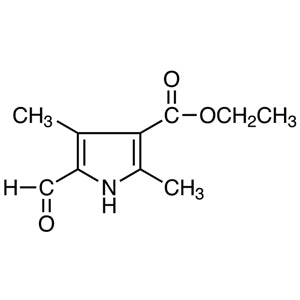
Ethyl 5-Formyl-2,4-dimethyl-3-pyrrolecarboxylate is a chemical compound widely used in organic synthesis reactions, particularly in the formation of heterocyclic compounds. Its complex molecular structure enables various chemical reactions such as substitution, reduction, and other essential processes in the synthesis of more complex molecules. This compound is a valuable building block in the field of heterocyclic chemistry, offering versatility in synthetic pathways. In laboratory settings, it serves as a key reagent for the development of compounds with specific structural features, including aromatic or heterocyclic derivatives.
The compound's chemical properties make it a preferred choice for researchers due to its reactivity and ability to participate in a wide range of chemical transformations. Its specific molecular structure allows for selective reactions, which are crucial in achieving desired synthetic outcomes. While it exhibits stability under certain conditions, it is sensitive to moisture and oxidation, requiring careful handling. These characteristics make it a reliable and effective reagent in organic chemistry applications.
In Indonesian laboratories, this compound is commonly used in organic chemistry research, especially in the development of new compounds with applications in pharmaceuticals, materials science, and industrial chemistry. Researchers from educational institutions and research organizations frequently utilize it for experiments requiring precise and reactive chemical intermediates. Its role in advancing chemical innovation underscores its importance in the scientific community.
Related TCI products
- TCI F0939 253870-02-9 5-Formyl-2,4-dimethyl-3-pyrrolecarboxylic Acid
- TCI E0843 2199-44-2 Ethyl 3,5-Dimethyl-2-pyrrolecarboxylate
- TCI M1145 40611-85-6 Ethyl 4-Methyl-2-pyrrolecarboxylate
- TCI M2161 6973-60-0 1-Methyl-2-pyrrolecarboxylic Acid
- TCI M1119 1192-58-1 1-Methyl-2-pyrrolecarboxaldehyde
- TCI D3950 2199-58-8 3,5-Dimethyl-2-pyrrolecarboxaldehyde
- Organic synthesis of heterocyclic compounds due to its reactive functional groups and structural versatility.
- Development of pharmaceutical intermediates through selective chemical transformations and functional group modifications.
- Creation of aromatic derivatives by facilitating substitution and reduction reactions in complex synthetic pathways.
- Research in materials science for the synthesis of novel compounds with specific structural and functional properties.
- Support in industrial chemistry applications where precise chemical intermediates are required for product development.
| Brand | TCI |
|---|---|
| CAS number | 2199-59-9 |
| Molecular formula | — |
| Purity | — |
| Category | Chemistry > Building Blocks > Heterocyclic Building Blocks |
| Pack sizes | Available in standard laboratory quantities |
| Physical form | Solid or liquid, depending on supplier packaging |
| Storage | Store in a dry, cool place away from moisture and oxidizing agents |
This compound should be stored in a dry, cool environment to prevent moisture-induced degradation. It is recommended to use airtight containers to minimize exposure to air and humidity. Due to its sensitivity to oxidation, it should be kept away from strong oxidizing agents. Proper labeling and secure storage are essential to ensure safety in the laboratory. Always use appropriate personal protective equipment when handling this material. Regular monitoring of storage conditions will help maintain its chemical integrity and effectiveness in synthetic applications.
—
Produk Terkait
-
5-Formyl-2,4-dimethyl-3-pyrrolecarboxylicAcid TCI F0939
Regular price From Rp 1.458.450,00Regular price -
Ethyl3,5-Dimethyl-2-pyrrolecarboxylate TCI E0843
Regular price From Rp 2.439.150,00Regular price -
Ethyl4-Methyl-2-pyrrolecarboxylate TCI M1145
Regular price From Rp 6.281.100,00Regular price -
1-Methyl-2-pyrrolecarboxylicAcid TCI M2161
Regular price Rp 1.829.100,00Regular price -
1-Methyl-2-pyrrolecarboxaldehyde TCI M1119
Regular price From Rp 1.326.150,00Regular price -
3,5-Dimethyl-2-pyrrolecarboxaldehyde TCI D3950
Regular price From Rp 1.565.550,00Regular price -
3-Formyl-6-methoxychromone TCI F1115
Regular price Rp 769.650,00Regular price -
3-Formyl-6-methylchromone TCI F1005
Regular price From Rp 584.850,00Regular price


