

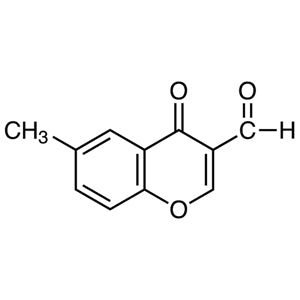
3-Formyl-6-methylchromone is a chemical compound widely used in organic synthesis reactions within laboratory settings. It serves as a versatile building block due to its heterocyclic structure, which allows for the creation of complex molecular frameworks. This compound is particularly valuable in research areas such as pharmacology, organic chemistry, and materials science. Its ability to participate in various chemical reactions makes it a key component in the development of bioactive compounds and functional materials.
The compound's unique chemical properties, including the presence of an aldehyde group and a heterocyclic ring, contribute to its reactivity and utility. These features enable it to undergo nucleophilic and electrophilic reactions, making it a preferred choice for synthetic chemists. Its predictable behavior under controlled conditions enhances its reliability in laboratory experiments. The combination of stability and reactivity ensures that it remains a valuable tool in the synthesis of complex organic molecules.
In Indonesian laboratories, 3-Formyl-6-methylchromone is commonly used in organic chemistry research, especially in the development of new compounds with applications in pharmaceuticals and advanced materials. It is frequently employed by research institutions and universities to explore the synthesis of bioactive molecules and functional polymers. Its role in creating structurally diverse compounds supports ongoing scientific innovation in various fields of study.
Related TCI products
- TCI M2764 38445-23-7 6-Methylchromone
- TCI M2725 5006-44-0 6-Methylchromone-2-carboxylic Acid
- TCI M2459 50743-18-5 6-Methylchromone-3-carbonitrile
- TCI F1115 42059-79-0 3-Formyl-6-methoxychromone
- TCI F0939 253870-02-9 5-Formyl-2,4-dimethyl-3-pyrrolecarboxylic Acid
- TCI F0856 49619-58-1 3-Formyl-6-isopropylchromone
- Organic synthesis research benefits from this compound's reactivity and structural versatility, enabling the creation of complex molecules with potential pharmaceutical applications.
- Drug development projects utilize its ability to form diverse molecular frameworks, supporting the design of new therapeutic agents with targeted biological activities.
- Materials science studies leverage its heterocyclic structure to develop advanced polymers and functional materials with unique chemical properties.
- Academic research in chemistry uses it as a key building block for exploring new synthetic methodologies and reaction mechanisms.
- Bioactive compound synthesis relies on its predictable chemical behavior to produce compounds with potential applications in medicinal and biological research.
| Brand | TCI |
|---|---|
| CAS number | 42059-81-4 |
| Molecular formula | — |
| Purity | — |
| Category | Chemistry > Building Blocks > Heterocyclic Building Blocks |
| Pack sizes | — |
| Physical form | — |
| Storage | Store in a cool, dry place away from light and moisture |
This compound should be stored in a cool, dry environment, away from direct light and moisture to maintain its chemical stability. It is recommended to use airtight containers to prevent exposure to air and potential degradation. Due to its reactivity, it should be handled with care in a well-ventilated laboratory setting. Standard laboratory safety protocols, such as the use of personal protective equipment, should be followed during handling. Avoid contact with incompatible substances to ensure safe storage and usage. Proper labeling of containers is essential for safe handling and to prevent accidental exposure.
—
Produk Terkait
-
6-Methylchromone TCI M2764
Regular price From Rp 1.485.750,00Regular price -
6-Methylchromone-2-carboxylicAcid TCI M2725
Regular price From Rp 1.353.450,00Regular price -
6-Methylchromone-3-carbonitrile TCI M2459
Regular price From Rp 743.400,00Regular price -
3-Formyl-6-methoxychromone TCI F1115
Regular price Rp 769.650,00Regular price -
5-Formyl-2,4-dimethyl-3-pyrrolecarboxylicAcid TCI F0939
Regular price From Rp 1.458.450,00Regular price -
3-Formyl-6-isopropylchromone TCI F0856
Regular price Rp 1.538.250,00Regular price -
5-Formyl-2-thiopheneboronicAcid(containsvaryingamountsofAnhydride) TCI F0549
Regular price From Rp 823.200,00Regular price -
5-Formyl-2-thiophenecarboxylicAcid TCI F0336
Regular price From Rp 2.279.550,00Regular price


