

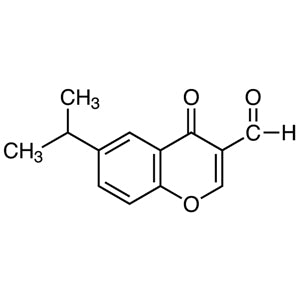
3-Formyl-6-isopropylchromone is a chemical compound widely used as a building block in the synthesis of complex heterocyclic compounds. Its molecular structure consists of a chromone ring substituted with a formyl group and an isopropyl group, enabling it to participate in various chemical reactions. This compound plays a crucial role in organic chemistry laboratories, where it serves as a key component in the development of new chemical entities. Its versatility makes it an essential tool for researchers working on drug discovery and advanced material synthesis.
The compound's stability and reactivity make it a preferred choice for laboratory applications. It exhibits good nucleophilic and electrophilic reactivity, allowing it to engage in substitution and condensation reactions. Its chemical properties also provide flexibility for modifications, making it adaptable to different research needs. The compound's solid form and ease of handling further contribute to its popularity among scientists seeking reliable and efficient reagents.
In Indonesian laboratories, 3-Formyl-6-isopropylchromone is commonly used in organic chemistry research and pharmaceutical development. Its availability and chemical properties make it a valuable resource for academic and industrial research. It is frequently employed in the synthesis of bioactive compounds and functional materials, supporting innovation in both academic and applied scientific fields.
Related TCI products
- TCI C2661 50743-32-3 6-Isopropylchromone-3-carbonitrile
- TCI F1115 42059-79-0 3-Formyl-6-methoxychromone
- TCI F1005 42059-81-4 3-Formyl-6-methylchromone
- TCI F0939 253870-02-9 5-Formyl-2,4-dimethyl-3-pyrrolecarboxylic Acid
- TCI F0549 4347-33-5 5-Formyl-2-thiopheneboronic Acid (contains varying amounts of Anhydride)
- TCI F0336 4565-31-5 5-Formyl-2-thiophenecarboxylic Acid
- Organic synthesis applications benefit from this compound's ability to participate in nucleophilic and electrophilic reactions, supporting the creation of complex molecular structures.
- Drug discovery projects often utilize it as a versatile building block for the development of new pharmaceutical compounds with specific biological activities.
- Heterocyclic compound synthesis relies on its chromone core, which can be modified to produce a wide range of functional derivatives for various applications.
- Research in medicinal chemistry frequently incorporates it to explore new therapeutic agents and improve existing drug formulations.
- Advanced material development uses its reactivity to create novel compounds with unique physical and chemical properties for specialized applications.
| Brand | TCI |
|---|---|
| CAS number | 49619-58-1 |
| Molecular formula | — |
| Purity | — |
| Category | Chemistry > Building Blocks > Heterocyclic Building Blocks |
| Pack sizes | Available in standard laboratory quantities as per supplier specifications |
| Physical form | Solid |
| Storage | Store in a cool, dry place away from light and moisture |
This compound should be stored in a cool, dry place, away from direct light and moisture to maintain its chemical integrity. It is recommended to use airtight containers to prevent exposure to humidity and air. Due to its reactivity, it should be handled with appropriate laboratory safety measures, including the use of personal protective equipment. It is advisable to store it in a well-ventilated area to minimize any potential risks associated with its chemical properties. Proper labeling and storage conditions ensure the compound remains stable and suitable for use in various experimental applications.
—
Produk Terkait
-
6-Isopropylchromone-3-carbonitrile TCI C2661
Regular price From Rp 795.900,00Regular price -
3-Formyl-6-methoxychromone TCI F1115
Regular price Rp 769.650,00Regular price -
3-Formyl-6-methylchromone TCI F1005
Regular price From Rp 584.850,00Regular price -
5-Formyl-2,4-dimethyl-3-pyrrolecarboxylicAcid TCI F0939
Regular price From Rp 1.458.450,00Regular price -
5-Formyl-2-thiopheneboronicAcid(containsvaryingamountsofAnhydride) TCI F0549
Regular price From Rp 823.200,00Regular price -
5-Formyl-2-thiophenecarboxylicAcid TCI F0336
Regular price From Rp 2.279.550,00Regular price -
Ethyl2-(3-Formyl-4-hydroxyphenyl)-4-methylthiazole-5-carboxylate TCI E1394
Regular price From Rp 875.700,00Regular price -
Ethyl5-Formyl-2,4-dimethyl-3-pyrrolecarboxylate TCI E1051
Regular price From Rp 1.405.950,00Regular price


