

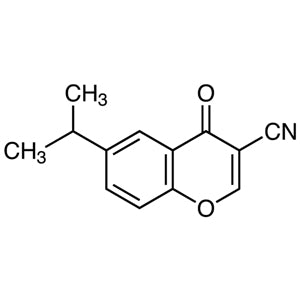
6-Isopropylchromone-3-carbonitrile is a chemical compound widely used in organic synthesis reactions within laboratory settings. This compound belongs to the class of heterocyclic building blocks, which are essential for constructing complex molecular structures. Its unique chemical structure, featuring a chromene ring and a nitrile group, makes it a versatile reagent in the development of new compounds with specific biological activities. Due to its functional group diversity, it is frequently employed in synthetic pathways that require precise control over reaction conditions.
The compound is valued for its chemical stability under controlled conditions, although it is sensitive to moisture and air exposure. Its ability to react with various reagents and its solid form make it a reliable choice for laboratory applications. The presence of both aromatic and functional groups enhances its reactivity, allowing it to participate in a wide range of chemical transformations. Its structural complexity also means that it requires careful handling and precise synthesis techniques to maintain its integrity.
In Indonesian laboratories, 6-Isopropylchromone-3-carbonitrile is commonly used in research focused on organic chemistry and pharmacology. Scientists utilize this compound to develop new molecules with potential therapeutic applications. Its role in creating complex structures makes it an important tool for both academic and industrial research. The compound’s versatility and chemical properties make it a valuable asset in the pursuit of scientific innovation.
- Organic synthesis is a key application where this compound serves as a building block for creating complex molecules with specific functional groups.
- Medicinal chemistry research benefits from its ability to form diverse molecular structures, aiding in the development of bioactive compounds.
- Heterocyclic compound synthesis relies on its unique chromene and nitrile groups for constructing new ring systems.
- Pharmaceutical research utilizes its reactivity to design compounds with potential therapeutic effects in drug development.
- Analytical chemistry applications take advantage of its chemical stability and reactivity for testing and characterizing new synthetic pathways.
| Brand | TCI |
|---|---|
| CAS number | 50743-32-3 |
| Molecular formula | — |
| Purity | — |
| Category | Chemistry > Building Blocks > Heterocyclic Building Blocks |
| Pack sizes | — |
| Physical form | Solid |
| Storage | Keep in a dry, cool, and dark place away from moisture and air exposure. |
This compound should be stored in a dry, cool, and dark environment to prevent degradation due to moisture and air exposure. It is recommended to use airtight containers made of glass or high-density polyethylene to maintain its chemical integrity. Laboratory personnel should handle the compound with care, using appropriate personal protective equipment such as gloves and safety goggles. Due to its sensitivity, it should be stored away from incompatible substances like strong bases or reducing agents. Regular monitoring of storage conditions is essential to ensure the compound remains stable and suitable for use in research applications.
—
Produk Terkait
-
4-Bromotetrahydro-2H-pyran TCI B5600
Regular price From Rp 1.060.500,00Regular price -
3,3-Bis(bromomethyl)oxetane TCI B5641
Regular price From Rp 1.035.300,00Regular price -
1,3:2,4-Bis-O-(3,4-dimethylbenzylidene)-D-sorbitol TCI B5693
Regular price From Rp 689.850,00Regular price -
1-Bromodibenzofuran TCI B5766
Regular price Rp 1.378.650,00Regular price -
2-Bromo-9,9-dimethyl-9H-xanthene TCI B5794
Regular price Rp 2.411.850,00Regular price -
2-Bromobenzo[b]naphtho[2,3-d]furan TCI B5805
Regular price From Rp 2.254.350,00Regular price -
2,8-Bis(diphenylphosphoryl)dibenzo[b,d]furan TCI B5822
Regular price From Rp 2.306.850,00Regular price -
2-Bromospiro[9H-fluorene-9,9'-[9H]xanthene] TCI B5842
Regular price Rp 1.246.350,00Regular price


![2-Bromobenzo[b]naphtho[2,3-d]furan (CAS 1627917-16-1) - TCI B5805 - AMI Scientific](http://amiscientific.com/cdn/shop/files/TCI2510B5805.jpg?v=1768815902&width=533)
![2,8-Bis(diphenylphosphoryl)dibenzo[b,d]furan (CAS 911397-27-8) - TCI B5822 - AMI Scientific](http://amiscientific.com/cdn/shop/files/TCI2510B5822.jpg?v=1768815910&width=533)
![2-Bromospiro[9H-fluorene-9,9'-[9H]xanthene] (CAS 899422-06-1) - TCI B5842 - AMI Scientific](http://amiscientific.com/cdn/shop/files/TCI2510B5842_e2ad23d0-bb0e-4716-9985-8039749f6ec4.jpg?v=1767863565&width=533)