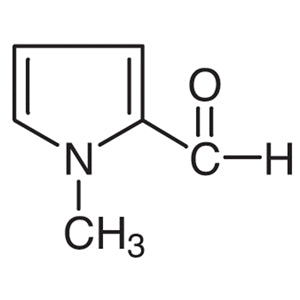
TCI M1119 1-Methyl-2-pyrrolecarboxaldehyde is a pyrrole derivative carrying an aldehyde group at the 2-position and a methyl group on the ring nitrogen. The combination of an electron-rich pyrrole core with a reactive carbonyl group makes it one of the most versatile heterocyclic building blocks in routine use in organic synthesis. The aldehyde group acts as an entry point to a wide range of classical transformations — condensations, reductive amination, olefination and multicomponent reactions — so that a single reagent can lead researchers toward many different compound classes.
The property that sets this material apart is methylation at the nitrogen, which significantly improves stability compared with pyrroles bearing a free N–H. Unsubstituted pyrroles tend to polymerise readily and darken on exposure to air or acid, whereas capping the nitrogen with a methyl group removes that reaction pathway and at the same time prevents the nitrogen from competing as a nucleophile in reactions targeted at the aldehyde group. The methyl group also improves solubility in organic solvents, while the aldehyde at the 2-position remains activated by the aromatic pyrrole system, so its reactivity is retained where it is wanted.
In Indonesian laboratories this building block is typically used in university and institutional synthetic chemistry groups, in medicinal chemistry and materials research programmes, and in industrial R&D units developing heterocyclic intermediates. Its predictable handling behaviour and the breadth of transformations it supports make it a practical stock item for laboratories that run multi-step syntheses and need a dependable pyrrole-aldehyde starting material rather than preparing one in-house each time.
Related TCI products
- TCI D3950 2199-58-8 3,5-Dimethyl-2-pyrrolecarboxaldehyde
- TCI M2161 6973-60-0 1-Methyl-2-pyrrolecarboxylic Acid
- TCI M1145 40611-85-6 Ethyl 4-Methyl-2-pyrrolecarboxylate
- TCI F0939 253870-02-9 5-Formyl-2,4-dimethyl-3-pyrrolecarboxylic Acid
- TCI E1051 2199-59-9 Ethyl 5-Formyl-2,4-dimethyl-3-pyrrolecarboxylate
- TCI E0843 2199-44-2 Ethyl 3,5-Dimethyl-2-pyrrolecarboxylate
- Condensation reactions: the activated 2-aldehyde readily forms imines, hydrazones and related adducts, giving fast access to extended heterocyclic scaffolds from a single reagent.
- Reductive amination: the carbonyl group is converted cleanly to secondary or tertiary amines, and the capped nitrogen prevents the ring from interfering as a competing nucleophile during the step.
- Olefination chemistry: Wittig-type and related carbon–carbon bond forming reactions use the aldehyde directly to install alkenyl substituents on the electron-rich pyrrole ring.
- Multicomponent reactions: the aldehyde functions as the carbonyl partner in one-pot assemblies, allowing complex heterocyclic products to be built rapidly with minimal intermediate isolation.
- Medicinal chemistry intermediate synthesis: the N-methylated pyrrole motif is a common structural element, and this building block delivers it in a stable, ready-to-use form.
| Brand | TCI |
|---|---|
| CAS number | 1192-58-1 |
| Molecular formula | — |
| Purity | — |
| Category | Chemistry > Building Blocks > Heterocyclic Building Blocks |
| Pack sizes | available in standard TCI research-scale packaging; please confirm the size required when ordering |
| Physical form | organic aldehyde reagent supplied in the manufacturer's sealed container |
| Storage | keep tightly closed, protected from air and light, in a cool place |
Store the container tightly closed in a cool, dry and well-ventilated area, away from light, heat and sources of ignition, and keep it separated from strong acids and strong oxidising agents. The original manufacturer's container is the preferred storage vessel; if transfer is required, use clean, dry glass or another compatible chemically resistant container with a secure closure and clear labelling. Handle the material in a fume hood using safety goggles, gloves and a laboratory coat, avoid inhaling vapours or allowing skin and eye contact, and close the container promptly after use to limit air exposure. Consult the manufacturer's safety data sheet before first use and dispose of residues through approved chemical waste channels.
—
Produk Terkait
-
3,5-Dimethyl-2-pyrrolecarboxaldehyde TCI D3950
Regular price From Rp 1.565.550,00Regular price -
1-Methyl-2-pyrrolecarboxylicAcid TCI M2161
Regular price Rp 1.829.100,00Regular price -
Ethyl4-Methyl-2-pyrrolecarboxylate TCI M1145
Regular price From Rp 6.281.100,00Regular price -
5-Formyl-2,4-dimethyl-3-pyrrolecarboxylicAcid TCI F0939
Regular price From Rp 1.458.450,00Regular price -
Ethyl5-Formyl-2,4-dimethyl-3-pyrrolecarboxylate TCI E1051
Regular price From Rp 1.405.950,00Regular price -
Ethyl3,5-Dimethyl-2-pyrrolecarboxylate TCI E0843
Regular price From Rp 2.439.150,00Regular price -
Cyclohexanecarboxaldehyde TCI C0880
Regular price From Rp 1.988.700,00Regular price -
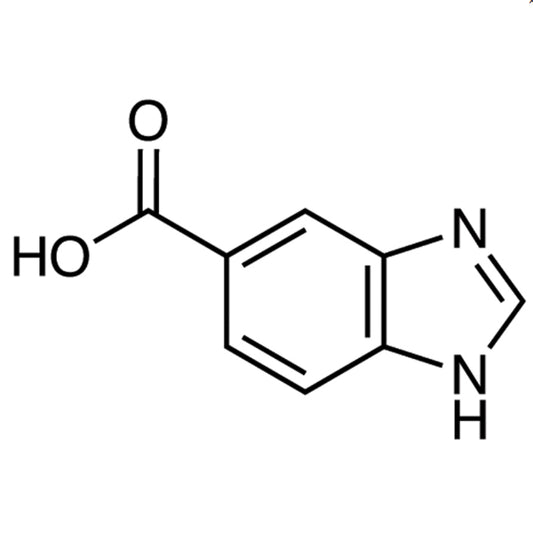
5-BenzimidazolecarboxylicAcid TCI B1763
Regular price From Rp 1.829.100,00Regular price