1-Fluoro-3,3-dimethyl-1,2-benziodoxole is a synthetic reagent widely used in laboratory settings for its unique chemical properties. As a member of the hypervalent iodine compound family, it plays a crucial role in organic synthesis due to its high reactivity and oxidizing capabilities. This compound is commonly employed in oxidation and substitution reactions, making it an essential tool for chemists working on complex molecule synthesis. Its versatility allows it to be used as both a reagent and a catalyst, depending on the reaction conditions.
The compound's high reactivity is attributed to the presence of a hypervalent iodine atom, which enhances its ability to participate in various chemical transformations. Its stability under controlled conditions ensures safe handling and long-term storage, making it a reliable choice for laboratory use. The molecular structure of 1-Fluoro-3,3-dimethyl-1,2-benziodoxole contributes to its effectiveness in promoting chemical reactions, particularly those involving oxidation or functional group modification.
In Indonesian laboratories, this compound is frequently utilized in organic chemistry research, especially in the development of new compounds or the modification of existing ones. Its availability in suitable packaging and solid form makes it convenient for both research and teaching applications. Researchers in various institutions rely on this reagent for its consistent performance and reliability in synthetic processes.
Advantages (TCI brochure)
- Moisture- and air-stable
- Effective for 1,1-difluorination of styrene derivatives
- Applicable to fluorinative intramolecular-cyclizations
TCI brochures (PDF)
- Unique Fluorinating Reagent with Various Reactivities 2025-06-03 · p. 1
- Hypervalent Iodine Compounds 2025-06-12 · p. 2
- Halogenation Reagents 2026-04-03 · p. 3
- Fluorination Reagents, Fluorinated Building Blocks 2026-03-18 · p. 7
Related TCI products
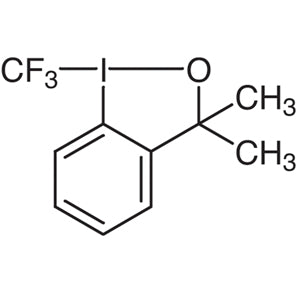
- TCI T2624 887144-97-0 1-Trifluoromethyl-3,3-dimethyl-1,2-benziodoxole
- TCI T3590 181934-34-9 1-[2-(Triisopropylsilyl)ethynyl]-3,3-bis(trifluoromethyl)-1,2-benziodoxole
- TCI F1345 2845105-20-4 N-(tert-Butyl)-N-fluoro-2-methylpropane-2-sulfonamide
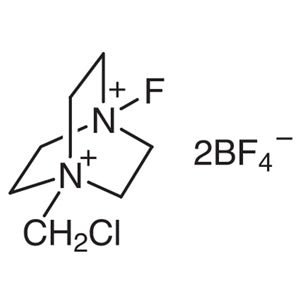
- TCI F0358 140681-55-6 N-Fluoro-N'-(chloromethyl)triethylenediamine Bis(tetrafluoroborate)
- TCI A2678 1580548-81-7 1-Acetoxy-5-bromo-1,2-benziodoxol-3(1H)-one
- TCI T3272 181934-29-2 1-[(Trimethylsilyl)ethynyl]-1,2-benziodoxol-3(1H)-one
- Organic synthesis reactions benefit from this compound's oxidizing properties, enabling the formation of complex organic molecules.
- It is ideal for substitution reactions due to its high reactivity and ability to act as a versatile reagent.
- In oxidation processes, the hypervalent iodine atom facilitates the conversion of functional groups, enhancing reaction efficiency.
- It supports the development of new chemical compounds by providing a reliable and effective synthetic pathway.
- This reagent is commonly used in academic and industrial research settings for its consistent performance in chemical transformations.
From the TCI brochure
- Alpha-fluorinations of 1,3-dicarbonyl compounds
- 1,1-difluorinations of styrene derivatives
- Fluorinative intramolecular-cyclizations
| Brand | TCI |
|---|---|
| CAS number | 1391728-13-4 |
| Molecular formula | — |
| Purity | — |
| Category | Chemistry > Synthetic Reagents > Hypervalent Iodine Compounds |
| Pack sizes | Available in various sizes as per standard laboratory requirements |
| Physical form | Solid |
| Storage | Store in a cool, dry place away from light and moisture |
Data from the TCI brochure
| Ukuran kemasan | 1g |
|---|
Source: TCI brochure RR056 (2025-06-03)
This compound should be stored in a cool, dry environment, away from direct light and moisture to maintain its stability and effectiveness. It is recommended to use airtight containers to prevent exposure to air and humidity. Due to its reactivity, it should be handled with care, using appropriate personal protective equipment such as gloves and safety goggles. Avoid contact with incompatible substances, and ensure proper ventilation in the laboratory. Proper storage and handling protocols help ensure the safety of laboratory personnel and the integrity of the compound during use.
References cited in the TCI brochure
- Gemma C. Geary. Electrophilic fluorination using a hypervalent iodine reagent derived from fluoride Chemical Communications, 2013. doi:10.1039/c3cc44792h
- Nadia O. Ilchenko. Mild Silver‐Mediated Geminal Difluorination of Styrenes Using an Air‐ and Moisture‐Stable Fluoroiodane Reagent Angewandte Chemie International Edition, 2014. doi:10.1002/anie.201408812
- Weiming Yuan. Catalytic Intramolecular Aminofluorination, Oxyfluorination, and Carbofluorination with a Stable and Versatile Hypervalent Fluoroiodine Reagent Angewandte Chemie International Edition, 2015. doi:10.1002/anie.201503373
Produk Terkait
-
1-Trifluoromethyl-3,3-dimethyl-1,2-benziodoxole TCI T2624
Regular price From Rp 5.724.600,00Regular priceRp 4.018.350,00Sale price From Rp 5.724.600,00 -
1-[2-(Triisopropylsilyl)ethynyl]-3,3-bis(trifluoromethyl)-1,2-benziodoxole TCI T3590
Regular price Rp 2.518.950,00Regular priceRp 1.776.600,00Sale price Rp 2.518.950,00 -
N-(tert-Butyl)-N-fluoro-2-methylpropane-2-sulfonamide TCI F1345
Regular price From Rp 3.922.800,00Regular priceRp 2.758.350,00Sale price From Rp 3.922.800,00 -
N-Fluoro-N'-(chloromethyl)triethylenediamineBis(tetrafluoroborate) TCI F0358
Regular price From Rp 1.351.350,00Regular priceRp 960.750,00Sale price From Rp 1.351.350,00 -
1-Acetoxy-5-bromo-1,2-benziodoxol-3(1H)-one TCI A2678
Regular price Rp 2.914.800,00Regular priceRp 2.053.800,00Sale price Rp 2.914.800,00 -
1-[(Trimethylsilyl)ethynyl]-1,2-benziodoxol-3(1H)-one TCI T3272
Regular price From Rp 3.895.500,00Regular priceRp 2.739.450,00Sale price From Rp 3.895.500,00 -
1-[(Triisopropylsilyl)ethynyl]-1,2-benziodoxol-3(1H)-one TCI T3039
Regular price From Rp 1.908.900,00Regular priceRp 1.350.300,00Sale price From Rp 1.908.900,00 -
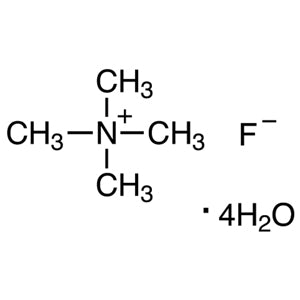
TetramethylammoniumFluorideTetrahydrate TCI T2754
Regular price From Rp 1.167.600,00Regular priceRp 831.600,00Sale price From Rp 1.167.600,00