


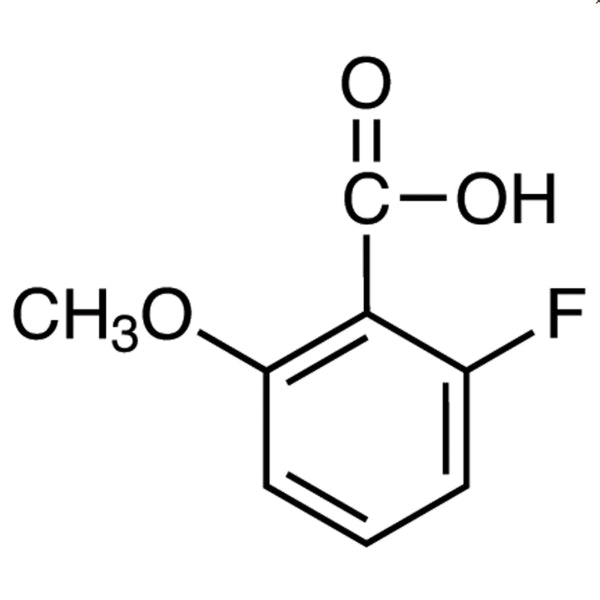
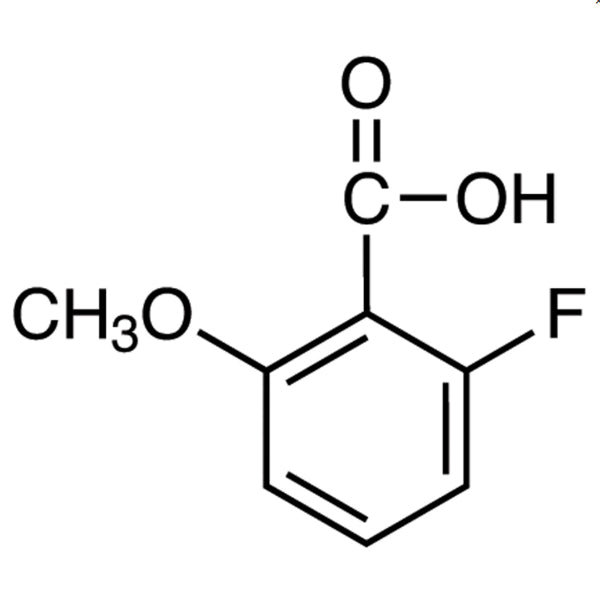
2-Fluoro-6-methoxybenzoic Acid is a chemical compound widely used as a building block in the synthesis of complex organic molecules. Its unique structure, featuring both a fluorine atom and a methoxy group, makes it a valuable reagent in various chemical reactions. In the laboratory, this compound plays a crucial role in the development of new compounds, particularly in pharmaceutical and organic chemistry research. Its presence allows for the introduction of specific functional groups into molecular frameworks, enabling the creation of a wide range of derivatives with tailored properties.
The compound's stability and controlled reactivity make it a preferred choice for researchers. The fluorine atom contributes to the molecule’s electronic properties, while the methoxy group enhances its solubility and reactivity in different reaction conditions. These characteristics allow for precise control over chemical transformations, making it ideal for substitution reactions, esterification, and other synthetic processes. Its versatility supports a broad spectrum of applications in both academic and industrial research settings.
In Indonesian laboratories, 2-Fluoro-6-methoxybenzoic Acid is extensively used by researchers and educational institutions for the development of new compounds. Its unique chemical properties and broad applicability make it an essential part of the chemical inventory in research facilities. Its role in advancing scientific research is significant, contributing to the progress of pharmaceutical and organic chemistry studies in the region.
Related TCI products
- TCI F1218 137654-20-7 2-Fluoro-3-methoxybenzoic Acid
- TCI F0681 82846-18-2 4-Fluoro-3-methoxybenzoic Acid
- TCI F0680 395-82-4 4-Fluoro-2-methoxybenzoic Acid
- TCI F0572 394-42-3 2-Fluoro-4-methoxybenzoic Acid
- TCI F0543 403-20-3 3-Fluoro-4-methoxybenzoic Acid
- TCI T1917 112811-65-1 2,4,5-Trifluoro-3-methoxybenzoic Acid
- Pharmaceutical research utilizes this compound for the synthesis of novel drug candidates due to its ability to introduce fluorine and methoxy groups into complex molecular structures.
- Organic synthesis applications benefit from its reactivity and stability, allowing for the controlled modification of aromatic rings in various chemical reactions.
- Academic research institutions use it as a key reagent in teaching and experimental studies, providing students with hands-on experience in advanced synthetic techniques.
- Analytical chemistry laboratories incorporate it as a standard reference material for the calibration of analytical instruments and the validation of chemical methods.
- Industrial chemical development projects rely on its unique properties to design and synthesize new materials with enhanced functional characteristics.
| Brand | TCI |
|---|---|
| CAS number | 137654-21-8 |
| Molecular formula | — |
| Purity | — |
| Category | Chemistry > Building Blocks > Fluorinated Building Blocks |
| Pack sizes | Available in various quantities as per standard laboratory supply requirements |
| Physical form | Solid, crystalline powder |
| Storage | Store in a cool, dry place away from direct sunlight and moisture |
This compound should be stored in a cool, dry environment to maintain its chemical integrity and prevent degradation. It is recommended to keep it in airtight containers to minimize exposure to moisture and air, which could affect its stability. Proper labeling of storage containers is essential for safety and traceability. Laboratory personnel should handle the compound with care, using appropriate personal protective equipment such as gloves and safety goggles. Due to its chemical nature, it should be stored separately from incompatible substances to avoid potential reactions. Regular monitoring of storage conditions ensures the compound remains suitable for use in research applications.
—
Produk Terkait
-
2-Fluoro-3-methoxybenzoicAcid TCI F1218
Regular price From Rp 980.700,00Regular price -
4-Fluoro-3-methoxybenzoicAcid TCI F0681
Regular price From Rp 1.008.000,00Regular price -
4-Fluoro-2-methoxybenzoicAcid TCI F0680
Regular price From Rp 664.650,00Regular price -
2-Fluoro-4-methoxybenzoicAcid TCI F0572
Regular price From Rp 1.856.400,00Regular price -
3-Fluoro-4-methoxybenzoicAcid TCI F0543
Regular price From Rp 848.400,00Regular price -
2,4,5-Trifluoro-3-methoxybenzoicAcid TCI T1917
Regular price From Rp 477.750,00Regular price -
2,4-Difluoro-3-methoxybenzoicAcid TCI D5309
Regular price Rp 1.908.900,00Regular price -
2-Bromo-4'-fluoro-3'-(trifluoromethyl)acetophenone TCI B5213
Regular price From Rp 505.050,00Regular price


