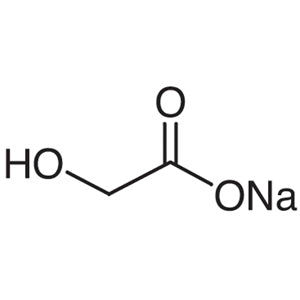
Sodium Glycolate is the sodium salt of glycolic acid, supplied by TCI under catalogue number G0111, and is available as a solid that is considerably easier to handle than the hygroscopic free acid or its corrosive concentrated solutions. In the laboratory, the compound serves as a ready-to-use source of the glycolate anion: its carboxylate group is already deprotonated, so it can act directly as a nucleophile, a chelating ligand, or a component of buffer systems without any prior neutralisation step. This makes it a convenient entry point wherever the glycolate anion itself, rather than the acid, is the species of interest.
The properties that make this material a preferred choice are the stability of its solid form, its good solubility in water, and the mildly alkaline character of its solutions, which is gentle on much of the glassware and laboratory metalware it comes into contact with. The glycolate anion carries a hydroxyl group at the alpha position that can coordinate together with the carboxylate group, forming a stable five-membered chelate ring with a range of metal ions. The absence of strong corrosive behaviour keeps handling simple and lowers the risk of workplace incidents compared with using the free acid or its concentrated solutions.
In Indonesian laboratories, the material finds its place in the synthesis of glycolate ethers, in the preparation of test solutions, and in metal coordination research that calls for a simple hydroxy carboxylic ligand. Because it arrives as a stable solid rather than a corrosive liquid, it suits teaching laboratories, university research groups, and industrial quality control units where straightforward weighing and dissolution matter more than elaborate handling precautions.
- Glycolate ether synthesis: the pre-deprotonated carboxylate acts directly as a nucleophile, removing the separate neutralisation step that the free acid would otherwise require before reaction.
- Preparation of test solutions: the stable solid dissolves readily in water to give reproducible working solutions, which simplifies routine weighing and makes solution preparation straightforward.
- Metal coordination research: the alpha hydroxyl and the carboxylate coordinate together to form a stable five-membered chelate ring with a wide range of metal ions.
- Buffer system components: because the carboxylate group is already deprotonated, the salt can be incorporated into buffer formulations without a prior acid-base adjustment step.
- Chelating ligand studies: the simple hydroxy carboxylic structure offers a well-defined, uncomplicated ligand framework for investigating metal binding behaviour in coordination chemistry work.
| Brand | TCI, catalogue number G0111 |
|---|---|
| CAS number | 2836-32-0 |
| Molecular formula | — |
| Purity | — |
| Category | Chemistry > Building Blocks > Non-Heterocyclic Building Blocks |
| Pack sizes | available in the standard TCI catalogue pack sizes; please confirm the required quantity when ordering |
| Physical form | solid, readily soluble in water |
| Storage | keep in a tightly closed container in a cool, dry place |
Store Sodium Glycolate in a tightly closed container in a cool, dry place, away from moisture that could cause the solid to cake or absorb water. Original supplier containers or clean, well-sealed glass or plastic vessels with clear labelling are suitable for storage and for any portions transferred for routine use. Although the salt is not strongly corrosive and its solutions are only mildly alkaline, standard laboratory practice still applies: wear gloves, safety glasses, and a laboratory coat, weigh and transfer the solid in a well-ventilated area to avoid inhaling dust, and close the container promptly after use to maintain the quality of the remaining material.
—
Produk Terkait
-
tert-ButylGlycolate TCI B5353
Regular price Rp 1.724.100,00Regular price -
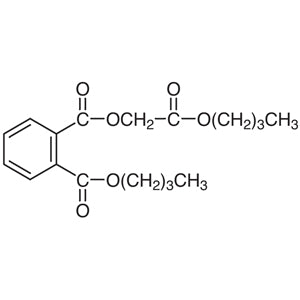
ButylPhthalylButylGlycolate TCI B0737
Regular price From Rp 769.650,00Regular price -
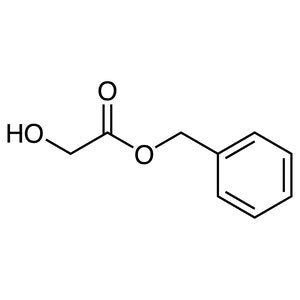
BenzylGlycolate TCI P2927
Regular price From Rp 2.016.000,00Regular price -
EthylGlycolate TCI G0242
Regular price From Rp 1.724.100,00Regular price -
CalciumGlycolate TCI G0200
Regular price Rp 2.094.750,00Regular price -
MethylGlycolate TCI G0199
Regular price From Rp 1.670.550,00Regular price -
EthylPhthalylEthylGlycolate TCI E0164
Regular price From Rp 769.650,00Regular price