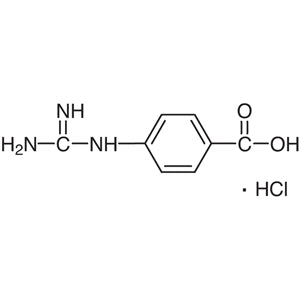
TCI G0238 4-Guanidinobenzoic Acid Hydrochloride is a benzoic acid derivative carrying a guanidino group at the para position, supplied as the hydrochloride salt to improve stability and ease of handling. The guanidino group is strongly basic and remains protonated at physiological pH, allowing it to mimic the side chain of the amino acid arginine. Because many serine protease enzymes recognise arginine residues within their substrates, this scaffold serves as a highly valuable building block in the design of protease inhibitors and reagents that target enzyme active sites.
The property that makes this compound a preferred choice is the balance between a readily activated carboxylate group and a guanidino group that provides specific molecular recognition. The carboxylate can be converted into esters, amides, or acid chlorides to generate a wide range of derivatives, while the permanent positive charge of the guanidinium moiety ensures affinity for negatively charged binding pockets on target enzymes. The hydrochloride salt form makes it a crystalline solid that is stable under ordinary storage, straightforward to weigh accurately, and reasonably soluble in water as well as polar solvents such as dimethyl sulfoxide.
In Indonesian laboratories, this building block is typically used in university and institutional research settings engaged in medicinal chemistry, enzymology, and organic synthesis. It suits groups preparing inhibitor candidates or reagent series on a laboratory scale, where a stable, easily weighed crystalline solid is preferred over hygroscopic or free-base alternatives. Its solubility in water and dimethyl sulfoxide also makes it convenient for preparing stock solutions used in enzyme assay work.
Related TCI products
- Protease inhibitor design — the arginine-mimicking guanidino group is recognised by serine protease active sites, making this scaffold a direct starting point for inhibitor candidate synthesis.
- Active-site targeting reagents — the permanently charged guanidinium moiety directs the molecule toward negatively charged enzyme binding pockets, supporting the preparation of reagents aimed at specific catalytic sites.
- Amide and ester derivative synthesis — the free carboxylate can be activated and coupled to amines or alcohols, allowing researchers to build systematic libraries around a single recognition motif.
- Acid chloride intermediate preparation — conversion of the carboxylate to the acid chloride gives a reactive handle for further functionalisation in multi-step organic synthesis routes.
- Enzymology assay work — reasonable solubility in water and dimethyl sulfoxide allows convenient stock solution preparation for enzyme studies that rely on arginine-recognition behaviour.
| Brand | TCI |
|---|---|
| CAS number | 42823-46-1 |
| Molecular formula | — |
| Purity | — |
| Category | Chemistry > Building Blocks > Non-Heterocyclic Building Blocks |
| Pack sizes | available in standard TCI catalogue pack sizes; please confirm the required size when ordering |
| Physical form | crystalline solid (hydrochloride salt) |
| Storage | stable under ordinary storage conditions for this salt form |
Store the material in its original tightly closed container, kept in a cool, dry, and well-ventilated area away from moisture and direct sunlight. Glass bottles with tight-sealing caps are suitable; reseal promptly after each use to limit exposure to atmospheric humidity, and allow chilled containers to reach room temperature before opening to avoid condensation on the solid. Handle in a fume hood using standard laboratory personal protective equipment, including safety goggles, gloves, and a laboratory coat. Weigh on a clean spatula and avoid generating dust. Keep the container clearly labelled, separate from strong oxidising agents and strong bases, and consult the manufacturer's safety data sheet before first use.
—
Produk Terkait
-
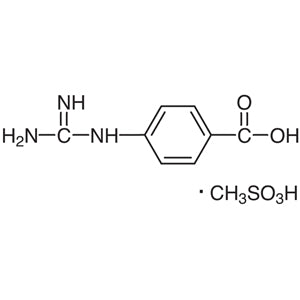
4-GuanidinobenzoicAcidMethanesulfonate TCI G0248
Regular price From Rp 980.700,00Regular price -
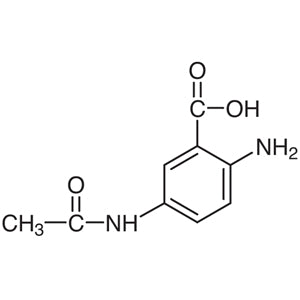
5-Acetamido-2-aminobenzoicAcid TCI A1081
Regular price Rp 9.328.200,00Regular price -
3-HydrazinobenzoicAcid TCI H0799
Regular price From Rp 1.193.850,00Regular price -
3,4-Diaminobenzohydrazide TCI D4551
Regular price From Rp 795.900,00Regular price -
3,4-Diaminobenzophenone TCI D1950
Regular price Rp 2.837.100,00Regular price -
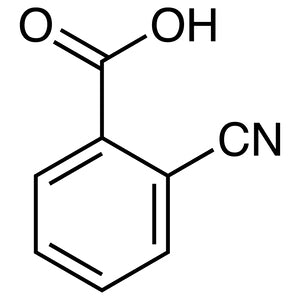
2-CyanobenzoicAcid TCI C1976
Regular price From Rp 1.961.400,00Regular price -
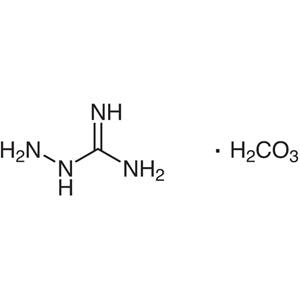
AminoguanidineBicarbonate TCI A0307
Regular price From Rp 505.050,00Regular price -
2-Aminobenzotrifluoride TCI A0433
Regular price From Rp 823.200,00Regular price