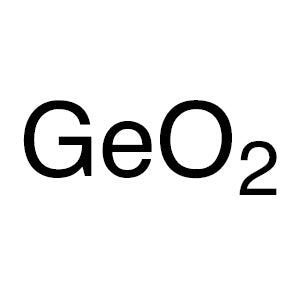
Germanium(IV) Oxide, or GeO₂, is a chemical compound widely used in laboratory settings, particularly in inorganic chemistry and catalysis. It is a solid material, typically appearing as white or pale yellow, and is known for its chemical stability. This compound plays a crucial role in various experimental processes, including the synthesis of complex compounds and as a catalyst in specific chemical reactions. Its inert nature and ability to interact with a range of substances make it a valuable resource in advanced chemical research.
The properties of Germanium(IV) Oxide make it a preferred choice for laboratory applications. It has a dense crystalline structure and a high melting point, allowing it to be used in high-temperature environments. Its stability in air and water ensures long-term storage and safe handling. These characteristics make it suitable for use in a variety of chemical experiments where durability and chemical inertness are essential. Additionally, its ability to act as a binding agent or catalyst enhances its utility in both synthetic and analytical processes.
In Indonesian laboratories, Germanium(IV) Oxide is commonly used in inorganic chemistry research, catalytic processes, and the development of new materials. Its reliability and consistent performance make it a favored material among researchers. Its application spans across multiple scientific disciplines, contributing to the advancement of chemical studies in the region.
TCI brochures (PDF)
- Metallic Salts 2025-11-06 · p. 6
- Inorganic chemistry research benefits from GeO₂ due to its chemical stability and use in synthesizing complex compounds.
- Catalytic processes often utilize GeO₂ as a catalyst because of its inert nature and ability to participate in chemical reactions.
- Material development projects employ GeO₂ for its structural properties, aiding in the creation of advanced materials.
- Analytical chemistry experiments use GeO₂ as a reagent due to its predictable chemical behavior and inertness.
- High-temperature experiments rely on GeO₂ because of its high melting point and resistance to thermal degradation.
| Brand | TCI |
|---|---|
| CAS number | 1310-53-8 |
| Molecular formula | — |
| Purity | — |
| Category | Chemistry > Catalysis and Inorganic Chemistry > Main-group Elements |
| Pack sizes | Available in various quantities as per standard laboratory supply |
| Physical form | Solid, white or pale yellow |
| Storage | Store in a cool, dry place away from moisture and direct sunlight |
Germanium(IV) Oxide should be stored in a cool, dry environment to maintain its chemical stability. It is recommended to keep it in airtight containers to prevent exposure to moisture, which could affect its properties. Since it is chemically inert, it does not react with air or water, making it relatively safe to handle. However, standard laboratory safety practices should still be followed, such as wearing appropriate personal protective equipment. The material is suitable for storage in glass or plastic containers, provided they are sealed and protected from environmental factors. Its stable nature allows for long-term storage without significant degradation, making it a reliable choice for laboratory use.
—
Produk Terkait
-
Tin(IV)Oxide TCI T4006
Regular price From Rp 584.850,00Regular price -
Tellurium(IV)Oxide TCI T3254
Regular price Rp 875.700,00Regular price -
Aluminum(III)Oxide,AEROXIDE(regR)AluC TCI A3546
Regular price Rp 1.220.100,00Regular price -
Lead(II)Oxide TCI L0469
Regular price From Rp 610.050,00Regular price -
Lead(II,IV)Oxide TCI L0412
Regular price From Rp 505.050,00Regular price -
LithiumOxide TCI L0403
Regular price From Rp 1.298.850,00Regular price -
Indium(III)Oxide TCI I1150
Regular price From Rp 2.306.850,00Regular price -
Gallium(III)Oxide TCI G0603
Regular price From Rp 1.510.950,00Regular price