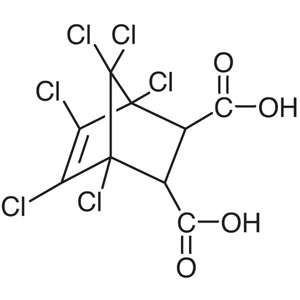
TCI H0054 Chlorendic Acid, also known as HET acid, is a dicarboxylic acid built on a bicyclic skeleton carrying six chlorine atoms attached to that framework. The material is supplied as a solid and features two carboxylic acid groups that serve as its primary reaction sites. In the laboratory, this compound is used mainly as a monomer and building block in polymer research, particularly in the preparation of unsaturated polyester resins, epoxy resins, and polyurethanes designed to resist fire. Its chlorinated structure becomes integrated into the polymer chain, so it does not readily migrate out of the matrix.
The properties that make this compound a preferred choice are its high chlorine content combined with a rigid norbornene skeleton. The two carboxylate groups allow it to take part in polycondensation reactions in the same way as a conventional dicarboxylic acid, while the firmly bound chlorine atoms contribute to the flame-retardant behaviour of the final product. The rigid bicyclic framework also tends to raise the glass transition temperature and the stiffness of the resulting resin. In addition, this compound is recognised for imparting good chemical resistance to resins, which is why it frequently serves as a reference material in studies of materials that must withstand corrosive environments.
In Indonesian laboratories, TCI H0054 Chlorendic Acid is typically encountered in academic and industrial research groups working on polymer chemistry and materials science. It is handled at the bench scale in synthesis laboratories where unsaturated polyester and epoxy formulations are prepared and evaluated, and in laboratories that assess thermal behaviour and chemical durability of resin systems. Researchers select it when a chlorine-containing acid monomer is required as a defined starting material for comparative formulation work.
TCI brochures (PDF)
- Monomers 2025-05-28 · p. 35
Related TCI products
- Unsaturated polyester resin synthesis — the two carboxylic acid groups participate directly in polycondensation with polyols, incorporating the chlorinated bicyclic unit into the polyester backbone as a defined monomer.
- Flame-retardant polymer research — the high chlorine content bound to the rigid skeleton contributes flame-retardant character to the finished resin without relying on additives that can migrate out.
- Epoxy resin formulation studies — the compound acts as an acid-functional building block that can be incorporated into epoxy systems where chlorine-bearing structural units are required by the study design.
- Polyurethane research — its dicarboxylic acid functionality allows it to serve as a building block in polyurethane preparations intended to exhibit resistance to fire in laboratory evaluations.
- Corrosion-resistant materials research — because it is known to impart good chemical resistance to resins, it is often used as a reference material when developing systems for corrosive environments.
| Brand | TCI (Tokyo Chemical Industry) |
|---|---|
| CAS number | 115-28-6 |
| Molecular formula | — |
| Purity | — |
| Category | Chemistry > Building Blocks > Non-Heterocyclic Building Blocks |
| Pack sizes | Available in the standard catalogue pack sizes offered by TCI for this item; please confirm the required quantity when ordering. |
| Physical form | Solid |
| Storage | Store in a tightly closed container in a cool, dry, well-ventilated area. |
- Product Code: H0054
Store TCI H0054 Chlorendic Acid in its original tightly closed container, kept in a cool, dry and well-ventilated area away from moisture and from incompatible materials such as strong bases and strong oxidising agents. Containers of chemically resistant material with secure closures are suitable, and the label should remain legible throughout storage. As with any laboratory acid in solid form, handle the material in a fume hood or a well-ventilated workspace to avoid generating and inhaling dust, and wear appropriate personal protective equipment including safety goggles, gloves and a laboratory coat. Avoid contact with skin and eyes, keep the container closed when not in use, and clean up any spilled solid promptly using dry methods. Always consult the manufacturer's safety data sheet before use and dispose of waste according to applicable local regulations.
—
Produk Terkait
-
trans-AconiticAcid TCI A0127
Regular price From Rp 2.068.500,00Regular price -
AzelaicAcid TCI A0561
Regular price From Rp 505.050,00Regular price -
AdipicAcid TCI A0161
Regular price From Rp 452.550,00Regular price -
AcetylenedicarboxylicAcid TCI A0088
Regular price From Rp 1.167.600,00Regular price -
alpha,alpha,alpha',alpha'-Tetramethyl-1,3-benzenedipropionicAcid TCI T3420
Regular price Rp 3.472.350,00Regular price -
1,3,5-BenzenetricarboxylicAcid TCI B0043
Regular price From Rp 1.035.300,00Regular price -
AzelaicAcid TCI A1318
Regular price From Rp 795.900,00Regular price -
TetradecanedioicAcid TCI T0704
Regular price From Rp 2.121.000,00Regular price