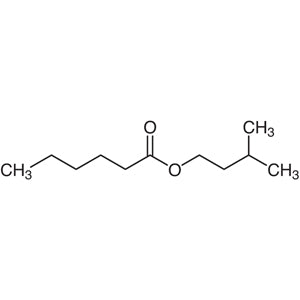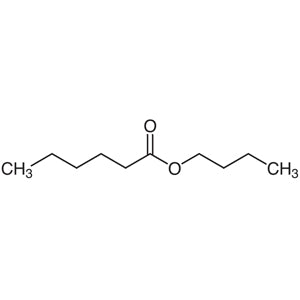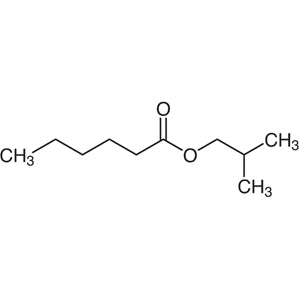
Isobutyl Hexanoate is an ester formed from hexanoic acid and isobutanol, combining a six-carbon acyl chain with a branched four-carbon alkyl group. The compound belongs to the family of fruity-smelling esters frequently encountered in the analysis of volatile food compounds. In the laboratory, this material serves as a standard compound in chromatography, a reference substance for aroma research, and an intermediate in organic synthesis. Its listing as a Non-Heterocyclic Building Block in the TCI catalogue indicates that the compound is prepared for direct use across a range of research purposes.
The properties that make Isobutyl Hexanoate a preferred choice are the combination of good volatility and the branched structure on its alcohol portion. That branching slightly lowers the boiling point relative to its straight-chain isomer and produces a distinctive elution pattern, which is useful for distinguishing isomers on a chromatogram. The compound is a liquid that dissolves readily in organic solvents and is almost insoluble in water, making it easy to separate during liquid-liquid extraction. Its ester group is neutral and stable under normal storage conditions, yet remains reactive toward hydrolysis and transesterification when required.
In Indonesian laboratories, this material is typically used in food and flavour analysis work, in academic research on volatile aroma compounds, and in organic synthesis teaching and research settings. Analytical laboratories working with gas chromatography rely on well-characterised ester standards of this kind for method development and peak identification. Its catalogue position as a ready-to-use building block suits both routine analytical service work and exploratory research programmes.
TCI brochures (PDF)
- Lipids 2025-12-17 · p. 12
- Gas chromatography reference standard: its good volatility and distinctive branched-ester elution behaviour give a well-defined peak suitable for retention time calibration and method validation work.
- Food volatile compound analysis: as a member of the fruity ester group commonly found in food matrices, it serves as an authentic comparison substance during identification of volatile constituents.
- Aroma and flavour research: the compound functions as a comparison material in sensory and instrumental aroma studies, supporting characterisation of ester contributions within complex fragrance profiles.
- Organic synthesis intermediate: the neutral ester group stays stable in storage yet reacts under hydrolysis or transesterification conditions, making it a workable starting point for further derivatisation.
- Isomer differentiation studies: branching on the alcohol portion shifts the boiling point relative to the straight-chain isomer, allowing analysts to resolve and distinguish closely related ester isomers.
| Brand | TCI |
|---|---|
| CAS number | 105-79-3 |
| Molecular formula | — |
| Purity | — |
| Category | Chemistry > Building Blocks > Non-Heterocyclic Building Blocks |
| Pack sizes | available in the standard TCI catalogue pack sizes |
| Physical form | liquid, soluble in organic solvents and almost insoluble in water |
| Storage | stable under normal storage conditions; keep containers tightly closed |
- Catalogue number: H0110
Store Isobutyl Hexanoate in a tightly closed container in a cool, dry, well-ventilated area away from direct sunlight and sources of ignition, since the material is a volatile organic liquid. Chemically resistant glass bottles with secure closures are appropriate, and containers should be resealed immediately after use to limit evaporation and moisture ingress. Although the ester group is stable under normal storage conditions, it remains susceptible to hydrolysis, so contact with water, strong acids, and strong bases should be avoided. Handle the material in a fume hood, wear safety glasses, gloves, and a laboratory coat, and follow standard institutional procedures for the handling and disposal of organic solvents.
—
Produk Terkait
-
IsoamylHexanoate TCI I0899
Regular price From Rp 610.050,00Regular price -
PropylHexanoate TCI P1940
Regular price Rp 557.550,00Regular price -
4-NitrophenylHexanoate TCI H0484
Regular price From Rp 2.862.300,00Regular price -
2,4,6-TribromophenylHexanoate TCI H0113
Regular price Rp 2.439.150,00Regular price -
MethylHexanoate TCI H0111
Regular price From Rp 505.050,00Regular price -
IsoamylHexanoate(contains2-MethylbutylHexanoate) TCI H0109
Regular price Rp 530.250,00Regular price -
EthylHexanoate TCI H0108
Regular price From Rp 505.050,00Regular price -
ButylHexanoate TCI H0107
Regular price From Rp 505.050,00Regular price