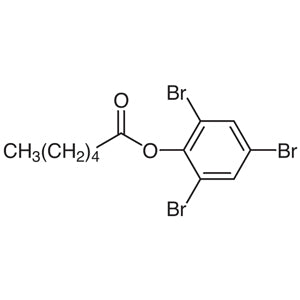
2,4,6-Tribromophenyl Hexanoate is an ester formed between hexanoic acid and 2,4,6-tribromophenol, combining a six-carbon aliphatic acyl chain with an aromatic ring that carries three bromine atoms. This combined structure makes it an interesting material in the organic synthesis laboratory, serving both as a building block toward more complex molecules and as a model compound in studies of phenolic ester reactivity. Its placement in the Non-Heterocyclic Building Blocks category confirms that the product is prepared to support stepwise synthetic routes in research laboratories.
The property that makes this compound a preferred choice is its phenolic ester character, which differs from that of ordinary alkyl esters. The phenol group substituted with three bromine atoms is strongly electron-withdrawing, so the phenolate portion becomes a relatively good leaving group and the acyl group is more readily transferred to other nucleophiles. The presence of three bromine atoms also gives the molecule a high molecular weight and a rigid aromatic framework, so the compound is supplied as a solid that is easy to weigh and shows a distinctive mass spectral pattern thanks to the bromine isotope signature.
In Indonesian laboratories, this material is generally used within organic synthesis and reactivity research programmes at universities and research institutes, where small, well-characterised quantities of a defined building block matter more than bulk volume. It is typically handled at the bench scale, weighed out for individual reaction steps, and stored alongside other fine chemicals in the laboratory's reagent inventory, supporting graduate research, method development, and teaching work in synthetic chemistry.
- Organic synthesis building block: the defined acyl and tribrominated aryl portions let researchers assemble more complex target molecules through planned, stepwise routes at the research bench.
- Acyl transfer reagent studies: because the tribromophenolate is a relatively good leaving group, the hexanoyl unit moves readily to nucleophiles, making the compound useful for acylation chemistry.
- Phenolic ester reactivity investigations: it serves as a model compound for comparing how electron-withdrawing aryl substitution changes ester behaviour relative to ordinary alkyl esters.
- Mass spectrometry method work: the characteristic bromine isotope pattern from three bromine atoms gives a distinctive spectral signature that helps in identification and instrument method development.
- Teaching and method development in synthetic chemistry: its solid form and high molecular weight make it straightforward to weigh accurately for reproducible small-scale laboratory exercises and trials.
| Brand | TCI |
|---|---|
| CAS number | 16732-09-5 |
| Molecular formula | — |
| Purity | — |
| Category | Chemistry > Building Blocks > Non-Heterocyclic Building Blocks |
| Pack sizes | supplied in standard TCI research-scale packaging; please confirm the available size when ordering |
| Physical form | solid, convenient for accurate weighing |
| Storage | — |
- Product code: TCI H0113
Store the material in its original tightly closed container, kept in a cool, dry, well-ventilated place away from direct sunlight, moisture, and sources of heat or ignition. Amber glass or the manufacturer's supplied packaging is suitable, since it limits light and moisture exposure that could promote ester hydrolysis. Handle in a fume hood using safety glasses, gloves, and a laboratory coat, and avoid generating dust when weighing the solid. Keep the container closed when not in use, label all working portions clearly, return the stock to its designated storage location promptly after use, and consult the manufacturer's safety data sheet before first handling.
—
Produk Terkait
-
2,4,6-TribromophenylMethacrylate TCI T3802
Regular price Rp 3.340.050,00Regular price -
IsoamylHexanoate TCI I0899
Regular price From Rp 610.050,00Regular price -
PropylHexanoate TCI P1940
Regular price Rp 557.550,00Regular price -
4-NitrophenylHexanoate TCI H0484
Regular price From Rp 2.862.300,00Regular price -
MethylHexanoate TCI H0111
Regular price From Rp 505.050,00Regular price -
IsobutylHexanoate TCI H0110
Regular price Rp 477.750,00Regular price -
IsoamylHexanoate(contains2-MethylbutylHexanoate) TCI H0109
Regular price Rp 530.250,00Regular price -
EthylHexanoate TCI H0108
Regular price From Rp 505.050,00Regular price