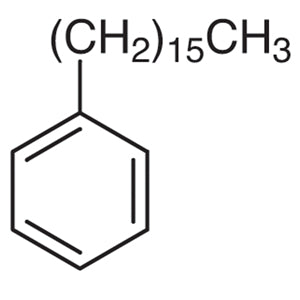
TCI H0513 Hexadecylbenzene is a long-chain alkylbenzene compound consisting of a single benzene ring bonded to a straight, sixteen-carbon hexadecyl chain. This structure makes it a pure model of the linear alkylbenzene class, a group of compounds of considerable importance as the basic framework of surfactants and cleaning agents. In the laboratory, the compound serves as a starting material for sulfonation, as a reference compound for chromatographic analysis, and as a model liquid or solid in research on lubricants and aromatic hydrocarbon-based materials.
The principal characteristic of this material is the clear separation between the relatively reactive aromatic portion and the long, nonpolar alkyl tail. The benzene ring provides a site for electrophilic substitution reactions such as sulfonation, nitration, or acylation, while the hexadecyl chain governs the solubility, viscosity, and interfacial behaviour of the molecule. Because the chain is straight and clearly defined, experimental results are far easier to interpret than those obtained with commercial alkylbenzenes, which are generally mixtures of branched isomers.
This material is typically a solid at room temperature and may soften when the room feels warm — a practical consideration for laboratories in Indonesia, where ambient conditions are consistently warm and humid. It is used in academic and industrial laboratories working on surfactant chemistry, detergent formulation, and aromatic hydrocarbon studies, where a well-defined single-isomer reference is needed rather than a technical-grade mixture.
- Sulfonation starting material: the benzene ring accepts electrophilic sulfonation cleanly, giving a single-isomer alkylbenzene sulfonate useful for studying detergent synthesis routes under controlled conditions.
- Chromatographic reference compound: its defined straight-chain structure produces a predictable, reproducible retention behaviour, making it a dependable standard for identifying and calibrating alkylbenzene separations.
- Surfactant research model: the sharp division between the aromatic head and the long nonpolar tail lets researchers study interfacial behaviour without interference from branched isomer mixtures.
- Lubricant and hydrocarbon studies: the compound functions as a model aromatic hydrocarbon material whose viscosity and solubility behaviour are governed by a single, well-characterised sixteen-carbon chain.
- Electrophilic substitution teaching and method development: nitration, acylation, and related substitution reactions can be demonstrated on a substrate where the reactive ring and inert tail are cleanly separated.
| Brand | TCI (Tokyo Chemical Industry) |
|---|---|
| CAS number | 1459-09-2 |
| Molecular formula | — |
| Purity | — |
| Category | Chemistry > Building Blocks > Non-Heterocyclic Building Blocks |
| Pack sizes | supplied in standard TCI catalogue pack sizes — please confirm the available option when ordering |
| Physical form | solid at room temperature; may soften in warm ambient conditions |
| Storage | — |
- Product code: H0513
Store the container in a cool, dry place away from direct sunlight, heat sources, and ignition sources, keeping it tightly closed to prevent moisture ingress and contamination. Because the material softens in warm conditions, an air-conditioned storage area or a temperature-controlled cabinet is preferable in Indonesian laboratories. Keep it in its original tightly sealed container, or in a clean glass or chemically compatible bottle if transferred. Handle in a well-ventilated area or fume hood, wearing safety goggles, gloves, and a laboratory coat. Keep away from strong oxidising agents, and consult the manufacturer's safety data sheet before use and disposal.
—
Produk Terkait
-
Decylbenzene TCI D0034
Regular price From Rp 1.087.800,00Regular priceRp 760.200,00Sale price From Rp 1.087.800,00 -
Undecylbenzene TCI U0010
Regular price From Rp 1.140.300,00Regular priceRp 796.950,00Sale price From Rp 1.140.300,00 -
Dodecylbenzene TCI D1074
Regular price From Rp 1.510.950,00Regular priceRp 1.056.300,00Sale price From Rp 1.510.950,00 -
Dodecylbenzene(hardtype)(mixtureofbranchedchainisomers) TCI D0988
Regular price From Rp 637.350,00Regular priceRp 445.200,00Sale price From Rp 637.350,00 -
Tetradecylbenzene TCI T0866
Regular price From Rp 1.458.450,00Regular priceRp 1.019.550,00Sale price From Rp 1.458.450,00 -
Pentadecylbenzene TCI P0665
Regular price From Rp 2.625.000,00Regular priceRp 1.835.400,00Sale price From Rp 2.625.000,00 -
Octadecylbenzene TCI O0160
Regular price From Rp 3.127.950,00Regular priceRp 2.187.150,00Sale price From Rp 3.127.950,00 -
Nonadecylbenzene TCI N0349
Regular price Rp 3.738.000,00Regular priceRp 2.613.450,00Sale price Rp 3.738.000,00