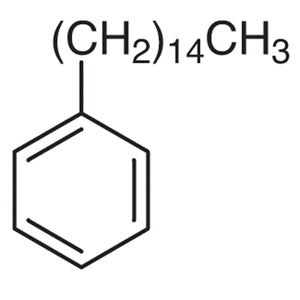
Pentadecylbenzene from TCI is an aromatic hydrocarbon made of a benzene ring carrying a single straight fifteen-carbon alkyl chain. It belongs to the linear alkylbenzenes, a family of materials that are very important as precursors to alkylbenzene sulfonate surfactants in the detergent industry. In the laboratory, pentadecylbenzene is used as a non-heterocyclic building block, as an analytical reference compound for hydrocarbons, and as a model compound for studying how amphiphilic molecules behave once they have been functionalized. Its well-defined structure makes research results easier to interpret.
The aromatic ring combined with a long alkyl chain makes the compound strongly hydrophobic, with a high boiling point and low volatility. The benzene ring can be functionalized through sulfonation, nitration, or Friedel-Crafts acylation, and the long chain gives the resulting derivatives a lipophilic character. These features make it a good starting material for preparing model surfactants with a uniform chain length, where mixed-chain commercial alkylbenzenes would make results harder to read. Because it carries a single defined substituent, reaction products and analytical signals can be assigned to one known structure.
Pentadecylbenzene is also useful as a gas chromatography standard for identifying alkylbenzenes in petroleum, sediment, and industrial wastewater samples. In Indonesia, it suits university chemistry laboratories studying organic synthesis and surfactant chemistry, research institutes working on petroleum and environmental analysis, and industrial quality control laboratories in the detergent and oleochemical sectors. AMI Scientific supplies this TCI product to laboratories that need a well-characterized long-chain alkylbenzene for synthesis, reference, and method development work.
- Surfactant precursor synthesis: the benzene ring can be sulfonated to give a model alkylbenzene sulfonate with a uniform fifteen-carbon chain, which suits structure-property studies of detergents.
- Non-heterocyclic building block: the aromatic ring accepts nitration, sulfonation, and Friedel-Crafts acylation, while the long alkyl chain adds lipophilic character to the new derivatives.
- Gas chromatography reference standard: its defined structure and low volatility make it suitable for identifying and comparing alkylbenzenes in petroleum, sediment, and industrial wastewater samples.
- Amphiphilic model compound studies: after functionalization, the combination of a polar head group and a long hydrophobic tail lets researchers study how amphiphilic molecules behave in a controlled way.
- Hydrocarbon analytical reference: as a single, well-characterized linear alkylbenzene, it helps laboratories confirm retention behaviour and calibrate methods for aromatic hydrocarbon analysis.
| Brand | TCI (product code P0665) |
|---|---|
| CAS number | 2131-18-2 |
| Molecular formula | — |
| Purity | — |
| Category | Chemistry > Building Blocks > Non-Heterocyclic Building Blocks |
| Pack sizes | available in TCI standard pack sizes; please check with AMI Scientific |
| Physical form | — |
| Storage | keep tightly closed in a cool, dry, well-ventilated place |
- Chemical class: linear alkylbenzene (benzene ring with a straight C15 alkyl chain)
Store pentadecylbenzene in its original tightly closed container, in a cool, dry, well-ventilated area away from direct sunlight, heat sources, and strong oxidizing agents. Use glass or other chemically compatible containers when transferring the material, and label any secondary containers clearly. Handle it following good laboratory practice: wear safety glasses, chemical-resistant gloves, and a lab coat, and work in a fume hood or well-ventilated area. Avoid skin and eye contact and avoid breathing vapours, especially when heating. Before use, read the TCI Safety Data Sheet for specific hazard, first-aid, and disposal information, and dispose of waste according to local regulations.
—
Produk Terkait
-
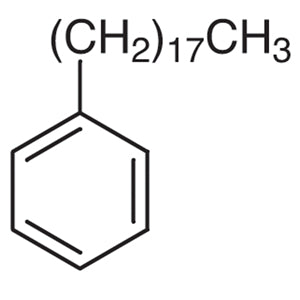
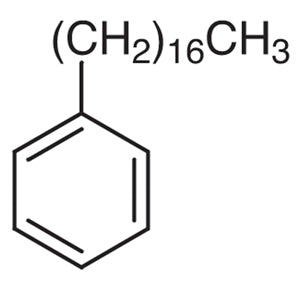
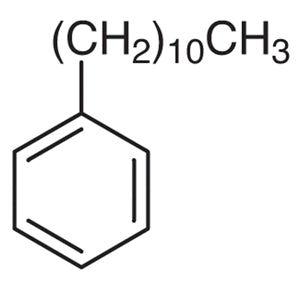
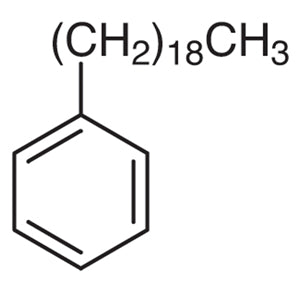
Decylbenzene TCI D0034
Regular price From Rp 1.087.800,00Regular price -
Octadecylbenzene TCI O0160
Regular price From Rp 3.127.950,00Regular price -
Heptadecylbenzene TCI H0020
Regular price From Rp 2.279.550,00Regular price -
Undecylbenzene TCI U0010
Regular price From Rp 1.140.300,00Regular price -
Dodecylbenzene TCI D1074
Regular price From Rp 1.510.950,00Regular price -
Dodecylbenzene(hardtype)(mixtureofbranchedchainisomers) TCI D0988
Regular price From Rp 637.350,00Regular price -
Nonadecylbenzene TCI N0349
Regular price Rp 3.738.000,00Regular price -
Hexadecylbenzene TCI H0513
Regular price From Rp 1.670.550,00Regular price