

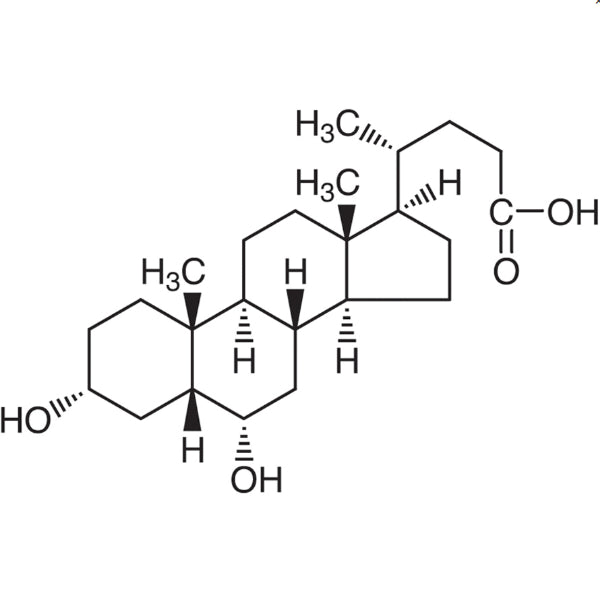
TCI H0535 Hyodeoxycholic Acid is a secondary bile acid belonging to the steroid class, found naturally in pig bile and in the bile of several other mammals. As a member of the cholanic acid family, the compound carries a steroid skeleton bearing hydroxyl groups and a carboxylic acid side chain, a combination that gives it the amphipathic character typical of bile acids. In the laboratory, this material serves as a reference compound and test substance for research into bile metabolism, fat absorption, gut microbiota–host interaction, and the development of analytical methods for profiling bile acids in biological samples.
The properties that make hyodeoxycholic acid attractive to researchers begin with its ability to form micelles and act as a natural emulsifier, allowing it to solubilise lipids and hydrophobic compounds within aqueous systems. Its hydroxylation pattern differs from that of the principal human bile acids, which makes it a useful marker for distinguishing metabolic pathways and species of origin in comparative studies. The compound generally presents as a white crystalline powder that dissolves in ethanol, methanol, and dilute alkaline solutions, while its solubility in neutral water remains limited. The high purity characteristic of TCI reagents makes it suitable for use as a reference material.
In Indonesian laboratories, this reagent finds a natural place in university research groups, biochemistry and physiology departments, and analytical service units that work on lipid and bile acid chemistry. It is typically prepared as a stock solution in ethanol or methanol before dilution into working buffers, and is used alongside chromatographic instrumentation for bile acid profiling. Research units studying digestion, nutrition, and gut microbiology commonly keep such bile acid standards on hand for comparative and method-development work.
- Bile acid profiling in biological samples, where the compound serves as a reference standard whose distinct hydroxylation pattern allows clear identification against other cholanic acids in a chromatographic separation.
- Bile metabolism research, where hyodeoxycholic acid is used as a defined secondary bile acid to study conversion pathways and to trace how bile constituents are processed within a biological system.
- Fat absorption studies, in which the compound's amphipathic structure and natural emulsifying behaviour let researchers examine how bile acids assist the uptake of dietary lipids.
- Gut microbiota–host interaction work, where this bile acid functions as a test substance for investigating how microbial communities transform bile constituents and how the host responds.
- Comparative species studies, since its hydroxylation differs from the principal human bile acids, making it a practical marker for distinguishing metabolic pathways and the species origin of a bile acid sample.
| Brand | TCI (Tokyo Chemical Industry) |
|---|---|
| CAS number | 83-49-8 |
| Molecular formula | — |
| Purity | — |
| Category | Life Science > Biochemicals and Reagents > Steroids |
| Pack sizes | available in standard TCI reagent pack sizes; please confirm the size required when ordering |
| Physical form | white crystalline powder |
| Storage | keep in a tightly closed container, protected from light and moisture |
Store the container tightly closed in a cool, dry place away from direct sunlight and sources of moisture, since the powder is best protected from humidity that can affect weighing accuracy. Use clean glass or chemically compatible plastic containers for prepared stock solutions, and label them clearly with the solvent and preparation date. Handle the powder in a well-ventilated area or fume hood, wearing a laboratory coat, safety glasses, and gloves, and avoid generating dust during weighing. Use a clean, dry spatula for each withdrawal to prevent contamination of the stock, and consult the supplier safety data sheet before first use and before disposal of residues.
—
Produk Terkait
-
DeoxycholicAcid TCI C0315
Regular price From Rp 1.618.050,00Regular price -
UrsodeoxycholicAcid TCI U0030
Regular price Rp 1.115.100,00Regular price -
TauroursodeoxycholicAcidDihydrate TCI T1567
Regular price From Rp 1.590.750,00Regular price -
MethylHyodeoxycholate TCI H0529
Regular price Rp 2.837.100,00Regular price -
GlycoursodeoxycholicAcid TCI G0459
Regular price From Rp 2.730.000,00Regular price -
ChenodeoxycholicAcid TCI C0750
Regular price Rp 1.246.350,00Regular price -
SodiumChenodeoxycholate TCI S0941
Regular price Rp 1.008.000,00Regular price -
SodiumGlycochenodeoxycholate TCI O0530
Regular price From Rp 1.405.950,00Regular price


