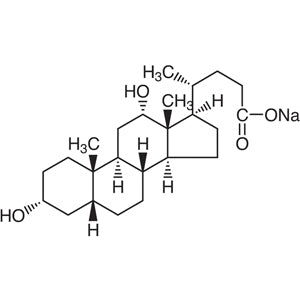
Sodium Chenodeoxycholate is a chemical compound widely used in laboratory experiments related to biochemistry and steroid research. It plays a crucial role in studies involving lipid metabolism, liver function, and the development of drugs related to the digestive system. As a derivative of choline, this compound exhibits properties that make it an effective emulsifying agent and cholesterol regulator in solution. Its presence in various biochemical processes makes it a valuable tool for researchers seeking to understand the interactions between lipids and proteins.
This compound is preferred due to its chemical stability under certain conditions and its solubility in organic solvents such as ethyl acetate and acetone. These characteristics facilitate its use in separation processes and chemical reactions. Additionally, its non-toxic nature and relative safety when used properly make it a reliable choice for laboratory applications. Sodium Chenodeoxycholate is particularly favored for its ability to support both basic and applied research in life sciences.
In Indonesian laboratories, Sodium Chenodeoxycholate is commonly used in academic and industrial research settings. It is often found in biochemistry labs where it supports studies on metabolic pathways and drug development. Its versatility and reliability make it a standard component in many experimental protocols, especially those involving lipid-based research and pharmaceutical testing.
TCI brochures (PDF)
- Steroids 2026-07-28 · p. 6
- Biochemical Research: Sodium Chenodeoxycholate is used to study lipid metabolism and liver function, supporting fundamental research in biochemistry.
- Drug Development: It plays a role in the formulation and testing of drugs related to the digestive system and cholesterol regulation.
- Pharmacological Testing: This compound is utilized in experiments to evaluate the effects of substances on lipid transport and absorption.
- Emulsification Studies: Its emulsifying properties make it ideal for experiments involving the mixing of immiscible substances.
- Lipid-Protein Interaction Analysis: Sodium Chenodeoxycholate is used to investigate how lipids interact with proteins in biological systems.
| Brand | TCI |
|---|---|
| CAS number | 2646-38-0 |
| Molecular formula | — |
| Purity | — |
| Category | Life Science > Biochemicals and Reagents > Steroids |
| Pack sizes | Available in various quantities as per supplier specifications |
| Physical form | Solid powder |
| Storage | Store in a cool, dry place away from moisture and air exposure |
Sodium Chenodeoxycholate should be stored in a cool, dry environment to maintain its chemical stability. It is recommended to keep the compound in airtight containers to prevent exposure to moisture and air, which can degrade its properties. Due to its sensitivity to environmental factors, it should be handled with care to avoid contamination. In laboratory settings, it is advisable to use gloves and appropriate protective equipment when handling the compound. Proper labeling of storage containers is essential to ensure safe and efficient access. Regular monitoring of storage conditions helps maintain the integrity of the material for reliable experimental results.
—
Produk Terkait
-
MethylChenodeoxycholate TCI M3485
Regular price From Rp 2.491.650,00Regular priceRp 1.757.700,00Sale price From Rp 2.491.650,00 -
SodiumGlycochenodeoxycholate TCI O0530
Regular price From Rp 1.458.450,00Regular priceRp 1.035.300,00Sale price From Rp 1.458.450,00 -
SodiumDeoxycholate TCI C0316
Regular price From Rp 1.696.800,00Regular priceRp 1.202.250,00Sale price From Rp 1.696.800,00 -
ChenodeoxycholicAcid TCI C0750
Regular price Rp 1.298.850,00Regular priceRp 924.000,00Sale price Rp 1.298.850,00 -
MethylHyodeoxycholate TCI H0529
Regular price Rp 2.889.600,00Regular priceRp 2.035.950,00Sale price Rp 2.889.600,00 -
MethylDesoxycholate TCI M3904
Regular price From Rp 2.942.100,00Regular priceRp 2.072.700,00Sale price From Rp 2.942.100,00 -
SodiumDeoxycholate[forElectrophoresis] TCI D1820
Regular price Rp 2.227.050,00Regular priceRp 1.572.900,00Sale price Rp 2.227.050,00 -
DeoxycholicAcid TCI C0315
Regular price From Rp 1.670.550,00Regular priceRp 1.183.350,00Sale price From Rp 1.670.550,00