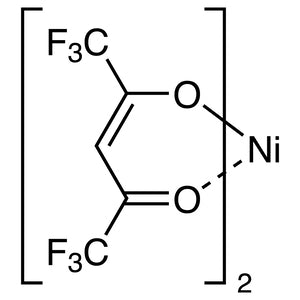
TCI H0558 Bis(hexafluoroacetylacetonato)nickel(II), CAS 14949-69-0, is a nickel(II) complex in which two hexafluoroacetylacetonate ligands bind the metal centre in a bidentate fashion through pairs of donor oxygen atoms. This neutral complex delivers nickel in a form that dissolves readily in organic solvents, which makes it particularly useful for homogeneous catalysis in the laboratory. Nickel is a prominent metal in cross-coupling chemistry and in the activation of difficult bonds, including C–H and C–O bonds, so an easily handled nickel precursor of this kind has become an important material in modern catalysis research programmes as well as in the preparation of nickel-based materials.
The property that leads chemists to select this complex is the influence of the fluorinated ligands, which lower the electron density at the nickel centre and raise its Lewis acidity, so that substrates coordinate and become activated more readily. The hexafluoroacetylacetonate ligand also confers adequate thermal stability and volatility, making the complex a candidate precursor for vapour-phase processes. Compared with inorganic nickel salts, this compound is far easier to dissolve in organic solvents and can be combined with supporting ligands such as phosphines, bipyridines, or N-heterocyclic carbenes to tune the behaviour of the active species.
In Indonesian laboratories the compound is typically found in university and institutional research groups working on catalysis, synthetic organic chemistry, and materials chemistry, where a soluble and well-defined nickel source is needed for method development on a small scale. It is also used in laboratories exploring nickel-based thin films and coordination compounds, where a volatile and thermally stable precursor is preferred over simple inorganic nickel salts.
TCI brochures (PDF)
- C-H Bond Activation Reaction 2025-06-20 · p. 6
- Transition Metal Catalysts 2026-04-10 · p. 12
Related TCI products
- TCI N0861 60871-84-3 Nickel(II) Trifluoromethanesulfonate
- TCI N0851 7791-20-0 Nickel(II) Chloride Hexahydrate
- TCI N0850 7718-54-9 Nickel(II) Chloride Anhydrous
- TCI N0096 120156-44-7 Bis(2,4-pentanedionato)nickel(II) Hydrate
- TCI B3235 903592-98-3 [1,3-Bis(2,6-diisopropylphenyl)imidazol-2-ylidene]triphenylphosphine Nickel(II) Dichloride
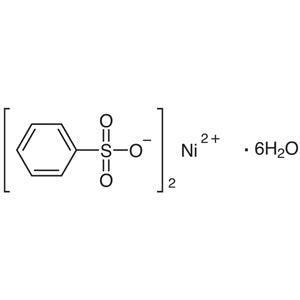
- TCI B0034 39819-65-3 Nickel(II) Benzenesulfonate Hexahydrate
- C–H activation studies: the electron-poor, Lewis acidic nickel centre created by the fluorinated ligands helps substrates coordinate and undergo activation of otherwise inert C–H bonds.
- Cross-coupling method development: as a soluble nickel(II) precursor it is readily combined with phosphines, bipyridines, or N-heterocyclic carbenes to generate catalytically active species in situ.
- C–O bond activation research: nickel is a leading metal for cleaving strong C–O bonds, and this handling-friendly complex provides that nickel in a defined, dissolvable form.
- Homogeneous catalysis screening: because it dissolves well in organic solvents, the complex allows reproducible catalyst loading in solution-phase reaction screening far more easily than inorganic nickel salts.
- Vapour-phase precursor work: the thermal stability and volatility imparted by the hexafluoroacetylacetonate ligands make this complex a candidate starting material for preparing nickel-based materials and films.
| Brand | TCI |
|---|---|
| CAS number | 14949-69-0 |
| Molecular formula | — |
| Purity | — |
| Category | Chemistry > Catalysis and Inorganic Chemistry > C-H Activation [Catalysis] |
| Pack sizes | available in the standard TCI research-scale packaging options; please refer to the product listing for the sizes currently offered |
| Physical form | — |
| Storage | keep tightly closed in a cool, dry place, protected from moisture |
- Chemical form: neutral nickel(II) coordination complex with two bidentate hexafluoroacetylacetonate ligands bound through oxygen donor atoms
Store the container tightly closed in a cool, dry, well-ventilated place away from moisture, since fluorinated metal complexes of this type are best kept protected from humid air. Original supplier packaging or tightly sealed glass containers with chemically resistant closures are suitable; where the material is used as a volatile precursor, sealed vessels are preferred to limit loss and contamination. Handle the compound in a fume hood using gloves, safety glasses, and a laboratory coat, transfer it with clean dry spatulas to avoid introducing water, and consult the supplier safety data sheet before use and disposal.
—
Product Categories
Produk Terkait
-
Nickel(II)Trifluoromethanesulfonate TCI N0861
Regular price From Rp 1.326.150,00Regular price -
Nickel(II)ChlorideHexahydrate TCI N0851
Regular price From Rp 505.050,00Regular price -
Nickel(II)ChlorideAnhydrous TCI N0850
Regular price From Rp 610.050,00Regular price -
Bis(2,4-pentanedionato)nickel(II)Hydrate TCI N0096
Regular price From Rp 2.041.200,00Regular price -
[1,3-Bis(2,6-diisopropylphenyl)imidazol-2-ylidene]triphenylphosphineNickel(II)Dichloride TCI B3235
Regular price From Rp 2.466.450,00Regular price -
Nickel(II)BenzenesulfonateHexahydrate TCI B0034
Regular price Rp 1.988.700,00Regular price -
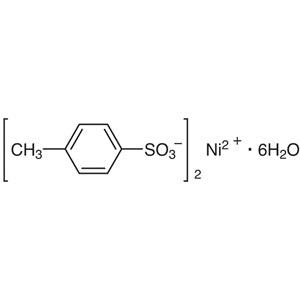
Nickel(II)p-ToluenesulfonateHexahydrate TCI T0276
Regular price From Rp 1.246.350,00Regular price -
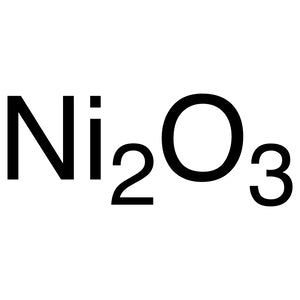
Nickel(III)OxideBlack TCI N1291
Regular price From Rp 2.121.000,00Regular price


![903592-98-3 [1,3-Bis(2,6-diisopropylphenyl)imidazol-2-ylidene]triphenylphosphine Nickel(II) Dichloride - AMI Scientific](http://amiscientific.com/cdn/shop/files/TCI2510B3235_58611862-7e09-4fa6-8ff5-7fa691c32969.jpg?v=1767431895&width=533)