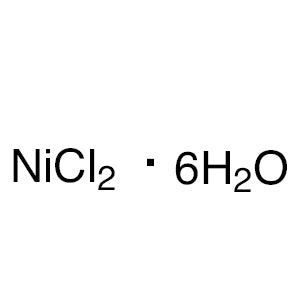
Nickel(II) Chloride Hexahydrate is a chemical compound widely utilized in laboratory settings for its versatility in catalytic and inorganic chemical reactions. As a key reagent in catalysis, it plays a crucial role in various synthetic processes, particularly in the activation of carbon compounds and substitution reactions. Its presence in laboratory workflows supports both organic and inorganic chemistry applications, making it an essential component for researchers and chemists. This compound is commonly used in the synthesis of metal complexes and in electroplating processes, where its reactivity and solubility properties are highly advantageous.
The compound's stability and solubility in water make it a preferred choice for many laboratory applications. Its crystalline structure ensures consistent performance, while its hygroscopic nature necessitates careful handling to maintain its integrity. The ability of Nickel(II) Chloride Hexahydrate to react with water and other ions allows it to function effectively in environments that require reactive and efficient catalysts. These properties contribute to its widespread use in both academic and industrial research settings.
In Indonesian laboratories, Nickel(II) Chloride Hexahydrate is a commonly used reagent for catalytic experiments and the synthesis of complex compounds. It is relied upon by educational institutions and research organizations for its reliability and effectiveness in chemical processes. Its availability and performance make it a go-to material for a variety of experimental needs in the chemical sciences.
TCI brochures (PDF)
- C-H Bond Activation Reaction 2025-06-20 · p. 6
- Metallic Salts 2025-11-06 · p. 3
- Transition Metal Catalysts 2026-04-10 · p. 12
- Suzuki-Miyaura Cross Coupling Reaction 2025-12-01 · p. 23
Related TCI products
- TCI N0850 7718-54-9 Nickel(II) Chloride Anhydrous
- TCI N0096 120156-44-7 Bis(2,4-pentanedionato)nickel(II) Hydrate
- TCI B3235 903592-98-3 [1,3-Bis(2,6-diisopropylphenyl)imidazol-2-ylidene]triphenylphosphine Nickel(II) Dichloride
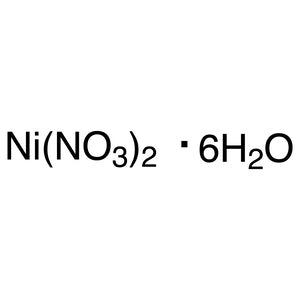
- TCI N1252 13478-00-7 Nickel(II) Nitrate Hexahydrate
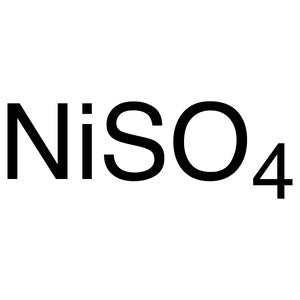
- TCI N1264 7786-81-4 Nickel(II) Sulfate
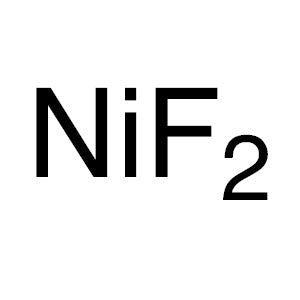
- TCI N1215 10028-18-9 Nickel(II) Fluoride
- Catalytic Reactions: Nickel(II) Chloride Hexahydrate is ideal for catalytic processes due to its ability to activate carbon compounds and facilitate substitution reactions in both organic and inorganic chemistry.
- Metal Complex Synthesis: The compound is frequently used in the preparation of metal complexes, where its reactivity and solubility properties aid in forming stable coordination structures.
- Electroplating Processes: Its reactivity with water and ions makes it suitable for electroplating applications, where it helps in the deposition of metallic coatings on various substrates.
- Organic Synthesis: It is a valuable reagent in organic synthesis, particularly in reactions that require a mild and efficient catalyst for functional group transformations.
- Analytical Chemistry: The compound's stability and solubility make it useful in analytical procedures, where it can be used as a reagent or standard for qualitative and quantitative analysis.
| Brand | TCI |
|---|---|
| CAS number | 7791-20-0 |
| Molecular formula | — |
| Purity | — |
| Category | Chemistry > Catalysis and Inorganic Chemistry > C-H Activation [Catalysis] |
| Pack sizes | Available in various quantities as per standard laboratory supply |
| Physical form | Crystalline solid |
| Storage | Requires desiccation to prevent hygroscopic degradation |
Nickel(II) Chloride Hexahydrate should be stored in a cool, dry place away from moisture to prevent hygroscopic degradation. It is recommended to use airtight containers to minimize exposure to humidity and maintain its chemical integrity. Due to its reactivity with water and other ions, it should be handled with care in laboratory environments. Storage in a sealed container is essential to prevent absorption of moisture from the air. Proper labeling and storage conditions ensure the compound remains stable and effective for its intended applications. Always follow standard laboratory safety protocols when handling this material.
—
Product Categories
- Catalysis and Inorganic ChemistryC-H Activation [Catalysis]Nickel Compounds [C-H Activation]
- Catalysis and Inorganic ChemistryNon-Precious Metal Catalysis [Catalysis]
- Catalysis and Inorganic ChemistryTransition Elements [Catalysis and Inorganic Chemistry]Nickel [Catalysis and Inorganic Chemistry]
- Catalysis and Inorganic ChemistryCross-coupling Reaction using Transition Metal Catalysts [C-C Bond Formation]Nickel Catalysts [Cross-coupling Reaction using Transition Metal Catalysts]
- Catalysis and Inorganic ChemistryMetallic Salts [Catalysis and Inorganic Chemistry]Chloride Salts [Metallic Salts]
- Synthetic ReagentsC-C Bond Formation [Synthetic Reagents]Cross-coupling Reaction using Transition Metal Catalysts [C-C Bond Formation]
- Synthetic ReagentsC-X(Non-Halogen) Bond Formation [Synthetic Reagents]C-H Bond Activation Reaction [Synthetic Reagents]
Produk Terkait
-
Nickel(II)ChlorideAnhydrous TCI N0850
Regular price From Rp 610.050,00Regular priceRp 426.300,00Sale price From Rp 610.050,00 -
Bis(2,4-pentanedionato)nickel(II)Hydrate TCI N0096
Regular price From Rp 2.041.200,00Regular priceRp 1.426.950,00Sale price From Rp 2.041.200,00 -
[1,3-Bis(2,6-diisopropylphenyl)imidazol-2-ylidene]triphenylphosphineNickel(II)Dichloride TCI B3235
Regular price From Rp 2.518.950,00Regular priceRp 1.776.600,00Sale price From Rp 2.518.950,00 -
Nickel(II)NitrateHexahydrate TCI N1252
Regular price From Rp 610.050,00Regular priceRp 426.300,00Sale price From Rp 610.050,00 -
Nickel(II)Sulfate TCI N1264
Regular price From Rp 875.700,00Regular priceRp 612.150,00Sale price From Rp 875.700,00 -
Nickel(II)Fluoride TCI N1215
Regular price From Rp 1.326.150,00Regular priceRp 927.150,00Sale price From Rp 1.326.150,00 -
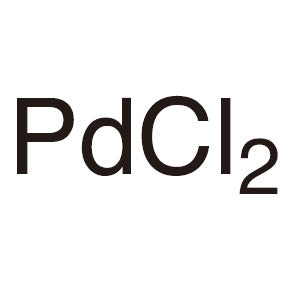
Palladium(II)Chloride TCI P1489
Regular price From Rp 3.127.950,00Regular priceRp 2.202.900,00Sale price From Rp 3.127.950,00 -
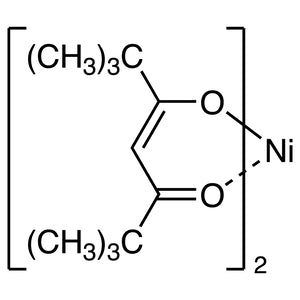
Nickel(II)Bis(2,2,6,6-tetramethyl-3,5-heptanedionate) TCI N1207
Regular price From Rp 1.485.750,00Regular priceRp 1.038.450,00Sale price From Rp 1.485.750,00


![TCI B3235 903592-98-3 [1,3-Bis(2,6-diisopropylphenyl)imidazol-2-ylidene]triphenylphosphine Nickel(II) Dichloride](http://amiscientific.com/cdn/shop/files/TCI2510B3235.jpg?v=1792661110&width=533)
![903592-98-3 [1,3-Bis(2,6-diisopropylphenyl)imidazol-2-ylidene]triphenylphosphine Nickel(II) Dichloride - AMI Scientific](http://amiscientific.com/cdn/shop/files/TCI2510B3235_58611862-7e09-4fa6-8ff5-7fa691c32969.jpg?v=1767431895&width=533)