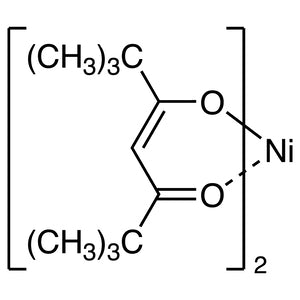
Nickel(II) Bis(2,2,6,6-tetramethyl-3,5-heptanedionate) is a chemical compound widely used in catalytic reactions and organic synthesis within laboratory settings. As a transition metal complex, it plays a crucial role in facilitating chemical reactions by lowering activation energy without being consumed in the process. This compound is particularly valued for its ability to act as a catalyst in various industrial and research applications. Its presence in laboratory environments is essential for advancing chemical processes that require precision and efficiency.
The compound is known for its stable complex structure and reactive properties that can be tailored to suit specific experimental needs. It exhibits good solubility in organic solvents, which enhances its versatility in different reaction conditions. Additionally, its thermal stability ensures that it remains effective across a range of laboratory environments. These properties make it a reliable and efficient choice for researchers and industrial chemists.
In Indonesian laboratories, Nickel(II) Bis(2,2,6,6-tetramethyl-3,5-heptanedionate) is commonly used in chemical research and industrial applications. Its reliability and effectiveness in catalytic processes have made it a preferred material among scientists and technicians. The compound's ease of use and availability further contribute to its popularity in both academic and industrial settings.
TCI brochures (PDF)
- NHC Reagent for Redox Activation of Alcohols Deoxazole 2025-09-18 · p. 2
Related TCI products
- Organic synthesis reactions benefit from this compound's catalytic properties, enabling efficient and selective chemical transformations.
- Transition metal-based catalysts often require stable complexes, making this material ideal for such applications.
- Industrial chemical processes may utilize this compound to enhance reaction efficiency and reduce energy consumption.
- Research laboratories rely on its predictable behavior and stability to achieve consistent results in experiments.
- It supports the development of new materials and compounds by facilitating controlled chemical reactions under various conditions.
From the TCI brochure
- Nickel catalyst in C(sp3)-C(sp3) cross-coupling with hypervalent iodine compounds
| Brand | TCI |
|---|---|
| CAS number | 14481-08-4 |
| Molecular formula | — |
| Purity | — |
| Category | Chemistry > Catalysis and Inorganic Chemistry > Transition Elements |
| Pack sizes | Available in various sizes as per standard laboratory requirements |
| Physical form | Solid |
| Storage | Store in a cool, dry place away from moisture and direct sunlight |
This compound should be stored in a cool, dry environment to maintain its stability and effectiveness. It is recommended to use airtight containers to prevent exposure to moisture and air, which could affect its properties. Due to its chemical nature, it should be handled with appropriate safety measures, such as wearing gloves and goggles. It is advisable to store it in a well-ventilated area to minimize any potential risks. Proper storage ensures that the compound remains suitable for use in laboratory applications without compromising its performance.
—
Product Categories
- Catalysis and Inorganic ChemistryTransition Elements [Catalysis and Inorganic Chemistry]Nickel [Catalysis and Inorganic Chemistry]
- Catalysis and Inorganic ChemistryCross-coupling Reaction using Transition Metal Catalysts [C-C Bond Formation]Nickel Catalysts [Cross-coupling Reaction using Transition Metal Catalysts]
- Synthetic ReagentsC-C Bond Formation [Synthetic Reagents]Cross-coupling Reaction using Transition Metal Catalysts [C-C Bond Formation]
Produk Terkait
-
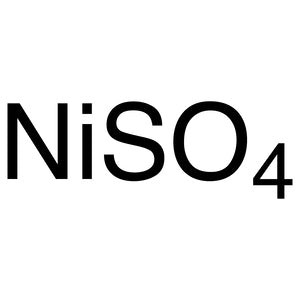
Nickel(II)Sulfate TCI N1264
Regular price From Rp 875.700,00Regular priceRp 612.150,00Sale price From Rp 875.700,00 -
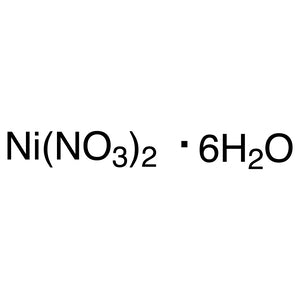
Nickel(II)NitrateHexahydrate TCI N1252
Regular price From Rp 610.050,00Regular priceRp 426.300,00Sale price From Rp 610.050,00 -
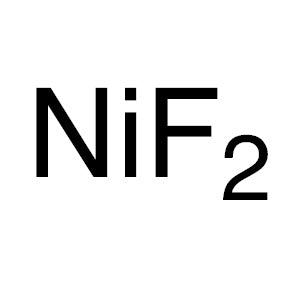
Nickel(II)Fluoride TCI N1215
Regular price From Rp 1.326.150,00Regular priceRp 927.150,00Sale price From Rp 1.326.150,00 -
Nickel(II)ChlorideHexahydrate TCI N0851
Regular price From Rp 505.050,00Regular priceRp 352.800,00Sale price From Rp 505.050,00 -
Nickel(II)ChlorideAnhydrous TCI N0850
Regular price From Rp 610.050,00Regular priceRp 426.300,00Sale price From Rp 610.050,00 -
Bis(2,4-pentanedionato)nickel(II)Hydrate TCI N0096
Regular price From Rp 2.041.200,00Regular priceRp 1.426.950,00Sale price From Rp 2.041.200,00 -
[1,3-Bis(2,6-diisopropylphenyl)imidazol-2-ylidene]triphenylphosphineNickel(II)Dichloride TCI B3235
Regular price From Rp 2.518.950,00Regular priceRp 1.776.600,00Sale price From Rp 2.518.950,00 -
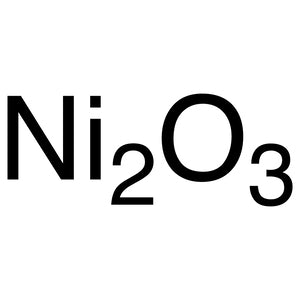
Nickel(III)OxideBlack TCI N1291
Regular price From Rp 2.121.000,00Regular priceRp 1.482.600,00Sale price From Rp 2.121.000,00