

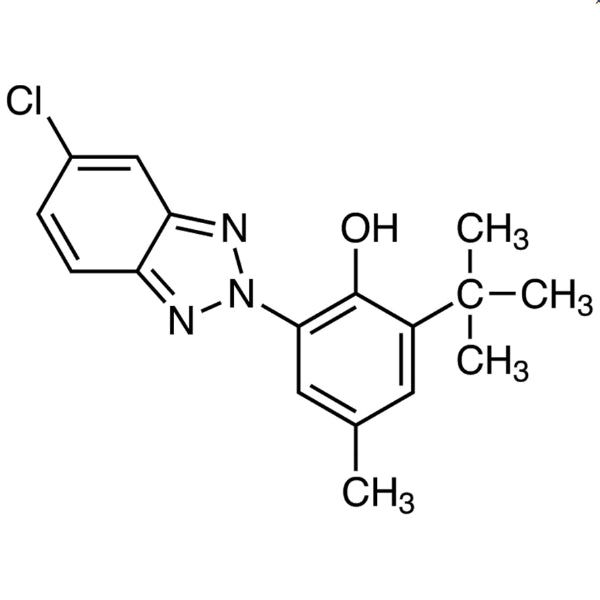
2-(5-Chloro-2-benzotriazolyl)-6-tert-butyl-p-cresol is a chemical compound widely used as a polymer additive in laboratory settings. It serves as a UV stabilizer, playing a critical role in protecting polymers from degradation caused by exposure to ultraviolet light. This compound is essential in the development of materials that require long-term durability and resistance to environmental factors. In the laboratory, it is commonly used to test the effectiveness of UV protection in various polymer formulations. Its presence ensures that materials maintain their structural integrity and functional properties over time.
The compound is favored for its excellent chemical stability, good solubility in organic solvents, and efficient UV absorption capabilities. These properties make it a reliable choice for formulating UV protective agents in polymer-based products. Its molecular structure allows for strong interactions with different types of polymers, enhancing its effectiveness across a range of applications. Additionally, its stability under various conditions ensures consistent performance, making it a preferred material for both research and industrial applications.
In Indonesian laboratories, this compound is extensively used in polymer research and development. It is a key component in studies related to material science and chemical engineering. Researchers often use it to evaluate the performance of UV stabilizers in different environmental conditions. Its versatility and effectiveness make it an important tool for advancing polymer technology and improving material longevity.
TCI brochures (PDF)
- Polymer Additives 2026-04-16 · p. 6
Related TCI products
- TCI B5709 2170-39-0 2-(2H-Benzotriazol-2-yl)-4-methyl-6-(2-propenyl)phenol
- TCI H0719 3147-76-0 2-(5-tert-Butyl-2-hydroxyphenyl)benzotriazole
- TCI H0560 2440-22-4 2-(2-Hydroxy-5-methylphenyl)benzotriazole
- TCI D0228 128-37-0 2,6-Di-tert-butyl-p-cresol
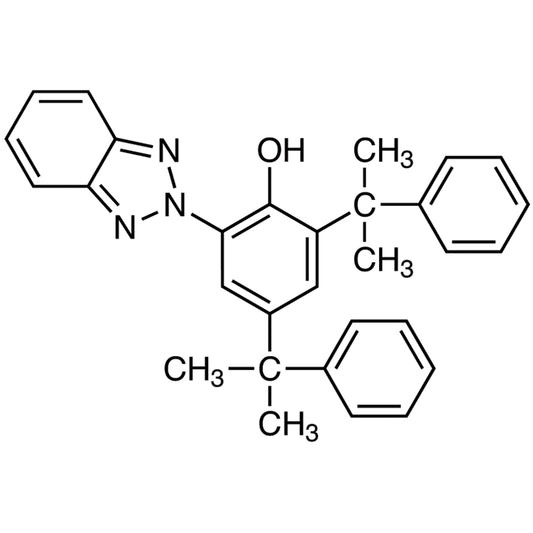
- TCI B3717 70321-86-7 2-(2H-Benzotriazol-2-yl)-4,6-bis(1-methyl-1-phenylethyl)phenol
- TCI M1259 103597-45-1 2,2'-Methylenebis[6-(benzotriazol-2-yl)-4-tert-octylphenol]
- UV Stabilizer Testing – This compound is ideal for assessing the effectiveness of UV protection in polymer formulations, ensuring materials remain durable under sunlight exposure.
- Polymer Formulation Development – Its ability to interact with various polymers makes it a valuable additive in creating stable and long-lasting materials.
- Material Durability Studies – It is used to evaluate how well materials resist degradation, especially in outdoor or harsh environments.
- Environmental Stress Testing – Its UV absorption properties help simulate real-world conditions to test material resilience.
- Chemical Compatibility Analysis – It is used to determine how well different polymers interact with UV stabilizers in various applications.
| Brand | TCI |
|---|---|
| CAS number | 3896-11-5 |
| Molecular formula | — |
| Purity | — |
| Category | Materials Science > Polymer/Macromolecule Reagents > Polymer Additives |
| Pack sizes | Available in standard laboratory quantities |
| Physical form | Solid powder |
| Storage | Store in a cool, dry place away from direct sunlight |
This compound should be stored in a cool, dry environment, away from direct sunlight and sources of heat. It is recommended to keep it in a sealed container to prevent moisture absorption and contamination. Due to its chemical nature, it should be handled with appropriate personal protective equipment, such as gloves and safety goggles. Avoid inhalation of dust particles during handling. Ensure proper ventilation in the workspace to minimize exposure. The compound is not flammable but should be stored separately from incompatible materials to maintain safety standards in the laboratory.
—
Produk Terkait
-
2-(2H-Benzotriazol-2-yl)-4-methyl-6-(2-propenyl)phenol TCI B5709
Regular price From Rp 2.094.750,00Regular price -
2-(5-tert-Butyl-2-hydroxyphenyl)benzotriazole TCI H0719
Regular price From Rp 1.378.650,00Regular price -
2-(2-Hydroxy-5-methylphenyl)benzotriazole TCI H0560
Regular price From Rp 664.650,00Regular price -
2,6-Di-tert-butyl-p-cresol TCI D0228
Regular price From Rp 477.750,00Regular price -
2-(2H-Benzotriazol-2-yl)-4,6-bis(1-methyl-1-phenylethyl)phenol TCI B3717
Regular price From Rp 823.200,00Regular price -
2,2'-Methylenebis[6-(benzotriazol-2-yl)-4-tert-octylphenol] TCI M1259
Regular price From Rp 1.618.050,00Regular price -
2-[2-Hydroxy-5-[2-(methacryloyloxy)ethyl]phenyl]-2H-benzotriazole TCI H1261
Regular price From Rp 1.035.300,00Regular price -
2-(2-Hydroxy-5-tert-octylphenyl)benzotriazole TCI H0716
Regular price From Rp 530.250,00Regular price


![103597-45-1 2,2'-Methylenebis[6-(benzotriazol-2-yl)-4-tert-octylphenol] - AMI Scientific](http://amiscientific.com/cdn/shop/files/TCI2510M1259.jpg?v=1769056742&width=533)
![96478-09-0 2-[2-Hydroxy-5-[2-(methacryloyloxy)ethyl]phenyl]-2H-benzotriazole - AMI Scientific](http://amiscientific.com/cdn/shop/files/TCI2510H1261.jpg?v=1769056387&width=533)
