![103597-45-1 2,2'-Methylenebis[6-(benzotriazol-2-yl)-4-tert-octylphenol] - AMI Scientific](http://amiscientific.com/cdn/shop/files/TCI2510M1259.jpg?v=1769056742&width=1946)
![103597-45-1 2,2'-Methylenebis[6-(benzotriazol-2-yl)-4-tert-octylphenol] - AMI Scientific](http://amiscientific.com/cdn/shop/files/TCI2510M1259.jpg?v=1769056742&width=1445)
2,2'-Methylenebis[6-(benzotriazol-2-yl)-4-tert-octylphenol] is a chemical compound widely used as a polymer additive in laboratory settings. It serves as a photostabilizer, protecting polymeric materials from degradation caused by ultraviolet (UV) light exposure. This compound is essential in materials science for maintaining the integrity and longevity of polymer-based products. Its role in laboratory research is critical, especially in studies focused on material durability and performance under environmental stress.
The compound’s effectiveness stems from its molecular structure, which allows it to bond with polymer chains and neutralize free radicals generated by UV radiation. Its stability under harsh chemical conditions further enhances its utility in laboratory applications. The compound is also resistant to thermal and oxidative degradation, making it a reliable choice for long-term material testing. These properties ensure consistent results in experiments involving polymer stability and degradation analysis.
In Indonesian laboratories, this compound is commonly used in research related to the development of durable polymer materials. It is particularly favored in studies aimed at improving the lifespan of plastics, rubbers, and composite materials. Local research institutions and industries rely on this compound to enhance product quality and extend the service life of polymer-based goods. Its widespread use underscores its importance in both academic and industrial material science applications.
TCI brochures (PDF)
- Polymer Additives 2026-04-16 · p. 7
Related TCI products
- TCI B5709 2170-39-0 2-(2H-Benzotriazol-2-yl)-4-methyl-6-(2-propenyl)phenol
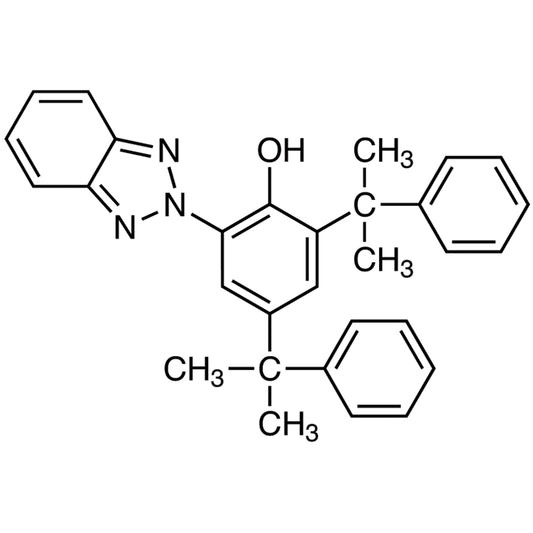
- TCI B3717 70321-86-7 2-(2H-Benzotriazol-2-yl)-4,6-bis(1-methyl-1-phenylethyl)phenol
- TCI H0719 3147-76-0 2-(5-tert-Butyl-2-hydroxyphenyl)benzotriazole
- TCI H0560 2440-22-4 2-(2-Hydroxy-5-methylphenyl)benzotriazole
- TCI H0716 3147-75-9 2-(2-Hydroxy-5-tert-octylphenyl)benzotriazole
- TCI H0559 3896-11-5 2-(5-Chloro-2-benzotriazolyl)-6-tert-butyl-p-cresol
- UV Stability Testing for polymer materials to assess resistance to photodegradation in outdoor environments.
- Research on polymer aging processes to evaluate long-term performance under UV exposure and environmental stress.
- Development of UV-resistant coatings and additives for plastics and composites used in construction and automotive industries.
- Analysis of polymer degradation mechanisms to improve material formulations and enhance product durability.
- Formulation testing for polymer-based products to optimize the inclusion of photostabilizers for enhanced stability.
| Brand | TCI |
|---|---|
| CAS number | 103597-45-1 |
| Molecular formula | — |
| Purity | — |
| Category | Materials Science > Polymer/Macromolecule Reagents > Polymer Additives |
| Pack sizes | Available in various quantities as per supplier specifications |
| Physical form | Solid powder |
| Storage | Store in a cool, dry place away from direct sunlight and moisture |
This compound should be stored in a cool, dry environment, away from direct sunlight and sources of heat. It is recommended to use airtight containers to prevent moisture absorption and contamination. Due to its chemical nature, it should be handled with appropriate personal protective equipment, including gloves and safety goggles, to ensure laboratory safety. Avoid prolonged exposure to UV light during storage to maintain its chemical integrity. The compound is non-hazardous under normal conditions but should be kept out of reach of children and not mixed with incompatible substances. Proper labeling of containers is essential for safe handling and storage in laboratory settings.
—
Produk Terkait
-
2-(2H-Benzotriazol-2-yl)-4-methyl-6-(2-propenyl)phenol TCI B5709
Regular price From Rp 2.094.750,00Regular price -
2-(2H-Benzotriazol-2-yl)-4,6-bis(1-methyl-1-phenylethyl)phenol TCI B3717
Regular price From Rp 823.200,00Regular price -
2-(5-tert-Butyl-2-hydroxyphenyl)benzotriazole TCI H0719
Regular price From Rp 1.378.650,00Regular price -
2-(2-Hydroxy-5-methylphenyl)benzotriazole TCI H0560
Regular price From Rp 664.650,00Regular price -
2-(2-Hydroxy-5-tert-octylphenyl)benzotriazole TCI H0716
Regular price From Rp 530.250,00Regular price -
2-(5-Chloro-2-benzotriazolyl)-6-tert-butyl-p-cresol TCI H0559
Regular price From Rp 1.140.300,00Regular price -
2-(3,5-Di-tert-butyl-2-hydroxyphenyl)-5-chlorobenzotriazole TCI D1529
Regular price Rp 1.326.150,00Regular price -
4-Octylphenol TCI O0562
Regular price From Rp 4.902.450,00Regular price