


2-(5-tert-Butyl-2-hydroxyphenyl)benzotriazole is a chemical compound widely used as a polymer additive in laboratory settings. It serves as a key ingredient in polymer formulations, particularly in applications requiring UV protection. This compound is commonly employed to enhance the stability and longevity of polymer materials by preventing degradation caused by exposure to ultraviolet light. Its role is critical in maintaining the integrity of materials under prolonged light exposure, making it an essential component in polymer research and development.
The compound is valued for its high UV absorption capacity, which effectively blocks harmful radiation from damaging polymer structures. Its chemical stability ensures it does not react readily with other substances, making it a reliable additive in various formulations. Additionally, it offers excellent compatibility with a wide range of polymer matrices, contributing to its popularity in both academic and industrial laboratories. Its non-toxic nature and safe handling profile further support its use in controlled laboratory environments.
In Indonesian laboratories, this compound is extensively utilized in polymer-related research and development. It is commonly found in studies focused on composite materials, plastics, and protective coatings. Researchers and industry professionals rely on it to meet quality standards and ensure the durability of polymer-based products. Its application extends to both academic and commercial sectors, supporting innovation in material science and polymer engineering.
TCI brochures (PDF)
- Polymer Additives 2026-04-16 · p. 6
Related TCI products
- TCI H1261 96478-09-0 2-[2-Hydroxy-5-[2-(methacryloyloxy)ethyl]phenyl]-2H-benzotriazole
- TCI H0716 3147-75-9 2-(2-Hydroxy-5-tert-octylphenyl)benzotriazole
- TCI H0560 2440-22-4 2-(2-Hydroxy-5-methylphenyl)benzotriazole
- TCI D1529 3864-99-1 2-(3,5-Di-tert-butyl-2-hydroxyphenyl)-5-chlorobenzotriazole
- TCI B5709 2170-39-0 2-(2H-Benzotriazol-2-yl)-4-methyl-6-(2-propenyl)phenol
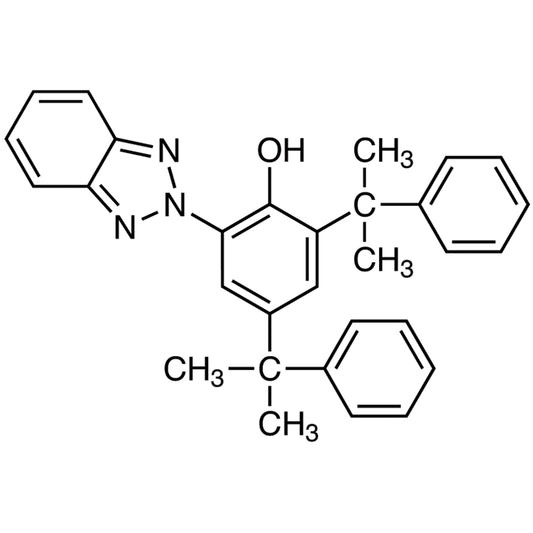
- TCI B3717 70321-86-7 2-(2H-Benzotriazol-2-yl)-4,6-bis(1-methyl-1-phenylethyl)phenol
- UV Stabilization of Polymers: This compound is ideal for protecting polymer materials from UV-induced degradation, ensuring long-term stability and performance in outdoor applications.
- Composite Material Formulation: It is commonly used in the development of composite materials to enhance their resistance to environmental factors, such as sunlight and weathering.
- Plastic Additive Testing: It serves as a key additive in plastic formulations, helping to improve the light stability and lifespan of plastic products in various industrial applications.
- Coating and Film Development: It is used in the formulation of protective coatings and films to prevent UV damage, making it suitable for applications in packaging and construction.
- Material Stability Studies: It is frequently employed in research to assess the long-term stability of polymer materials under different environmental conditions.
| Brand | TCI |
|---|---|
| CAS number | 3147-76-0 |
| Molecular formula | — |
| Purity | — |
| Category | Materials Science > Polymer/Macromolecule Reagents > Polymer Additives |
| Pack sizes | Available in various standard sizes as per supplier specifications |
| Physical form | Solid (as per standard product description) |
| Storage | Store in a cool, dry place away from direct sunlight |
This compound should be stored in a cool, dry environment, away from direct sunlight and sources of heat. It is recommended to use airtight containers to prevent moisture absorption and contamination. Due to its chemical stability, it does not require special handling under normal laboratory conditions. However, it is advisable to keep it in a well-ventilated area to ensure safe handling. Avoid contact with incompatible materials, and always follow standard laboratory safety protocols when working with chemical substances. Proper labeling of containers is essential to ensure safe storage and easy identification.
—
Produk Terkait
-
2-[2-Hydroxy-5-[2-(methacryloyloxy)ethyl]phenyl]-2H-benzotriazole TCI H1261
Regular price From Rp 1.035.300,00Regular price -
2-(2-Hydroxy-5-tert-octylphenyl)benzotriazole TCI H0716
Regular price From Rp 530.250,00Regular price -
2-(2-Hydroxy-5-methylphenyl)benzotriazole TCI H0560
Regular price From Rp 664.650,00Regular price -
2-(3,5-Di-tert-butyl-2-hydroxyphenyl)-5-chlorobenzotriazole TCI D1529
Regular price Rp 1.326.150,00Regular price -
2-(2H-Benzotriazol-2-yl)-4-methyl-6-(2-propenyl)phenol TCI B5709
Regular price From Rp 2.094.750,00Regular price -
2-(2H-Benzotriazol-2-yl)-4,6-bis(1-methyl-1-phenylethyl)phenol TCI B3717
Regular price From Rp 823.200,00Regular price -
2,2'-Methylenebis[6-(benzotriazol-2-yl)-4-tert-octylphenol] TCI M1259
Regular price From Rp 1.618.050,00Regular price -
2-(5-Chloro-2-benzotriazolyl)-6-tert-butyl-p-cresol TCI H0559
Regular price From Rp 1.140.300,00Regular price
![96478-09-0 2-[2-Hydroxy-5-[2-(methacryloyloxy)ethyl]phenyl]-2H-benzotriazole - AMI Scientific](http://amiscientific.com/cdn/shop/files/TCI2510H1261.jpg?v=1769056387&width=533)


![103597-45-1 2,2'-Methylenebis[6-(benzotriazol-2-yl)-4-tert-octylphenol] - AMI Scientific](http://amiscientific.com/cdn/shop/files/TCI2510M1259.jpg?v=1769056742&width=533)
