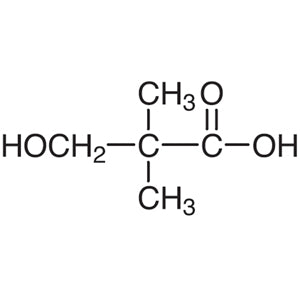
Hydroxypivalic Acid (TCI H0661, CAS 4835-90-9) is a chemical compound widely used in laboratory settings as a building block for organic synthesis. It serves as a versatile reagent in various chemical reactions, enabling the formation of complex molecular structures. This compound is commonly found in chemical laboratories, especially in the synthesis of esters, amides, and other organic compounds with long carbon chains. Its role as a foundational element in chemical synthesis makes it an essential tool for both academic and industrial research.
Hydroxypivalic Acid is valued for its chemical stability and moderate reactivity, which make it suitable for a wide range of synthetic applications. It is available in solid or liquid form, depending on packaging, and is resistant to degradation under normal laboratory conditions. This stability ensures that it remains effective throughout the duration of chemical reactions, making it a preferred choice for researchers seeking reliable and consistent results. Its non-heterocyclic nature also simplifies its integration into various synthetic pathways.
In Indonesian laboratories, Hydroxypivalic Acid is extensively used in both educational and industrial research contexts. It plays a crucial role in the development of new compounds and in analytical chemistry, where understanding molecular reactivity and structure is essential. Its application spans multiple fields, including pharmaceuticals and chemical manufacturing, where it supports the creation of complex chemical structures and the advancement of scientific knowledge.
- Ester Synthesis for pharmaceutical applications as it provides stable and reactive intermediates for drug development.
- Organic Compound Synthesis due to its ability to form esters and amides, supporting the creation of complex molecules.
- Industrial Chemical Production as it facilitates the synthesis of long-chain compounds used in various chemical industries.
- Analytical Chemistry for studying molecular reactivity and structural properties in laboratory experiments.
- Educational Research in chemistry courses to teach fundamental concepts of organic synthesis and chemical reactivity.
| Brand | TCI |
|---|---|
| CAS number | 4835-90-9 |
| Molecular formula | — |
| Purity | — |
| Category | Chemistry > Building Blocks > Non-Heterocyclic Building Blocks |
| Pack sizes | Available in various sizes as per standard laboratory supply options |
| Physical form | Solid or liquid, depending on packaging |
| Storage | Store in a cool, dry place away from direct sunlight and moisture |
Hydroxypivalic Acid should be stored in a cool, dry environment to maintain its chemical stability. It is recommended to keep it in airtight containers to prevent exposure to moisture and air, which could affect its reactivity. Laboratory personnel should handle the compound with care, using appropriate personal protective equipment such as gloves and safety goggles. It is important to ensure that storage areas are well-ventilated to minimize any potential risks associated with its chemical properties. Regular monitoring of storage conditions will help maintain the integrity and effectiveness of the compound for use in laboratory applications.
—
Produk Terkait
-
NeopentylGlycolMono(hydroxypivalate) TCI N0461
Regular price From Rp 875.700,00Regular price -
MethylHydroxypivalate TCI H0906
Regular price From Rp 2.041.200,00Regular price