


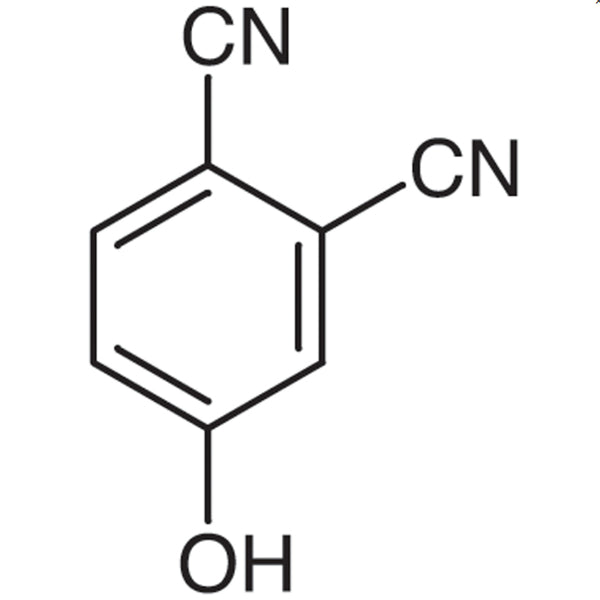
4-Hydroxyphthalonitrile (CAS 30757-50-7) from TCI is a phthalonitrile derivative carrying a hydroxyl group on the benzene ring alongside two adjacent nitrile groups. Compounds of the phthalonitrile class are widely recognised as key starting materials for constructing phthalocyanines — intensely coloured macrocycles that form the backbone of research into dyes, photosensitisers, catalysts, and organic semiconducting materials. The presence of the hydroxyl group at the 4-position makes this compound more than an ordinary precursor; it is an entry point toward substituted phthalocyanines whose solubility and electronic character can be deliberately designed.
The property that makes this material a preferred choice is its complementary dual reactivity. The pair of adjacent nitrile groups is able to undergo cyclotetramerisation into a phthalocyanine core, typically assisted by a metal-ion template. Meanwhile, the phenolic hydroxyl group is readily etherified or esterified before the macrocyclisation step, allowing researchers to install long alkyl chains, PEG chains, or other directing groups in order to overcome the classic problem of phthalocyanines, namely their tendency to aggregate and their poor solubility. The nitrile groups can likewise be directed toward other transformations, giving a single building block access to several synthetic routes.
In Indonesian laboratories, this building block is typically used within university and institutional research groups working on synthetic organic chemistry, functional dyes, and organic electronic materials. It is normally handled at gram to sub-gram scale on a bench schlenk line or in a fume hood, weighed out for multi-step sequences in which the substituted phthalonitrile is prepared first and the macrocycle assembled afterwards. Supplying it as a catalogue reagent from TCI spares research groups the time and yield losses of preparing the substituted precursor in house.
- Phthalocyanine synthesis — the adjacent dinitrile pair undergoes cyclotetramerisation around a metal-ion template, giving direct access to the macrocyclic core that underpins dye and pigment research.
- Peripherally substituted phthalocyanine design — the 4-hydroxyl position accepts alkyl or PEG chains before macrocyclisation, letting researchers tune solubility and suppress the aggregation that limits phthalocyanine work.
- Photosensitiser development — phthalocyanines built from this precursor are studied as intensely absorbing chromophores, and the hydroxyl handle allows the substituents that govern photophysical behaviour to be varied systematically.
- Organic semiconductor materials research — substituted phthalocyanines derived from this building block serve in studies of organic semiconducting films, where side-chain engineering through the phenolic group influences processability.
- Non-heterocyclic building block chemistry — the phenolic hydroxyl supports etherification and esterification while the nitriles remain available for further transformation, making it a versatile multi-step intermediate.
| Brand | TCI (Tokyo Chemical Industry) |
|---|---|
| CAS number | 30757-50-7 |
| Molecular formula | — |
| Purity | — |
| Category | Chemistry > Building Blocks > Non-Heterocyclic Building Blocks |
| Pack sizes | available in the catalogue pack sizes offered by TCI for this item; please confirm the size you require when ordering |
| Physical form | — |
| Storage | store according to the conditions stated on the product label and in the manufacturer's safety data sheet |
- Catalogue number: H0813
Store the container tightly closed in a cool, dry, well-ventilated place, away from direct sunlight, heat sources, and incompatible materials, following the storage conditions stated on the manufacturer's label and safety data sheet. Keep the material in its original supplier container or in a clean, clearly labelled amber glass bottle, and reseal it promptly after each use to limit exposure to moisture and air. Handle and weigh the compound inside a functioning fume hood while wearing safety goggles, a laboratory coat, and chemically resistant gloves. Avoid generating dust, avoid inhalation and skin or eye contact, and wash hands thoroughly after handling. Dispose of residues and contaminated consumables through your institution's chemical waste procedures, and consult the current safety data sheet before beginning work.
—
Produk Terkait
-
Phthalonitrile TCI P0404
Regular price From Rp 505.050,00Regular price -
4-Butoxyphthalonitrile TCI B1353
Regular price Rp 1.565.550,00Regular price -
4-Pentyloxyphthalonitrile TCI P1071
Regular price From Rp 1.326.150,00Regular price -
4-Propoxyphthalonitrile TCI P1070
Regular price From Rp 1.696.800,00Regular price -
4-Hexyloxyphthalonitrile TCI H0691
Regular price Rp 1.326.150,00Regular price -
4-Dodecyloxyphthalonitrile TCI D2237
Regular price From Rp 1.510.950,00Regular price -
4-(2',6'-Dimethylphenoxy)phthalonitrile TCI D1983
Regular price From Rp 2.625.000,00Regular price -
4-Iodophthalonitrile TCI I1050
Regular price Rp 4.823.700,00Regular price


