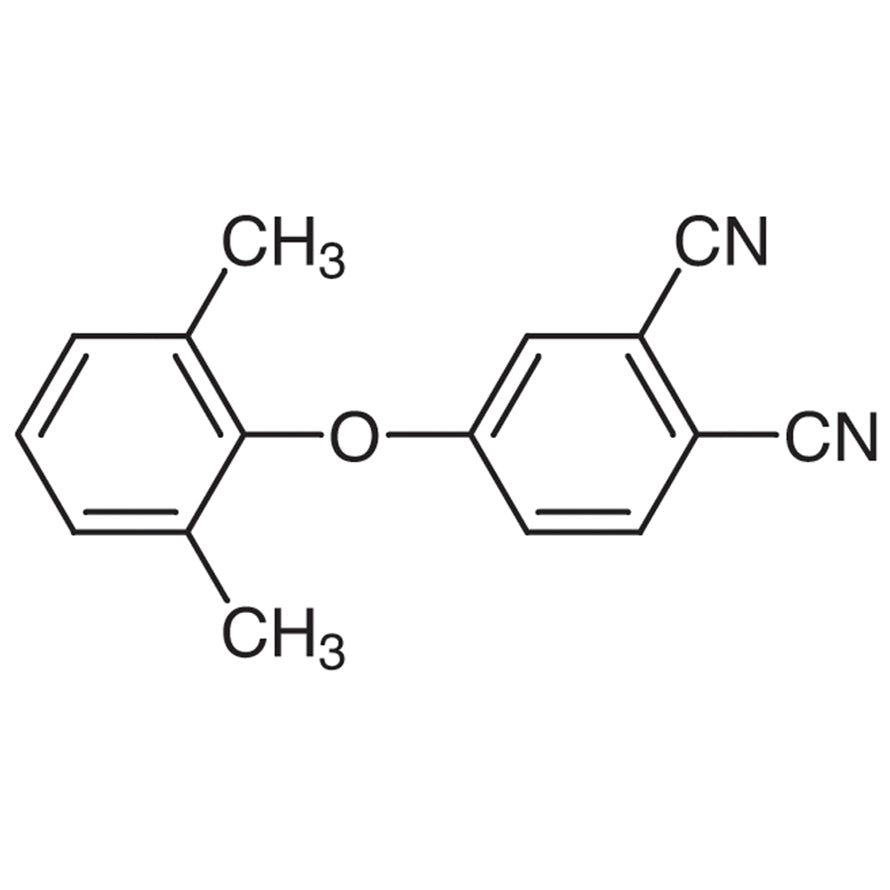
4-(2',6'-Dimethylphenoxy)phthalonitrile is a chemical compound widely used as a building block in the synthesis of complex organic molecules. This compound contains both nitrile and phenyl groups, which enable it to participate in various chemical reactions such as substitution, condensation, and electrophilic reactions. Its structural versatility makes it a valuable tool for chemists seeking to construct molecules with specific functional groups. In laboratory settings, it serves as a foundational material for the development of new compounds in organic chemistry and pharmaceutical research.
The compound is known for its chemical stability and solubility in organic solvents, which are essential properties for its use in synthetic processes. These characteristics make it a preferred choice for researchers aiming to achieve consistent and reproducible results in their experiments. Its non-heterocyclic nature further simplifies the synthesis of target molecules without introducing unwanted side reactions. This reliability and predictability are key factors in its widespread application across various scientific fields.
In Indonesian laboratories, 4-(2',6'-Dimethylphenoxy)phthalonitrile is commonly used in academic and research institutions. It is particularly favored in organic chemistry and pharmaceutical research due to its ability to form complex molecular structures. Its availability and performance make it an essential component in the chemical supply chain supporting scientific innovation in Indonesia.
- Organic synthesis applications benefit from this compound's reactivity and structural versatility, allowing the creation of complex molecules with high precision.
- Pharmaceutical research utilizes it as a building block for developing new drug compounds, leveraging its chemical stability and solubility.
- Academic research institutions use it in teaching and experimental settings to demonstrate synthetic techniques and molecular construction.
- Industrial chemical processes incorporate it due to its reliability in producing consistent results in large-scale synthesis.
- Analytical chemistry labs use it as a reference standard for testing and validating synthetic pathways and reaction mechanisms.
| Brand | TCI |
|---|---|
| CAS number | 221302-75-6 |
| Molecular formula | — |
| Purity | — |
| Category | Chemistry > Building Blocks > Non-Heterocyclic Building Blocks |
| Pack sizes | Available in various quantities as per standard laboratory supply specifications |
| Physical form | Solid, typically in crystalline or powder form |
| Storage | Store in a cool, dry place away from moisture and direct sunlight |
This compound should be stored in a cool, dry environment to maintain its chemical stability and prevent degradation. It is recommended to use airtight containers to protect it from moisture and air exposure. Due to its reactivity, it should be handled in a well-ventilated area, preferably under a fume hood. Avoid contact with incompatible substances such as strong acids or bases. Always wear appropriate personal protective equipment, including gloves and safety goggles, when handling this material. Proper storage and handling ensure the compound remains effective and safe for use in laboratory applications.
—
Produk Terkait
-
Phthalonitrile TCI P0404
Regular price From Rp 505.050,00Regular price -
4-Bromophthalonitrile TCI B5509
Regular price From Rp 2.094.750,00Regular price -
4-Butoxyphthalonitrile TCI B1353
Regular price Rp 1.565.550,00Regular price -
4-Pentyloxyphthalonitrile TCI P1071
Regular price From Rp 1.326.150,00Regular price -
4-Propoxyphthalonitrile TCI P1070
Regular price From Rp 1.696.800,00Regular price -
4-Iodophthalonitrile TCI I1050
Regular price Rp 4.823.700,00Regular price -
4-Hydroxyphthalonitrile TCI H0813
Regular price From Rp 2.094.750,00Regular price -
4-Hexyloxyphthalonitrile TCI H0691
Regular price Rp 1.326.150,00Regular price