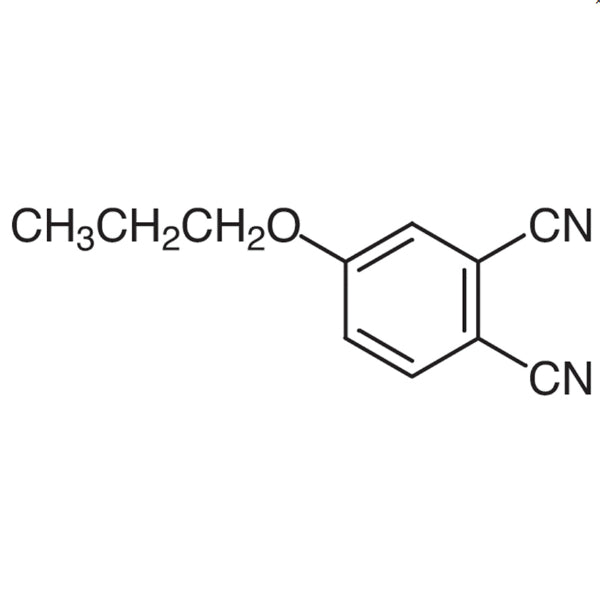
4-Propoxyphthalonitrile from TCI is a phthalonitrile derivative: a benzene ring with two adjacent nitrile groups in the ortho position and a propoxy group at the 4-position. In the laboratory its main role is as a precursor for making substituted phthalocyanines. Phthalocyanines are intensely coloured macrocycles that form when four phthalonitrile units tetramerise, usually with a metal ion acting as a template. The propoxy group stays on the final product, where it changes the solubility and optical properties of the resulting phthalocyanine.
Researchers choose this material because unsubstituted phthalocyanines are well known for being very poorly soluble in organic solvents, which makes them hard to purify and process. Alkoxy groups such as propoxy make the macrocycle more soluble and less likely to aggregate, so its photophysical properties are easier to study. Because alkoxy substituents donate electrons, they can also shift how the product absorbs light. The fairly short propyl chain balances solubility against how tightly the molecules pack in solids or thin films. This lets researchers tune these properties to suit their target material.
In Indonesia, this building block suits materials chemistry, photochemistry and electrochemistry laboratories. University research groups, postgraduate thesis projects and institutional research centres use precursors like this to prepare and characterise functional macrocyclic compounds. Typical work includes synthesising new metal phthalocyanine complexes, comparing how substituents affect solubility and light absorption, and preparing soluble dyes for thin-film or solution-based measurements. Supplied under the TCI brand, it gives Indonesian research teams a consistent starting material for building phthalocyanines step by step.
- Synthesis of substituted phthalocyanines: as a phthalonitrile precursor, this compound can tetramerise with three other units to form the macrocyclic phthalocyanine core, which keeps propoxy groups on its periphery.
- Preparation of metal phthalocyanine complexes: a metal ion can serve as a template during tetramerisation, so researchers can make metal-centred phthalocyanines whose solubility is improved by the alkoxy groups.
- Photophysical studies of macrocyclic dyes: the propoxy groups reduce aggregation and improve solubility, so absorption and other optical properties can be measured more reliably in solution.
- Structure–property research on substituent effects: the electron-donating propoxy group can shift light absorption, which helps researchers compare how peripheral substituents change the optical behaviour of phthalocyanines.
- Thin-film and solid-state materials research: the relatively short propyl chain balances solubility against molecular packing density, which matters when preparing phthalocyanine layers or solid materials for study.
| Brand | TCI (product code P1070) |
|---|---|
| CAS number | 106144-18-7 |
| Molecular formula | — |
| Purity | — |
| Category | Chemistry > Building Blocks > Non-Heterocyclic Building Blocks |
| Pack sizes | see the available options listed on this product page |
| Physical form | — |
| Storage | follow the conditions on the TCI label and Safety Data Sheet |
- Chemical description: phthalonitrile derivative with a propoxy group at the 4-position
Store 4-Propoxyphthalonitrile in its original, tightly closed container, in a cool, dry, well-ventilated place away from direct sunlight, heat and moisture. Always check the TCI label and Safety Data Sheet for the recommended storage temperature and any specific hazard information. Handle the compound in a fume hood or well-ventilated area, wearing suitable personal protective equipment such as a lab coat, safety glasses and chemical-resistant gloves. Avoid creating dust and avoid contact with skin, eyes and clothing. Keep it away from incompatible substances, close the container promptly after use, and dispose of residues and contaminated materials according to institutional and local chemical waste rules.
—
Produk Terkait
-
TCI B5774 5,10-Bis(4,4,5,5-tetramethyl-1,3,2-dioxaborolan-2-yl)naphtho[1,2-c:5,6-c']bis([1,2,5]oxadiazole)
Regular price Rp 10.255.350,00Regular price -
Dihydroiodide TCI B6569
Regular price From Rp 1.936.200,00Regular price -
Trifluoromethanesulfonate TCI B7003
Regular price From Rp 1.936.200,00Regular price
![5,10-Bis(4,4,5,5-tetramethyl-1,3,2-dioxaborolan-2-yl)naphtho[1,2-c:5,6-c']bis([1,2,5]oxadiazole) - TCI B5774 - AMI Scientific](http://amiscientific.com/cdn/shop/files/TCI2510B5774.jpg?v=1769180228&width=533)