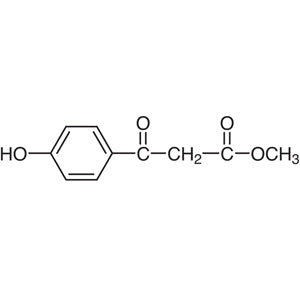
TCI H0828 Methyl (4-Hydroxybenzoyl)acetate is an aromatic β-ketoester, meaning it carries a ketone group and an ester group separated by a single carbon atom, attached to an aromatic ring that bears a hydroxyl substituent at the para position. This arrangement makes it a highly productive building block in organic synthesis laboratories, because the carbon sitting between the two carbonyl groups is acidic and readily deprotonated, allowing it to react with a wide range of electrophiles. From this single compound, researchers can access many different molecular frameworks simply by changing the reaction partner.
The principal property that drives its selection is the speed with which it forms heterocyclic rings. β-Ketoesters are classic starting materials for the synthesis of pyrazoles, isoxazoles, pyrimidines, and coumarins through condensation reactions with hydrazines, hydroxylamine, amidines, or phenols. The presence of the 4-hydroxyphenyl group adds a further dimension: that phenolic group can be protected, etherified, or left free to act as a hydrogen-bond donor in the final molecule, a feature frequently sought in the design of bioactive compounds. Its solid form also makes accurate weighing for reactions straightforward.
In Indonesian laboratories, this building block typically appears in university and institutional synthetic chemistry groups, medicinal chemistry research, and natural product analogue work, where heterocyclic scaffolds are assembled step by step from commercially available intermediates. Because it is supplied as a solid, it suits teaching and research settings that weigh out small quantities on an analytical balance rather than handling volatile liquids, and it fits routine bench practice in fume-hood-equipped synthesis laboratories.
Related TCI products
- TCI D2140 5809-23-4 2-(4-Diethylamino-2-hydroxybenzoyl)benzoic Acid
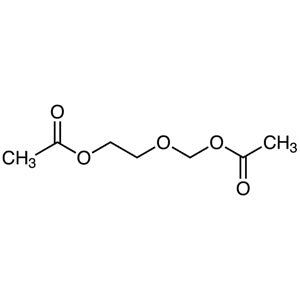
- TCI A3163 59278-00-1 (2-Acetoxyethoxy)methyl Acetate
- TCI A2960 42059-48-3 4-Acetyl-3-hydroxyphenyl Acetate
- TCI A1059 542-59-6 2-Hydroxyethyl Acetate
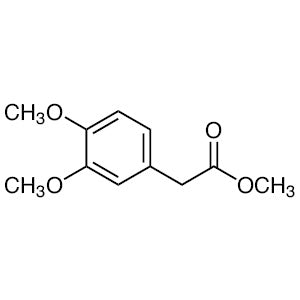
- TCI M3431 15964-79-1 Methyl 2-(3,4-Dimethoxyphenyl)acetate
- TCI H1920 3233-32-7 4-Hydroxyphenyl Acetate
- Pyrazole synthesis — condensation of the β-ketoester with hydrazines delivers substituted pyrazole rings directly, making this compound a convenient entry point into a widely used heterocyclic class.
- Isoxazole preparation — reaction with hydroxylamine exploits the same 1,3-dicarbonyl reactivity, letting researchers build isoxazole scaffolds without additional functional group manipulation on the starting material.
- Pyrimidine construction — condensation with amidines takes advantage of the acidic central carbon and the ester carbonyl, giving access to pyrimidine cores common in medicinal chemistry programmes.
- Coumarin synthesis — the β-ketoester reacts with phenols under classic condensation conditions, and the aromatic substitution pattern already present broadens the range of accessible coumarin products.
- Bioactive analogue design — the free para-hydroxyl group can be protected, etherified, or retained as a hydrogen-bond donor, allowing systematic structural variation around a single synthetic intermediate.
| Brand | TCI (Tokyo Chemical Industry) |
|---|---|
| CAS number | 32066-29-8 |
| Molecular formula | — |
| Purity | — |
| Category | Chemistry > Building Blocks > Non-Heterocyclic Building Blocks |
| Pack sizes | Available in standard TCI research-scale packaging; please confirm the size required when ordering |
| Physical form | Solid, convenient for accurate gravimetric weighing |
| Storage | Keep in the closed original container under the conditions stated on the manufacturer's label |
- Product Code: H0828
Store the container tightly closed in a cool, dry, well-ventilated area away from direct sunlight, moisture, and incompatible chemicals, following the storage conditions printed on the manufacturer's label and safety data sheet. Retain the material in its original supplier container wherever possible; if transferring, use clean, dry, chemically compatible glass or suitable plastic vessels that are clearly labelled with the substance name and CAS number. Handle the solid inside a fume hood to avoid inhalation of dust, and wear a laboratory coat, safety goggles, and chemical-resistant gloves. Avoid generating airborne powder during weighing, close the container promptly after use, and clean spatulas and balance surfaces afterwards. Consult the safety data sheet before first use and dispose of residues and contaminated materials through the laboratory's established chemical waste procedures.
—
Produk Terkait
-
2-(4-Diethylamino-2-hydroxybenzoyl)benzoicAcid TCI D2140
Regular price From Rp 1.378.650,00Regular price -
(2-Acetoxyethoxy)methylAcetate TCI A3163
Regular price From Rp 452.550,00Regular price -
4-Acetyl-3-hydroxyphenylAcetate TCI A2960
Regular price From Rp 1.696.800,00Regular price -
2-HydroxyethylAcetate TCI A1059
Regular price From Rp 2.094.750,00Regular price -
Methyl2-(3,4-Dimethoxyphenyl)acetate TCI M3431
Regular price From Rp 2.439.150,00Regular price -
4-HydroxyphenylAcetate TCI H1920
Regular price From Rp 1.378.650,00Regular price -
Ethyl2-(2,4-Dimethyl-1,3-dioxolan-2-yl)acetate(mixtureofdiastereoisomers) TCI E1417
Regular price From Rp 610.050,00Regular price -
Ethyl2-(2-Methyl-1,3-dioxolan-2-yl)acetate TCI E0929
Regular price From Rp 769.650,00Regular price