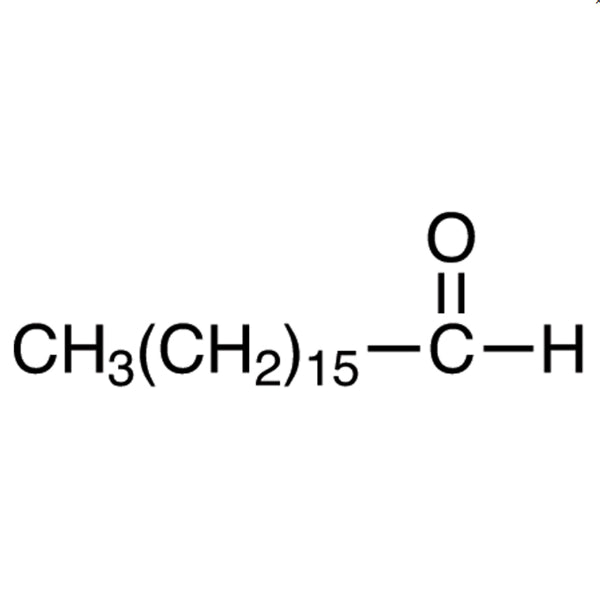
TCI H1295 Heptadecanal is a straight-chain saturated aliphatic aldehyde containing seventeen carbon atoms, placing it within the family of long-chain fatty aldehydes. In life science laboratories, this compound serves as a reference material and starting material for lipid studies, particularly for the class of fatty aldehydes that appear as intermediates of lipid metabolism, as degradation products of plasmalogens, and as components examined in chemical ecology research. Its odd-numbered carbon chain makes the compound frequently useful as a marker that is readily distinguished from the even-numbered fatty aldehydes that occur far more abundantly in nature.
The property that makes it a preferred choice is its mild amphiphilic character: a long, strongly hydrophobic hydrocarbon chain paired with a reactive aldehyde carbonyl group. This combination allows the compound to dissolve well in organic solvents such as hexane, chloroform, and ethanol, while remaining ready to undergo condensation reactions, reduction to the corresponding fatty alcohol, oxidation to the fatty acid, and the formation of oxime and hydrazone derivatives for analytical derivatization purposes. The long-chain aldehyde group also provides a useful point of attachment when researchers need to label or stabilize an analyte before measurement.
In Indonesian laboratories, TCI H1295 Heptadecanal is typically encountered in university and institutional research settings working on lipid chemistry, biochemistry, and natural product analysis. It is commonly used in chromatographic method development, in the preparation of calibration and comparison standards for fatty aldehyde profiling, and in synthetic work requiring a defined long-chain aldehyde building block. Its role is generally that of a reference or intermediate rather than a bulk production input.
- Lipid metabolism research, where heptadecanal serves as a defined long-chain fatty aldehyde reference for tracing intermediates formed during the breakdown and turnover of cellular lipids.
- Plasmalogen degradation studies, since fatty aldehydes are released as characteristic products and an authentic odd-chain standard helps researchers identify and confirm those species clearly.
- Chromatographic standard preparation, because the odd-numbered carbon chain is easily separated from the abundant even-chain natural aldehydes that would otherwise overlap in a profile.
- Analytical derivatization work, as the reactive aldehyde carbonyl readily forms oxime and hydrazone derivatives that improve detection and stability of the analyte before measurement.
- Organic synthesis of fatty derivatives, where the compound can be reduced to the corresponding fatty alcohol or oxidized to the fatty acid as a defined seventeen-carbon building block.
| Brand | TCI (Tokyo Chemical Industry) |
|---|---|
| CAS number | 629-90-3 |
| Molecular formula | — |
| Purity | — |
| Category | Life Science > Biochemicals and Reagents > Lipids |
| Pack sizes | available in standard TCI laboratory research pack sizes; please confirm the currently listed packaging option when ordering |
| Physical form | — |
| Storage | store according to the conditions stated on the manufacturer's label and safety data sheet |
- Catalog number: H1295
Store the product in its original tightly closed container, following the storage conditions stated on the manufacturer's label and safety data sheet. Long-chain aldehydes are generally sensitive to air and light, so containers should be kept well sealed and protected from prolonged exposure, and glass containers with chemically resistant closures are usually preferred over ordinary plastic. Handle the material in a well-ventilated area or fume hood, wearing gloves, safety glasses, and a laboratory coat. Allow refrigerated material to reach room temperature before opening to prevent moisture condensation, keep the compound away from strong oxidizing agents, and dispose of residues and contaminated consumables through the laboratory's established chemical waste procedure.
—
Produk Terkait
-
TCI B5774 5,10-Bis(4,4,5,5-tetramethyl-1,3,2-dioxaborolan-2-yl)naphtho[1,2-c:5,6-c']bis([1,2,5]oxadiazole)
Regular price Rp 10.255.350,00Regular price -
Dihydroiodide TCI B6569
Regular price From Rp 1.936.200,00Regular price -
Trifluoromethanesulfonate TCI B7003
Regular price From Rp 1.936.200,00Regular price
![5,10-Bis(4,4,5,5-tetramethyl-1,3,2-dioxaborolan-2-yl)naphtho[1,2-c:5,6-c']bis([1,2,5]oxadiazole) - TCI B5774 - AMI Scientific](http://amiscientific.com/cdn/shop/files/TCI2510B5774.jpg?v=1769180228&width=533)