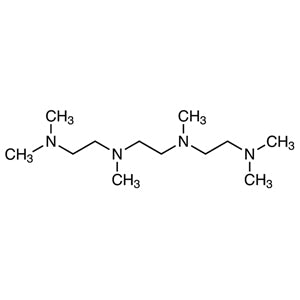
1,1,4,7,10,10-Hexamethyltriethylenetetramine, known among polymer researchers by the abbreviation HMTETA, is a linear polyamine ligand carrying four donor nitrogen atoms along a single chain, with six methyl groups distributed across terminal and internal positions. Its principal role in the laboratory is to act as the ligand that binds copper ions in atom transfer radical polymerization systems. Without an appropriate ligand, copper salts neither dissolve in organic media nor possess a suitable redox potential, and controlled polymerization reactions therefore fail to proceed as intended.
The property that makes this compound so useful is its ability to supply four nitrogen donor sites simultaneously from a single molecule, producing a highly stable chelate complex with copper. The methyl groups on every nitrogen render the ligand fully tertiary, so it carries no amine hydrogens that could interfere with the reaction, while at the same time improving the solubility of the resulting complex in both nonpolar and polar organic solvents. Being liquid at room temperature, it is straightforward to measure volumetrically and to add directly into a reaction flask. The flexibility of its backbone allows the coordination geometry to adjust as the oxidation state of the metal centre changes during the catalytic cycle.
In Indonesian laboratories, HMTETA is typically encountered in university and institutional research groups working on controlled radical polymerization, functional polymer synthesis, and coordination chemistry. It is usually ordered in small quantities alongside a copper halide source and purified monomer, since catalyst loadings in these systems are low relative to the monomer charge. Groups preparing block copolymers, polymer brushes, or well-defined macromolecular architectures generally keep a single bottle on hand for repeated small-scale reactions rather than for bulk consumption.
TCI brochures (PDF)
- Ligands 2025-12-01 · p. 9
- Biomaterials Research Reagents 2025-02-19 · p. 28
Related TCI products
- TCI T3371 150-77-6 N,N,N',N'-Tetraethylethylenediamine
- TCI T2898 33527-91-2 Tris[2-(dimethylamino)ethyl]amine
- TCI T1879 96556-05-7 1,4,7-Trimethyl-1,4,7-triazacyclononane (stabilized with NaHCO3)
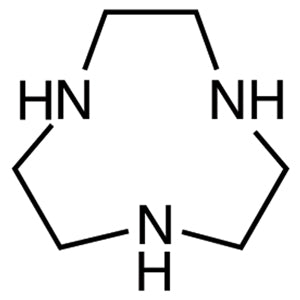
- TCI T1878 4730-54-5 1,4,7-Triazacyclononane
- TCI T1877 41203-22-9 1,4,8,11-Tetramethyl-1,4,8,11-tetraazacyclotetradecane
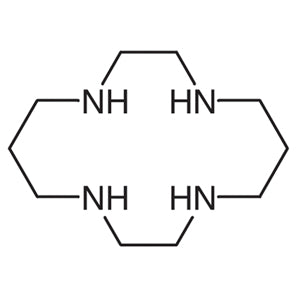
- TCI T1597 295-37-4 1,4,8,11-Tetraazacyclotetradecane
- Atom transfer radical polymerization catalysis — the four nitrogen donors chelate copper halide tightly, solubilising the metal in organic media and tuning its redox potential so that chain growth stays controlled.
- Controlled synthesis of block copolymers — stable ligand–copper coordination maintains reversible activation and deactivation across sequential monomer additions, allowing defined block lengths and narrow molecular weight distributions to be obtained.
- Surface-initiated polymerization and polymer brush growth — the liquid form and good organic solubility let researchers prepare homogeneous catalyst solutions that reach initiator sites anchored on substrate surfaces.
- Coordination chemistry and complex preparation — the flexible tetradentate backbone accommodates different coordination geometries, making it a convenient starting ligand for preparing and studying transition metal complexes.
- Mechanistic and kinetic studies of polymerization — the fully tertiary structure removes interfering amine protons, giving reproducible catalyst behaviour suitable for comparing rate constants and equilibrium measurements.
| Brand | TCI (product code H1371) |
|---|---|
| CAS number | 3083-10-1 |
| Molecular formula | — |
| Purity | — |
| Category | Chemistry > Catalysis and Inorganic Chemistry > Nitrogen-Donor Ligands [Catalysis] |
| Pack sizes | available in standard TCI research-scale pack sizes; please confirm the current options when ordering |
| Physical form | liquid at room temperature |
| Storage | keep tightly closed in a cool, dry place away from light and air |
- Chemical name: 1,1,4,7,10,10-Hexamethyltriethylenetetramine (HMTETA)
Store the bottle tightly closed in a cool, dry, well-ventilated area, protected from light and kept away from oxidising agents and acids. As an amine liquid, it is best kept in its original supplier container with the cap firmly sealed; for frequent use, transfer under inert gas into a septum-capped vial so that the bulk stock is not repeatedly exposed to air and moisture. Handle inside a fume hood, wearing safety goggles, nitrile gloves, and a laboratory coat, and use a dry syringe or pipette for volumetric transfer. Wipe up any spillage promptly and consult the supplier safety data sheet before first use.
—
Product Categories
- Polymer/Macromolecule ReagentsPolymerization ReagentsControlled Radical Polymerization Reagents
- Biomaterials/Biocompatible Materials Research ReagentsPolymerization Reagents (Initiators, Catalysts, Ligands) [Biomaterials/Biocompatible Materials Research Reagents]Atom Transfer Radical Polymerization (ATRP) Reagents
Produk Terkait
-
N,N,N',N'-Tetraethylethylenediamine TCI T3371
Regular price From Rp 1.115.100,00Regular price -
Tris[2-(dimethylamino)ethyl]amine TCI T2898
Regular price From Rp 2.254.350,00Regular price -
1,4,7-Trimethyl-1,4,7-triazacyclononane(stabilizedwithNaHCO3) TCI T1879
Regular price From Rp 6.333.600,00Regular price -
1,4,7-Triazacyclononane TCI T1878
Regular price From Rp 3.498.600,00Regular price -
1,4,8,11-Tetramethyl-1,4,8,11-tetraazacyclotetradecane TCI T1877
Regular price From Rp 2.625.000,00Regular price -
1,4,8,11-Tetraazacyclotetradecane TCI T1597
Regular price From Rp 2.174.550,00Regular price -
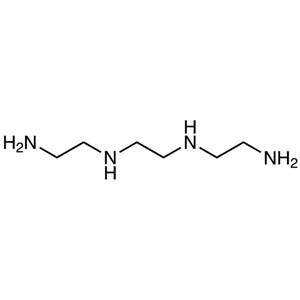
Triethylenetetramine TCI T0429
Regular price From Rp 505.050,00Regular price -
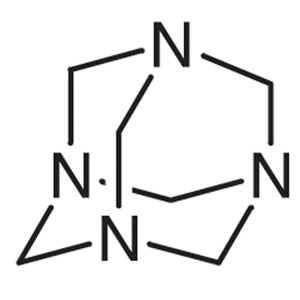
Hexamethylenetetramine TCI H0093
Regular price From Rp 477.750,00Regular price

![33527-91-2 Tris[2-(dimethylamino)ethyl]amine - AMI Scientific](http://amiscientific.com/cdn/shop/files/TCI2510T2898.jpg?v=1767143487&width=533)