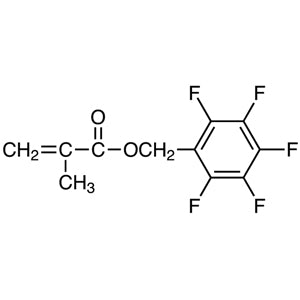
2,2,3,4,4,4-Hexafluorobutyl Methacrylate (stabilized with MEHQ) is a monomer-based chemical compound widely used in scientific research and industrial applications. It belongs to the category of polymer and macromolecule reagents, specifically monomers, and is commonly employed in polymer synthesis, surface modification, and composite material development. This compound plays a crucial role in laboratories where the creation of advanced materials with specific functional properties is required. Its unique chemical structure, featuring six fluorine atoms, contributes to its exceptional thermal stability and chemical reactivity, making it a valuable tool for material scientists and chemists.
The compound's high chemical stability, particularly after stabilization with MEHQ, is a key factor in its popularity among researchers. The stabilizer prevents degradation due to exposure to oxygen or light, ensuring long-term usability and consistent experimental results. Additionally, its good solubility in organic solvents makes it versatile for various synthesis and formulation processes. These properties enable scientists to work efficiently and reliably, reducing the risk of experimental inconsistencies and enhancing the reproducibility of results.
In Indonesian laboratories, this compound is commonly used in material science, organic chemistry, and polymer research. It supports the development of high-performance materials for applications such as coatings, electronics, and biomedical devices. Its availability and performance make it a preferred choice for researchers aiming to achieve precise and durable material properties in their experiments.
TCI brochures (PDF)
- Fluorinated Monomers 2025-10-03 · p. 1
- Monomers 2025-05-28 · p. 5
Related TCI products
- TCI H1674 13695-31-3 2,2,3,3,4,4,4-Heptafluorobutyl Methacrylate (stabilized with MEHQ)
- TCI T3728 45102-52-1 2,2,3,3-Tetrafluoropropyl Methacrylate (stabilized with MEHQ)
- TCI T3414 2144-53-8 1H,1H,2H,2H-Tridecafluoro-n-octyl Methacrylate (stabilized with HQ + MEHQ)
- TCI P2546 114859-23-3 Pentafluorobenzyl Methacrylate (stabilized with BHT)
- TCI P2353 45115-53-5 2,2,3,3,3-Pentafluoropropyl Methacrylate (stabilized with TBC)
- TCI P2289 13642-97-2 Pentafluorophenyl Methacrylate (stabilized with MEHQ)
- Polymer synthesis and modification for advanced material development due to its reactivity and stability.
- Surface modification of materials to enhance properties like hydrophobicity or chemical resistance.
- Composite material fabrication where high thermal and chemical stability are required for industrial applications.
- Organic chemistry research involving controlled polymerization reactions and functional group incorporation.
- Development of high-performance coatings and adhesives for specialized industrial and technological uses.
| Brand | TCI |
|---|---|
| CAS number | 36405-47-7 |
| Molecular formula | — |
| Purity | — |
| Category | Materials Science > Polymer/Macromolecule Reagents > Monomers |
| Pack sizes | Available in standard laboratory quantities as per supplier specifications |
| Physical form | Liquid |
| Storage | Store in a cool, dark place away from sources of heat and light |
This compound should be stored in a cool, dark environment to maintain its stability and prevent degradation. It is recommended to use airtight containers made of materials compatible with organic solvents to minimize exposure to oxygen and moisture. Due to its chemical nature, it should be handled in a well-ventilated area, and appropriate personal protective equipment, such as gloves and safety goggles, should be worn. Avoid direct contact with skin and eyes, and ensure that the storage area is free from incompatible substances. Regular monitoring of storage conditions is essential to maintain the integrity and usability of the material in laboratory settings.
—
Produk Terkait
-
2,2,3,3,4,4,4-HeptafluorobutylMethacrylate(stabilizedwithMEHQ) TCI H1674
Regular price From Rp 2.969.400,00Regular priceRp 2.075.850,00Sale price From Rp 2.969.400,00 -
2,2,3,3-TetrafluoropropylMethacrylate(stabilizedwithMEHQ) TCI T3728
Regular price From Rp 557.550,00Regular priceRp 389.550,00Sale price From Rp 557.550,00 -
1H,1H,2H,2H-Tridecafluoro-n-octylMethacrylate(stabilizedwithHQ+MEHQ) TCI T3414
Regular price From Rp 1.273.650,00Regular priceRp 890.400,00Sale price From Rp 1.273.650,00 -
PentafluorobenzylMethacrylate(stabilizedwithBHT) TCI P2546
Regular price From Rp 4.399.500,00Regular priceRp 3.076.500,00Sale price From Rp 4.399.500,00 -
2,2,3,3,3-PentafluoropropylMethacrylate(stabilizedwithTBC) TCI P2353
Regular price From Rp 1.696.800,00Regular priceRp 1.186.500,00Sale price From Rp 1.696.800,00 -
PentafluorophenylMethacrylate(stabilizedwithMEHQ) TCI P2289
Regular price From Rp 2.227.050,00Regular priceRp 1.557.150,00Sale price From Rp 2.227.050,00 -
1H,1H,5H-OctafluoropentylMethacrylate(stabilizedwithMEHQ) TCI O0481
Regular price From Rp 903.000,00Regular priceRp 631.050,00Sale price From Rp 903.000,00 -
1H,1H,2H,2H-NonafluorohexylMethacrylate(stabilizedwithTBC) TCI N1143
Regular price From Rp 1.485.750,00Regular priceRp 1.038.450,00Sale price From Rp 1.485.750,00