

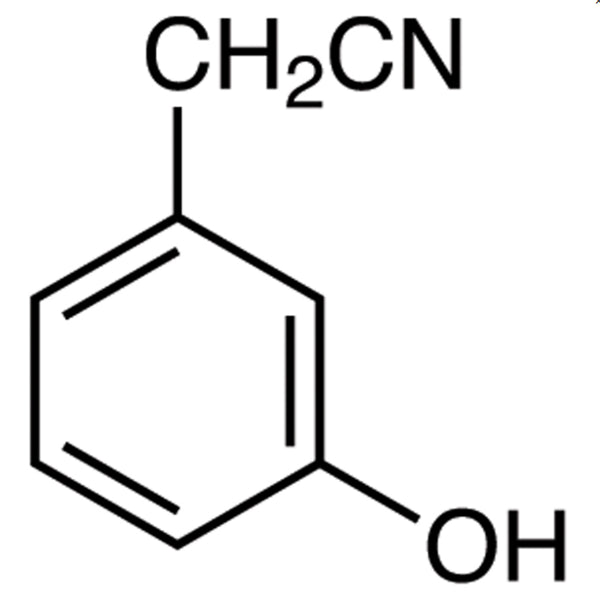
(3-Hydroxyphenyl)acetonitrile is a chemical compound widely used as a foundational building block in the synthesis of complex organic molecules. Its unique molecular structure, featuring both a hydroxyl group and a nitrile group attached to a phenyl ring, makes it a versatile reagent in organic chemistry. In laboratory settings, this compound plays a crucial role in the development of new compounds, particularly in pharmaceutical and materials science research. Its ability to participate in various chemical reactions, such as nucleophilic and electrophilic reactions, enhances its utility in synthetic pathways.
The compound’s chemical stability under controlled conditions, combined with its high reactivity, makes it a preferred choice for researchers. Its molecular complexity allows it to engage in a range of synthetic reactions, including coupling and substitution reactions. These properties make it an essential tool for chemists aiming to create novel compounds with specific functionalities. Its reliability and effectiveness in laboratory applications have established it as a go-to reagent in both academic and industrial research environments.
In Indonesian laboratories, (3-Hydroxyphenyl)acetonitrile is commonly used in organic chemistry research, especially in pharmaceutical and material development. It is frequently employed by research institutions and universities to synthesize new compounds with potential medical or industrial applications. Its availability and consistent performance make it a valuable resource for scientists working on innovative projects.
Related TCI products
- TCI H1954 54840-15-2 tert-Butyl (4-Hydroxyphenyl)carbamate
- TCI E1227 7159-96-8 Ethyl (3-Hydroxyphenyl)carbamate
- TCI B6210 19962-06-2 tert-Butyl (3-Hydroxyphenyl)carbamate
- TCI M0212 109-82-0 (Methyleneamino)acetonitrile
- TCI D1929 926-64-7 (Dimethylamino)acetonitrile
- TCI C2582 4640-66-8 (4-Chlorobenzoyl)acetonitrile
- Organic synthesis is a key application where (3-Hydroxyphenyl)acetonitrile is used to build complex molecules due to its reactive functional groups.
- Pharmaceutical research benefits from this compound as it can be used to develop new drugs through targeted molecular modifications.
- Materials science applications leverage its structural versatility to create advanced polymers and functional materials.
- Analytical chemistry uses it as a standard for chromatographic and spectroscopic analysis due to its distinct chemical profile.
- Academic research in Indonesia relies on this compound for teaching and experimental studies in organic chemistry and drug discovery.
| Brand | TCI |
|---|---|
| CAS number | 25263-44-9 |
| Molecular formula | — |
| Purity | — |
| Category | Chemistry > Building Blocks > Non-Heterocyclic Building Blocks |
| Pack sizes | Available in various quantities as per supplier specifications |
| Physical form | Liquid or solid, depending on the specific product variant |
| Storage | Store in a cool, dry place away from light and incompatible substances |
(3-Hydroxyphenyl)acetonitrile should be stored in a cool, dry environment, away from direct sunlight and sources of heat. It is recommended to use airtight containers made of glass or high-density polyethylene to prevent contamination and evaporation. Due to its reactivity, it should be kept separate from strong oxidizing agents and reactive metals. In laboratory settings, proper ventilation is essential when handling this compound to minimize exposure. Always wear appropriate personal protective equipment, such as gloves and safety goggles, when working with this material. Regular monitoring of storage conditions ensures the compound remains stable and effective for use in research applications.
—
Produk Terkait
-
tert-Butyl(4-Hydroxyphenyl)carbamate TCI H1954
Regular price Rp 2.359.350,00Regular price -
Ethyl(3-Hydroxyphenyl)carbamate TCI E1227
Regular price From Rp 2.916.900,00Regular price -
tert-Butyl(3-Hydroxyphenyl)carbamate TCI B6210
Regular price From Rp 1.035.300,00Regular price -
(Methyleneamino)acetonitrile TCI M0212
Regular price From Rp 928.200,00Regular price -
(Dimethylamino)acetonitrile TCI D1929
Regular price Rp 1.193.850,00Regular price -
(4-Chlorobenzoyl)acetonitrile TCI C2582
Regular price Rp 6.333.600,00Regular price -
(3-Chlorobenzoyl)acetonitrile TCI C2581
Regular price From Rp 769.650,00Regular price -
(2-Chlorobenzoyl)acetonitrile TCI C2580
Regular price From Rp 1.326.150,00Regular price


