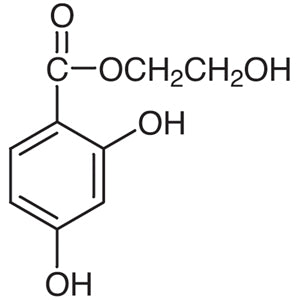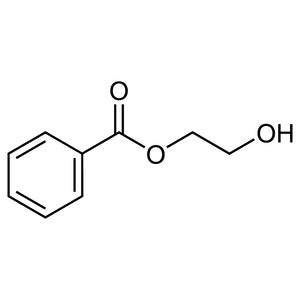
TCI H1910 2-Hydroxyethyl Benzoate is the ester formed from the reaction of benzoic acid with ethylene glycol, giving a molecule that carries an aromatic ring at one end and a free hydroxyl group at the other. This half-protected structure makes it a practical non-heterocyclic building block for synthetic chemists, because one of the glycol hydroxyl groups is already tied up as an ester while the other remains free for further reaction. In the laboratory, the compound is also widely used as a model substrate in studies of esterification, transesterification, and hydrolysis reactions.
What makes this material attractive is the presence of two reactivity centres of different character within one simple molecule. The aromatic ester group is relatively stable yet can be hydrolysed under basic or enzymatic conditions, while the primary hydroxyl group is ready to be etherified, acylated, oxidised, or converted into a leaving group. The benzoate ring provides strong ultraviolet absorption, so the compound and its derivatives are easy to monitor with UV detectors in liquid chromatography. The hydroxyl group also raises the polarity relative to simple benzoate esters, which affects solubility behaviour in common solvents.
In Indonesian laboratories, this combination of features suits routine synthetic and analytical work. University and institutional research groups use it for building block chemistry and for teaching or investigating ester reaction mechanisms, while analytical laboratories value the predictable UV response when developing chromatographic methods. Because the reactivity of the two functional groups can be addressed separately, it fits well into multi-step preparations carried out on a normal bench scale with standard glassware.
Related TCI products
- TCI T1679 3645-00-9 2-Hydroxyethyl Methyl Terephthalate
- TCI B3429 959-26-2 Bis(2-hydroxyethyl) Terephthalate
- TCI A1059 542-59-6 2-Hydroxyethyl Acetate
- TCI H1930 18838-10-3 N-(2-Hydroxyethyl)benzamide
- TCI H1844 1201-91-8 4-[(2-Hydroxyethyl)(methyl)amino]benzaldehyde
- TCI H0698 2496-90-4 2-Hydroxyethyl 4-Hydroxybenzoate
- Non-heterocyclic building block synthesis: the free primary hydroxyl allows chain extension or functional group installation while the benzoate ester keeps the other glycol position protected throughout the sequence.
- Esterification and transesterification studies: the aromatic ester provides a well-behaved model substrate for following reaction progress and comparing catalyst performance under controlled laboratory conditions.
- Hydrolysis mechanism research: the benzoate group can be cleaved under basic or enzymatic conditions, making the compound useful for kinetic investigations of ester bond cleavage.
- Chromatographic method development: the strongly UV-absorbing benzoate ring gives a clear detector response, so the material serves well as a reference analyte for liquid chromatography work.
- Selective functional group transformations: the primary hydroxyl can be etherified, acylated, oxidised, or converted to a leaving group while the ester remains intact under suitably mild conditions.
| Brand | TCI |
|---|---|
| CAS number | 94-33-7 |
| Molecular formula | — |
| Purity | — |
| Category | Chemistry > Building Blocks > Non-Heterocyclic Building Blocks |
| Pack sizes | available in the catalogue pack sizes offered by TCI for this product code |
| Physical form | — |
| Storage | keep in a tightly closed original container, away from heat and moisture |
- Product code: H1910
Store the container tightly closed in a cool, dry, well-ventilated area, away from direct sunlight, heat sources, and sources of ignition. Keep the material in its original supplier container or in a compatible tightly sealed glass bottle, since the free hydroxyl group makes the compound sensitive to moisture uptake and the ester linkage can be attacked by strong bases and acids. Handle the product inside a fume hood using safety goggles, chemical-resistant gloves, and a laboratory coat. Avoid contact with skin and eyes, avoid breathing vapours or aerosols, and keep it separated from strong oxidising agents and strong bases. Always consult the manufacturer safety data sheet before use, and dispose of residues and contaminated materials through the laboratory chemical waste route.
—
Produk Terkait
-
2-HydroxyethylMethylTerephthalate TCI T1679
Regular price From Rp 1.803.900,00Regular price -
Bis(2-hydroxyethyl)Terephthalate TCI B3429
Regular price From Rp 928.200,00Regular price -
2-HydroxyethylAcetate TCI A1059
Regular price From Rp 2.094.750,00Regular price -
N-(2-Hydroxyethyl)benzamide TCI H1930
Regular price From Rp 2.730.000,00Regular price -
4-[(2-Hydroxyethyl)(methyl)amino]benzaldehyde TCI H1844
Regular price From Rp 1.510.950,00Regular price -
2-Hydroxyethyl4-Hydroxybenzoate TCI H0698
Regular price Rp 1.829.100,00Regular price -
2,4-Dihydroxybenzoate TCI D2007
Regular price Rp 3.472.350,00Regular price -
Methyl4-(2-Hydroxyethoxy)benzoate TCI H0820
Regular price From Rp 3.287.550,00Regular price


![1201-91-8 4-[(2-Hydroxyethyl)(methyl)amino]benzaldehyde - AMI Scientific](http://amiscientific.com/cdn/shop/files/TCI2510H1844.jpg?v=1767118605&width=533)