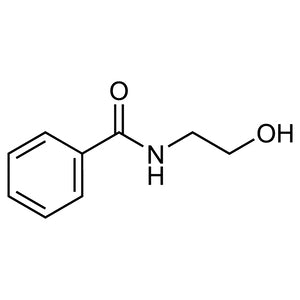
N-(2-Hydroxyethyl)benzamide, CAS 18838-10-3, is an aromatic amide compound carrying a hydroxyethyl side chain on the nitrogen atom. As a non-heterocyclic building block, it delivers three structural elements at once within a single molecule: a rigid benzene ring, a stable amide bond, and a reactive primary hydroxyl group. This combination makes it a versatile starting material for researchers in organic synthesis, medicinal chemistry, and materials chemistry who require an aromatic framework with clearly defined and readily accessible points of functionalisation.
The principal reason chemists select this compound is its selective reactivity. The primary hydroxyl group can be esterified, etherified, oxidised, or converted into a leaving group for substitution reactions, while the amide bond remains intact under most of those reaction conditions. The amide linkage is also capable of forming hydrogen bonds as both donor and acceptor, a property that matters in the design of bioactive molecules as well as in crystallographic and supramolecular studies. The benzene ring contributes structural rigidity along with the possibility of further modification through aromatic substitution reactions when required.
In Indonesian laboratory settings, this building block is typically used in university research groups, government research institutes, and industrial R&D units that carry out multi-step organic synthesis. It suits work where a defined aromatic scaffold is needed as an intermediate rather than being prepared in-house, allowing research teams to focus their effort on the later, more specialised steps of a synthetic route while working with a consistent, well-characterised starting material from a single supplier.
Related TCI products
- TCI C2309 41859-57-8 4-Chloro-N-[2-(4-hydroxyphenyl)ethyl]benzamide
- TCI T1679 3645-00-9 2-Hydroxyethyl Methyl Terephthalate
- TCI B3429 959-26-2 Bis(2-hydroxyethyl) Terephthalate
- TCI A1059 542-59-6 2-Hydroxyethyl Acetate
- TCI H1910 94-33-7 2-Hydroxyethyl Benzoate
- TCI H1844 1201-91-8 4-[(2-Hydroxyethyl)(methyl)amino]benzaldehyde
- Multi-step organic synthesis — provides a ready aromatic scaffold with an accessible hydroxyl handle, allowing researchers to begin a route without preparing the amide core in-house.
- Medicinal chemistry intermediate preparation — the amide bond and aromatic ring form a fragment pattern common to bioactive molecules, while the hydroxyl group permits systematic side-chain variation.
- Selective functional group transformation studies — the primary hydroxyl can be esterified, etherified, oxidised, or converted into a leaving group while the amide bond remains stable throughout.
- Supramolecular and crystallographic investigations — the amide linkage acts as both hydrogen bond donor and acceptor, making the compound useful for studying packing behaviour and intermolecular association.
- Materials chemistry building block work — the rigid benzene ring offers structural stability and further scope for aromatic substitution when additional functionalisation of the framework is required.
| Brand | TCI |
|---|---|
| CAS number | 18838-10-3 |
| Molecular formula | — |
| Purity | — |
| Category | Chemistry > Building Blocks > Non-Heterocyclic Building Blocks |
| Pack sizes | available in the standard TCI catalogue pack sizes; please confirm the currently listed options when ordering |
| Physical form | — |
| Storage | store in a tightly closed container in a cool, dry, well-ventilated place away from moisture and incompatible materials |
- Product code: H1930
Store the compound in its original tightly closed container, kept in a cool, dry, and well-ventilated area away from direct sunlight, heat sources, and moisture. Amber glass or the manufacturer's supplied packaging is suitable for maintaining product integrity; ensure the cap is resealed immediately after each use to limit exposure to atmospheric humidity. Handle the material in a fume hood or a well-ventilated workspace using standard personal protective equipment, including safety glasses, a laboratory coat, and chemically resistant gloves. Avoid inhalation of dust and contact with skin and eyes, and use clean, dry spatulas when weighing to prevent cross-contamination of the stock. Always consult the manufacturer's safety data sheet before use, and dispose of residues and contaminated materials in accordance with applicable laboratory waste procedures.
—
Produk Terkait
-
4-Chloro-N-[2-(4-hydroxyphenyl)ethyl]benzamide TCI C2309
Regular price From Rp 1.008.000,00Regular price -
2-HydroxyethylMethylTerephthalate TCI T1679
Regular price From Rp 1.803.900,00Regular price -
Bis(2-hydroxyethyl)Terephthalate TCI B3429
Regular price From Rp 928.200,00Regular price -
2-HydroxyethylAcetate TCI A1059
Regular price From Rp 2.094.750,00Regular price -
2-HydroxyethylBenzoate TCI H1910
Regular price From Rp 2.730.000,00Regular price -
4-[(2-Hydroxyethyl)(methyl)amino]benzaldehyde TCI H1844
Regular price From Rp 1.510.950,00Regular price -
2-Hydroxyethyl4-Hydroxybenzoate TCI H0698
Regular price Rp 1.829.100,00Regular price -
2,4-Dihydroxybenzoate TCI D2007
Regular price Rp 3.472.350,00Regular price
![4-Chloro-N-[2-(4-hydroxyphenyl)ethyl]benzamide (CAS 41859-57-8) - TCI C2309 - AMI Scientific](http://amiscientific.com/cdn/shop/files/TCI2510C2309.jpg?v=1767098116&width=533)


![1201-91-8 4-[(2-Hydroxyethyl)(methyl)amino]benzaldehyde - AMI Scientific](http://amiscientific.com/cdn/shop/files/TCI2510H1844.jpg?v=1767118605&width=533)