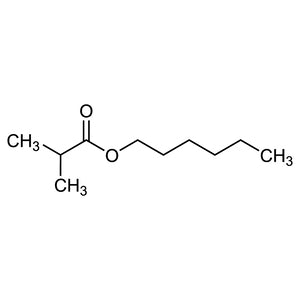
TCI H1919 Hexyl Isobutyrate is an ester formed from isobutyric acid and hexanol, producing a molecule in which a straight six-carbon alkyl chain is joined to a branched acyl group. The compound is widely recognised as a fruity aroma component and has been studied extensively in flavour and fragrance research. In the laboratory it serves several roles: a non-heterocyclic building block for synthetic chemists, a model substrate for studies of ester reactivity, and a reference compound of clearly defined identity in the chromatographic analysis of volatile components.
The characteristic that makes this ester a frequent choice is the branching on the acyl portion, which imposes moderate steric hindrance around the carbonyl group. This property makes it an attractive substrate when researchers wish to test how sensitive a given catalyst or enzyme is to spatial obstruction near the reaction centre. At the same time, the long hexyl chain confers strongly nonpolar character, so the compound dissolves readily in organic solvents and is almost immiscible with water. The ester is also more volatile than longer-chain esters, which means it can be analysed by gas chromatography without complicated sample preparation.
Laboratories in Indonesia draw on these properties in both academic and applied settings. The compound is used in organic synthesis teaching and research, in flavour and fragrance work where fruity ester profiles are of interest, and as a well-characterised comparison standard when volatile components are separated and identified. Its straightforward handling by gas chromatography makes it a practical choice for routine analytical workflows as well as for method development.
Related TCI products
- Organic synthesis building block — the defined ester structure gives synthetic chemists a reliable non-heterocyclic starting material for constructing more elaborate target molecules.
- Ester reactivity studies — the branched acyl group provides moderate steric hindrance near the carbonyl, making it a useful model substrate for probing ester reaction behaviour.
- Catalyst and enzyme screening — researchers use it to assess how strongly a catalyst or enzyme is affected by spatial obstruction close to the reaction centre.
- Gas chromatography reference compound — its clear identity and ready volatility allow it to serve as a comparison standard in volatile component analysis without complex sample pretreatment.
- Flavour and fragrance research — as a recognised fruity aroma component, it supports laboratory work on aroma profiles and the characterisation of ester-based scent contributions.
| Brand | TCI |
|---|---|
| CAS number | 2349-07-7 |
| Molecular formula | — |
| Purity | — |
| Category | Chemistry > Building Blocks > Non-Heterocyclic Building Blocks |
| Pack sizes | available in the pack sizes listed for this catalogue item |
| Physical form | organic ester, soluble in organic solvents and essentially immiscible with water |
| Storage | keep in a closed container under the conditions stated by the manufacturer |
Store the container tightly closed in a cool, well-ventilated area away from heat, direct sunlight, and sources of ignition, following the conditions stated by the manufacturer. Glass bottles with chemically resistant closures are suitable, since the material is a nonpolar organic ester; keep it away from strong oxidising agents. Because the compound is volatile, handle and dispense it inside a fume hood to limit vapour exposure, and use gloves, safety glasses, and a laboratory coat. Return containers to storage promptly after use, label all working aliquots clearly, and consult the manufacturer's safety data sheet before first use.
—
Produk Terkait
-
TrimethylOrthoisobutyrate TCI T2208
Regular price Rp 2.411.850,00Regular price -
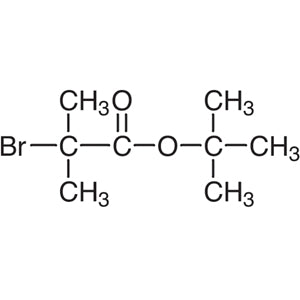
tert-Butyl2-Bromoisobutyrate TCI B3500
Regular price From Rp 584.850,00Regular price -
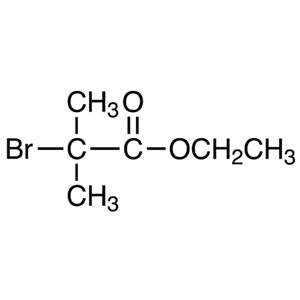
Ethyl2-Bromoisobutyrate TCI B0606
Regular price Rp 717.150,00Regular price -
2,2,4-Trimethyl-1,3-pentanediolDiisobutyrate TCI T0997
Regular price From Rp 477.750,00Regular price -
2-PhenylethylIsobutyrate TCI P2008
Regular price From Rp 795.900,00Regular price -
2-PhenoxyethylIsobutyrate TCI P1822
Regular price From Rp 477.750,00Regular price -
2-MethylbutylIsobutyrate TCI M3483
Regular price Rp 1.749.300,00Regular price -
Methyl3-Methoxyisobutyrate TCI M1191
Regular price From Rp 875.700,00Regular price