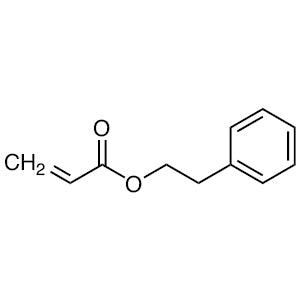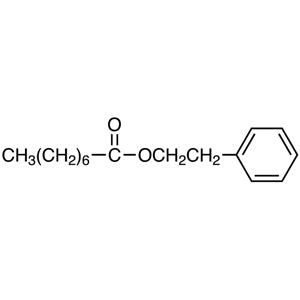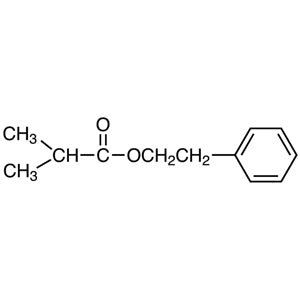
2-Phenylethyl Isobutyrate from TCI is an ester formed from isobutyric acid and 2-phenylethanol. It is a non-heterocyclic aromatic ester, well known in the fragrance and flavour industries for its fruity aroma with rosy notes. In the laboratory, this ester serves as a simple building block, an analytical standard for volatile compound analysis, and a research material for aroma formulation work and esterification studies. Its well-defined structure makes it a practical choice for both synthetic and analytical laboratories.
Researchers choose this compound because its structure is simple and clear: an aromatic phenylethyl portion and a branched isobutyryl portion joined by an ester bond. As a volatile ester, it is well suited to analysis by gas chromatography and mass spectrometry, so it works as a reference compound when identifying aroma components in complex samples. The ester bond can be hydrolysed or transesterified. This also makes the compound a useful model for studying ester reactions and the activity of lipase or esterase enzymes, where a clean, single-ester substrate gives results that are easy to interpret.
In Indonesia, this material is relevant to food technology laboratories, analytical chemistry laboratories, and essential oil research groups. It also supports the country's growing fragrance and cosmetic product development sector. University research groups studying natural aromas, quality control teams checking flavour and fragrance ingredients, and formulation chemists developing new scent profiles can all use this compound. The 25mL pack suits analytical standard preparation, small-scale sensory testing, and routine laboratory research.
Related TCI products
- Analytical reference standard: its volatility and defined structure make it a dependable comparison compound when identifying aroma components by gas chromatography and mass spectrometry.
- Volatile compound analysis: food technology and essential oil laboratories can use it to check retention behaviour and spectral matching when profiling fruity and floral aroma fractions.
- Aroma formulation research: its fruity aroma with rosy notes lets fragrance and cosmetic developers test it as a model ingredient in experimental scent formulations and sensory evaluations.
- Esterification and hydrolysis studies: its single ester bond can be hydrolysed or transesterified, so it is an easy model for teaching and studying fundamental ester reaction chemistry.
- Enzyme activity studies: it is a suitable model substrate for lipase or esterase assays, because cleavage of the ester bond gives products that are simple to track and interpret.
| Brand | TCI (product code P2008) |
|---|---|
| CAS number | 103-48-0 |
| Molecular formula | — |
| Purity | — |
| Category | Chemistry > Building Blocks > Non-Heterocyclic Building Blocks |
| Pack sizes | 25mL |
| Physical form | Liquid (supplied by volume) |
| Storage | Keep the container tightly closed in a cool, dry, well-ventilated place, following the supplier's label and Safety Data Sheet |
Store 2-Phenylethyl Isobutyrate in its original tightly sealed container, in a cool, dry, well-ventilated area away from direct sunlight, heat sources, and open flames. As a volatile organic ester, it should be kept away from strong oxidising agents, strong acids, and strong bases, which can break down the ester bond. When you transfer it, use clean glass or other chemically compatible containers and label them clearly. Handle it in a fume hood or well-ventilated area, and wear standard laboratory protective equipment, including safety glasses, chemical-resistant gloves, and a lab coat. Avoid inhaling vapours and contact with skin and eyes. Always read the product label and the Safety Data Sheet for full storage conditions, hazard information, and disposal guidance before use.
—
Produk Terkait
-
2-PhenylethylAcetate TCI A0692
Regular price From Rp 769.650,00Regular priceRp 537.600,00Sale price From Rp 769.650,00 -
N-(1-Phenylethyl)acetamide TCI P3170
Regular price From Rp 1.087.800,00Regular priceRp 775.950,00Sale price From Rp 1.087.800,00 -
2-PhenylethylAcrylate TCI P2888
Regular price From Rp 1.538.250,00Regular priceRp 1.075.200,00Sale price From Rp 1.538.250,00 -
2-Phenylethyln-Octanoate TCI P2741
Regular price From Rp 1.351.350,00Regular priceRp 960.750,00Sale price From Rp 1.351.350,00 -
2-PhenylethylMethacrylate(stabilizedwithHQ) TCI P2714
Regular price From Rp 1.298.850,00Regular priceRp 908.250,00Sale price From Rp 1.298.850,00 -
2-PhenylethylPropionate TCI P1823
Regular price Rp 742.350,00Regular priceRp 534.450,00Sale price Rp 742.350,00 -
N-(2-Phenylethyl)acetamide TCI P1066
Regular price Rp 1.776.600,00Regular priceRp 1.257.900,00Sale price Rp 1.776.600,00 -
IsoamylIsobutyrate TCI I0676
Regular price From Rp 662.550,00Regular priceRp 478.800,00Sale price From Rp 662.550,00