


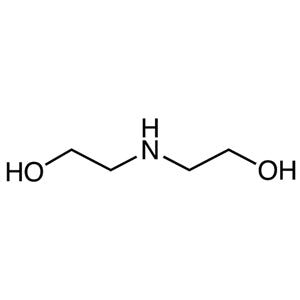
Diethanolamine is a secondary amine that carries two hydroxyethyl groups on a single nitrogen atom, which means the compound behaves both as an amine and as a double alcohol at the same time. This combination of two functional group types makes it a highly productive building block in synthesis laboratories, because the nitrogen can be acylated or alkylated while the two hydroxyl groups can be esterified, etherified, or used as attachment points on polymers. Its moderate basicity also means the compound is widely used as an acid gas absorbent and as a supporting agent in a range of experimental formulations.
The properties that make it a preferred choice are its high polarity and its strong hydrogen bonding capability. The compound mixes well with water and polar solvents, is strongly hygroscopic, and at room temperature is generally a white low-melting solid that readily turns into a viscous liquid when the room warms slightly. That character explains why this product is packaged by weight rather than by volume. The basicity of its nitrogen allows carbon dioxide and hydrogen sulfide to be bound reversibly, while its hydroxyl groups contribute the polarity and hydrogen bonding behaviour that govern how it dissolves and how it interacts with other reagents.
In Indonesian laboratories, this material is typically used in synthetic chemistry groups that assemble non-heterocyclic building blocks, in gas treatment and absorption studies, and in formulation work where a polar, water-miscible amine is required. Because the compound is strongly hygroscopic and softens near ambient temperature, laboratories in warm and humid conditions usually keep it tightly closed and weigh it out promptly, handling it by weight as supplied.
- Amine functionalisation reactions, where the secondary nitrogen serves as a reliable nucleophilic centre that can be acylated or alkylated to build more elaborate non-heterocyclic structures.
- Hydroxyl group derivatisation, since the two hydroxyethyl arms can be esterified or etherified independently, giving synthetic chemists two additional handles on a single small molecule.
- Polymer attachment chemistry, where the compound acts as an attachment point that introduces both an amine and two hydroxyl sites into a growing polymer framework.
- Acid gas absorption studies, because the basicity of the nitrogen allows carbon dioxide and hydrogen sulfide to be bound reversibly under controlled experimental conditions in the laboratory.
- Experimental formulation work, where it functions as a supporting agent and contributes high polarity plus strong hydrogen bonding to water-based and polar solvent systems.
| Brand | TCI |
|---|---|
| CAS number | 111-42-2 |
| Molecular formula | — |
| Purity | — |
| Category | Chemistry > Building Blocks > Non-Heterocyclic Building Blocks |
| Pack sizes | supplied and packaged by weight |
| Physical form | white low-melting solid at room temperature that readily becomes a viscous liquid on slight warming |
| Storage | keep tightly closed, as the material is strongly hygroscopic |
Store the container tightly closed in a cool, dry place away from moisture, since the compound is strongly hygroscopic and will absorb water from humid laboratory air. Because the material softens and turns viscous when the room warms slightly, keep it away from heat sources and warm storage areas so that it remains easy to weigh out. Use tightly sealing containers that resist moisture ingress, and reclose them immediately after each withdrawal. Handle the material as a basic amine, using gloves, eye protection, and a laboratory coat, and work in a well ventilated area or fume hood to avoid contact with skin and eyes.
—
Produk Terkait
-
DiethanolamineHydrochloride TCI I0009
Regular price From Rp 584.850,00Regular priceRp 408.450,00Sale price From Rp 584.850,00 -
Diethanolamine[MatrixforFABMSandliquidSIMS] TCI S0376
Regular price From Rp 505.050,00Regular priceRp 352.800,00Sale price From Rp 505.050,00 -
TriethanolamineBorate TCI T1291
Regular price From Rp 980.700,00Regular priceRp 701.400,00Sale price From Rp 980.700,00


