

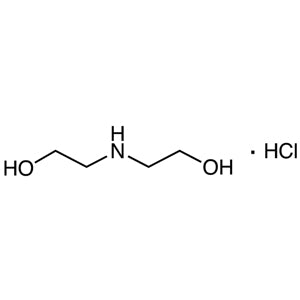
Diethanolamine Hydrochloride is the hydrochloride salt form of diethanolamine, a compound in which the amine nitrogen has been protonated and paired with a chloride ion. This simple change carries significant practical consequences in the laboratory: where the free amine is a sticky, hygroscopic material that resists accurate weighing, the salt form presents as a crystalline solid that is far easier to handle, weigh, and store. For this reason, the compound is frequently chosen when researchers require a source of diethanolamine with reliable stoichiometry and cleaner handling throughout the workflow.
The properties that make this material a preferred choice are its stability and its measurability. In the protonated form, the nitrogen is no longer nucleophilic, so the compound does not readily absorb carbon dioxide from the air and is not prone to oxidation, and the mass weighed out more faithfully reflects the actual quantity of substance present. The salt dissolves readily in water and produces a weakly acidic solution; the free amine can be regenerated whenever it is needed simply by adding a sufficient quantity of base. Both hydroxyl groups remain intact and available for esterification reactions or for anchoring onto polymer matrices.
In Indonesian laboratories, this material fits naturally into synthetic and preparative work where a defined, easily weighed source of diethanolamine is needed. It is used in academic research groups, institutional chemistry laboratories, and industrial development units that prepare building blocks for further transformation. Its crystalline nature suits routine bench practice in warm and humid working conditions, where a hygroscopic free amine would be difficult to manage, and it allows preparations to be repeated with consistent results.
- Non-heterocyclic building block synthesis: the intact hydroxyl groups and defined stoichiometry allow the compound to be introduced into multi-step preparations with predictable molar quantities and cleaner reaction control.
- Controlled generation of free diethanolamine: adding a suitable base liberates the free amine in situ, giving researchers the reactive species only at the moment it is actually required in the procedure.
- Esterification chemistry: both hydroxyl functions remain available for reaction with acids and acid derivatives, making the salt a convenient source of a difunctional alcohol fragment for ester formation.
- Polymer matrix functionalization: the two hydroxyl groups provide anchoring points for binding the diethanolamine unit onto polymer supports, introducing polar functionality into a prepared material.
- Preparation of aqueous stock solutions: the salt dissolves well in water and yields a weakly acidic solution, supporting the preparation of accurately concentrated working solutions for laboratory use.
| Brand | TCI |
|---|---|
| CAS number | 14426-21-2 |
| Molecular formula | — |
| Purity | — |
| Category | Chemistry > Building Blocks > Non-Heterocyclic Building Blocks |
| Pack sizes | available in standard TCI research-scale packaging; please confirm the specific size when ordering |
| Physical form | crystalline solid |
| Storage | keep in a tightly closed container in a cool, dry place |
- Product code: I0009
Store the material in a tightly closed container in a cool, dry place, away from direct sunlight and from sources of heat or moisture. Original supplier containers or well-sealed glass or chemically compatible plastic bottles are suitable; close the container promptly after each use to limit exposure to atmospheric humidity. Handle the solid in a well-ventilated area or within a fume hood, and wear standard laboratory personal protective equipment including gloves, safety goggles, and a laboratory coat. Avoid contact with skin and eyes and avoid inhaling dust when weighing or transferring the material. Note that aqueous solutions of this salt are weakly acidic, and that base addition will liberate the free amine, so plan neutralization and waste handling accordingly. Always consult the manufacturer's safety data sheet before use.
—
Produk Terkait
-
Diethanolamine TCI I0008
Regular price From Rp 477.750,00Regular price -
Diethanolamine[MatrixforFABMSandliquidSIMS] TCI S0376
Regular price From Rp 505.050,00Regular price -
TriethanolamineBorate TCI T1291
Regular price From Rp 928.200,00Regular price
![111-42-2 Diethanolamine [Matrix for FABMS and liquid SIMS] - AMI Scientific](http://amiscientific.com/cdn/shop/files/TCI2510S0376.jpg?v=1769181247&width=533)
