

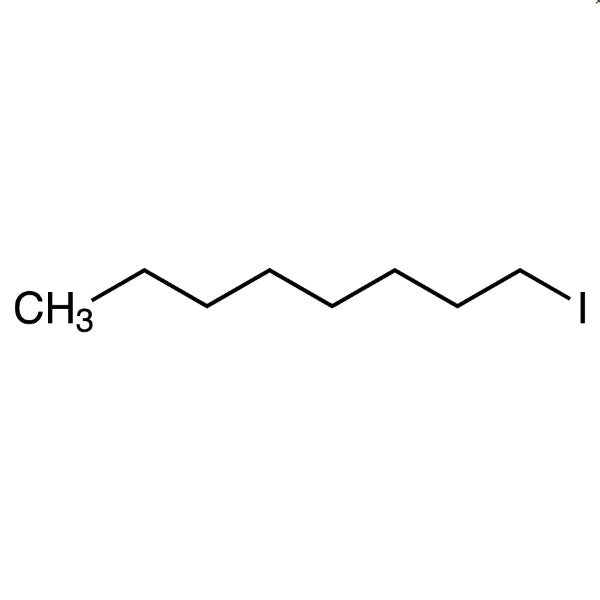
1-Iodooctane is a chemical compound widely used in laboratory settings as a fundamental building block for various organic synthesis reactions. It serves as a versatile reagent in chemical processes due to its unique molecular structure, which consists of a long hydrocarbon chain terminated by an iodide group. This structure allows it to participate in multiple reaction types, making it a valuable tool for chemists working on complex molecule synthesis. Its role in laboratory research is critical, especially in applications requiring high reactivity and stability under controlled conditions.
The compound is known for its chemical stability, particularly when stabilized with a copper chip, which prevents unwanted decomposition or oxidation. This stabilization ensures that the material remains effective over extended periods, even in environments where it might otherwise degrade. Additionally, its non-polar nature and high boiling point make it suitable for a range of chemical processes, including heating and evaporation steps. These properties make it a preferred choice for researchers aiming to maintain precision and consistency in their experiments.
In Indonesian laboratories, 1-Iodooctane is commonly used in organic chemistry research, particularly in nucleophilic substitution reactions and alkylating agents. Its stability and reactivity make it an essential component in the synthesis of heterocyclic compounds and other complex organic structures. The presence of a copper chip in the packaging further enhances its safety and reliability, ensuring it meets the high standards of quality control required in scientific research environments.
TCI brochures (PDF)
- Building Blocks for Organic Semiconductor 2026-03-24 · p. 41
Related TCI products
- TCI I0511 4292-19-7 1-Iodododecane (stabilized with Copper chip)
- TCI I0494 2050-77-3 1-Iododecane (stabilized with Copper chip)
- TCI I0493 4282-42-2 1-Iodononane (stabilized with Copper chip)
- TCI I0320 4282-40-0 1-Iodoheptane (stabilized with Copper chip)
- TCI I0066 628-17-1 1-Iodopentane (stabilized with Copper chip)
- TCI I0059 638-45-9 1-Iodohexane (stabilized with Copper chip)
- Nucleophilic Substitution Reactions: 1-Iodooctane is ideal for these reactions due to its high reactivity and stability, allowing for efficient substitution of iodide with other nucleophiles.
- Alkylating Agent in Organic Synthesis: The compound serves as a reliable alkylating agent, facilitating the introduction of alkyl groups into organic molecules with high selectivity.
- Heterocyclic Compound Synthesis: Its iodide group enables the formation of heterocyclic structures, making it a key reagent in the synthesis of complex organic compounds.
- Controlled Oxidation Reactions: The copper chip stabilizer prevents unwanted oxidation, ensuring the compound remains effective in controlled oxidation processes.
- Solvent in High-Temperature Reactions: Its high boiling point makes it suitable for use as a solvent in reactions requiring elevated temperatures without decomposition.
| Brand | TCI |
|---|---|
| CAS number | 629-27-6 |
| Molecular formula | — |
| Purity | — |
| Category | Chemistry > Building Blocks > Non-Heterocyclic Building Blocks |
| Pack sizes | Available in various sizes as per supplier specifications |
| Physical form | Liquid |
| Storage | Store in a cool, dark place with the copper chip included to maintain stability |
Data from the TCI brochure
| Stabilisasi | stabilized with Copper chip |
|---|
Source: TCI brochure F2032 (2026-03-24)
1-Iodooctane should be stored in a cool, dark location to prevent degradation and maintain its stability. The copper chip included in the packaging is essential for preventing oxidation and decomposition, so it must remain intact during storage. It is recommended to use airtight containers made of materials resistant to chemical reactions, such as glass or stainless steel. Avoid exposure to heat, light, and air to preserve its chemical integrity. In laboratory settings, always handle the compound with appropriate safety measures, including gloves and ventilation, to ensure safe usage. Regular monitoring of storage conditions is advised to maintain the quality and effectiveness of the material in research applications.
—
Product Categories
Produk Terkait
-
1-Iodododecane(stabilizedwithCopperchip) TCI I0511
Regular price Rp 1.618.050,00Regular price -
1-Iododecane(stabilizedwithCopperchip) TCI I0494
Regular price Rp 1.378.650,00Regular price -
1-Iodononane(stabilizedwithCopperchip) TCI I0493
Regular price Rp 1.565.550,00Regular price -
1-Iodoheptane(stabilizedwithCopperchip) TCI I0320
Regular price From Rp 557.550,00Regular price -
1-Iodopentane(stabilizedwithCopperchip) TCI I0066
Regular price From Rp 1.538.250,00Regular price -
1-Iodohexane(stabilizedwithCopperchip) TCI I0059
Regular price From Rp 1.167.600,00Regular price -
1-Iodobutane(stabilizedwithCopperchip) TCI I0055
Regular price From Rp 557.550,00Regular price -
1,8-Diiodooctane(stabilizedwithCopperchip) TCI D2158
Regular price From Rp 1.035.300,00Regular price


