

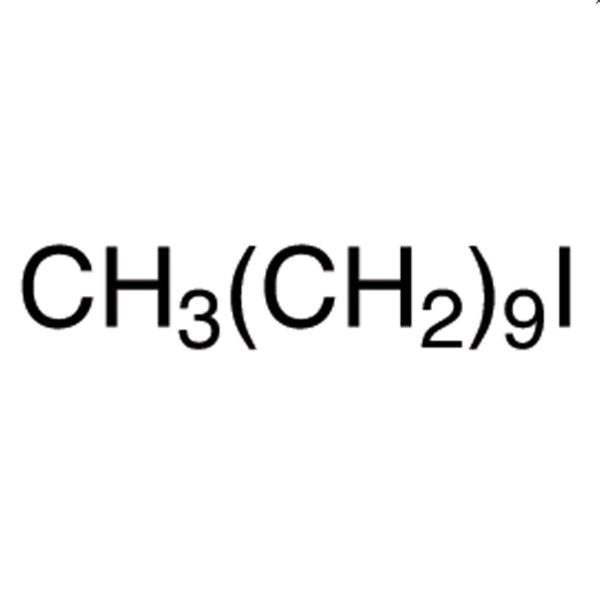
1-Iododecane is a chemical compound widely used in organic reactions as a building block or reagent. It serves as a valuable resource for chemists seeking to introduce iodine functionality into molecular structures. This compound is particularly useful in synthetic pathways where iodine-based reactivity is required. Its long alkyl chain and terminal iodine group make it a versatile reagent for substitution reactions and other organic transformations. In the laboratory, it plays a crucial role in the synthesis of complex molecules, especially in research settings where controlled reactivity is essential.
The properties of 1-Iododecane make it a preferred choice for many applications. It is stabilized with a copper chip, enhancing its stability under certain conditions. This stabilization significantly reduces its reactivity compared to other iodinated compounds, making it safer and more efficient for use in laboratory settings. Additionally, its high boiling point facilitates heating and separation processes during chemical reactions. These characteristics ensure that it remains a reliable and effective reagent in both academic and industrial research environments.
In Indonesian laboratories, 1-Iododecane is commonly used in organic chemistry research, especially in higher education institutions and research centers. Its availability, quality, and stability make it a popular choice among researchers. It is often selected for its ability to participate in various synthetic reactions without compromising the integrity of the final product. Its role in the development of new chemical compounds underscores its importance in the field of chemistry in Indonesia.
- Organic synthesis reactions benefit from 1-Iododecane due to its stable iodine functionality, which enables controlled substitution processes.
- It is ideal for cross-coupling reactions where iodine-based reactivity is required, enhancing the efficiency of synthetic pathways.
- In polymer chemistry, 1-Iododecane can be used as a chain-extending agent, contributing to the formation of complex polymer structures.
- Its high boiling point makes it suitable for distillation and purification processes in reaction mixtures.
- It is frequently used in mechanistic studies to investigate the behavior of iodine-containing compounds under various reaction conditions.
| Brand | TCI |
|---|---|
| CAS number | 2050-77-3 |
| Molecular formula | — |
| Purity | — |
| Category | Chemistry > Building Blocks > Non-Heterocyclic Building Blocks |
| Pack sizes | Available in various quantities as per supplier specifications |
| Physical form | Liquid |
| Storage | Store in a cool, dry place away from direct sunlight and incompatible materials |
1-Iododecane should be stored in a cool, dry environment, away from direct sunlight and sources of heat. It is recommended to keep it in a sealed container made of materials compatible with organic solvents, such as glass or high-density polyethylene. Due to its stability with a copper chip, it is less reactive than other iodinated compounds, but standard laboratory safety precautions should still be followed. Avoid contact with incompatible substances, and ensure proper ventilation in the workspace. Always handle it with appropriate personal protective equipment, including gloves and safety goggles, to minimize exposure risk.
—
Produk Terkait
-
1-Iodododecane(stabilizedwithCopperchip) TCI I0511
Regular price Rp 1.618.050,00Regular price -
1-Iodononane(stabilizedwithCopperchip) TCI I0493
Regular price Rp 1.565.550,00Regular price -
1-Iodooctane(stabilizedwithCopperchip) TCI I0321
Regular price From Rp 823.200,00Regular price -
1-Iodoheptane(stabilizedwithCopperchip) TCI I0320
Regular price From Rp 557.550,00Regular price -
1-Iodopentane(stabilizedwithCopperchip) TCI I0066
Regular price From Rp 1.538.250,00Regular price -
1-Iodohexane(stabilizedwithCopperchip) TCI I0059
Regular price From Rp 1.167.600,00Regular price -
1-Iodobutane(stabilizedwithCopperchip) TCI I0055
Regular price From Rp 557.550,00Regular price -
1-Bromododecane TCI B0587
Regular price From Rp 505.050,00Regular price


