

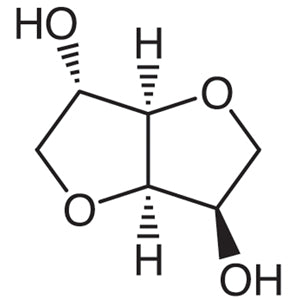
Isosorbide is a chemical compound widely used in scientific and industrial applications. As a derivative of sorbitol, it possesses a unique molecular structure that allows for versatile chemical reactions. In the laboratory, Isosorbide serves as a key building block in the synthesis of complex compounds, particularly in the fields of organic chemistry and biochemistry. Its ability to interact with various reagents makes it a preferred choice for researchers requiring molecular modification. Isosorbide is valued for its chemical stability and its capacity to transform into different molecular forms through specific chemical reactions. These properties make it highly suitable for synthesis and molecular modification processes.
Isosorbide is known for its chemical stability and compatibility with a wide range of reagents, which makes it a reliable material for laboratory use. Its non-toxic nature at normal concentrations ensures a relatively safe working environment in laboratories. This compound is also resistant to degradation under standard laboratory conditions, enhancing its usability in long-term research projects. Its versatility in chemical reactions and predictable behavior in different environments further solidify its position as a preferred material in chemical research.
In Indonesian laboratories, Isosorbide is commonly used in chemical and biochemical research, particularly in higher education institutions and research organizations. It plays a vital role in the development of new compounds and the study of molecular structures. Its availability and reliability make it a standard component in many laboratory protocols, supporting both academic and industrial research efforts.
TCI brochures (PDF)
- Reagents for Glyco Chemistry & Biology 5th Edition · p. 124
- Pharmaceutical Ingredients for Research and Experimental Use 2026-03-09 · p. 45
- Organic synthesis applications benefit from Isosorbide’s ability to participate in diverse chemical reactions, making it ideal for creating complex molecular structures.
- Biochemical research utilizes Isosorbide due to its compatibility with biological systems and its role in modifying molecular frameworks for drug development.
- Glycoscience studies rely on Isosorbide as a building block for carbohydrate-based compounds, supporting research in carbohydrate chemistry and related fields.
- Industrial chemical processes incorporate Isosorbide for its stability and reactivity, enabling the production of specialty chemicals and pharmaceutical intermediates.
- Analytical chemistry applications use Isosorbide as a standard compound for calibration and as a reference material in various analytical techniques.
| Brand | TCI |
|---|---|
| CAS number | 652-67-5 |
| Molecular formula | — |
| Purity | — |
| Category | Chemistry > Chemical Biology > Glycoscience |
| Pack sizes | Available in various quantities as per supplier specifications |
| Physical form | Solid, typically in crystalline form |
| Storage | Store in a cool, dry place away from direct sunlight and moisture |
Isosorbide should be stored in a cool, dry environment to maintain its chemical stability. It is recommended to keep it in airtight containers to prevent exposure to moisture and air, which may affect its integrity. Due to its non-toxic nature, it is generally safe to handle, but standard laboratory safety protocols should still be followed. Avoid direct contact with skin and eyes, and ensure proper ventilation when working with larger quantities. Isosorbide is stable under normal laboratory conditions, making it suitable for long-term storage as long as it is protected from environmental factors that could compromise its quality.
—
Product Categories
- GlycoscienceSugars (Other) [Glycoscience]
- Biochemicals and ReagentsCarbohydrates
- Biochemicals and ReagentsPharmaceutical Research Reagents (for Experimental Use)Pharmaceutical Research Reagents (Others)
- Pharmaceutical Development and Drug Discovery ResearchPharmaceutical Research Reagents (for Experimental Use)Pharmaceutical Research Reagents (Others)
Produk Terkait
-
Tobramycin TCI T2503
Regular price From Rp 2.889.600,00Regular price -
StreptomycinSulfate TCI S0585
Regular price From Rp 769.650,00Regular price -
ParomomycinSulfate TCI P2092
Regular price From Rp 1.035.300,00Regular price -
KanamycinMonosulfate TCI K0047
Regular price Rp 1.220.100,00Regular price -
GentamicinSulfate TCI G0383
Regular price From Rp 1.936.200,00Regular price -
L-Threitol TCI T1647
Regular price Rp 3.392.550,00Regular price -
StreptomycinSulfate[forProteinResearch] TCI S0834
Regular price From Rp 505.050,00Regular price -
SucroseFattyAcidEster TCI S0112
Regular price From Rp 610.050,00Regular price
![3810-74-0 Streptomycin Sulfate [for Protein Research] - AMI Scientific](http://amiscientific.com/cdn/shop/files/TCI2510S0834.jpg?v=1767139030&width=533)