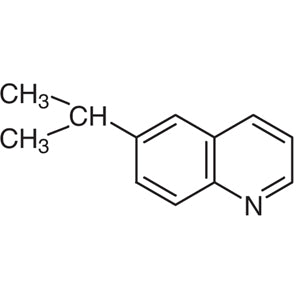
6-Isopropylquinoline is a chemical compound classified under the heterocyclic category, commonly used as a building block in the synthesis of complex compounds. This versatile compound plays a crucial role in organic chemistry laboratories, where it serves as a foundational element for the development of new substances. Its unique molecular structure enables a variety of chemical reactions, including substitution, oxidation, and reduction, making it a valuable tool for researchers. In the context of laboratory work, it is particularly useful for creating novel compounds with specific functional groups and properties.
The compound’s stability and controlled reactivity make it a preferred choice for various chemical applications. It exhibits non-polar characteristics and has low solubility in water, which facilitates separation and purification processes in synthesis. These properties are advantageous in techniques such as extraction and chromatography, where precise control over solubility and reactivity is essential. Its chemical inertness under certain conditions also allows it to be used in a wide range of experimental setups without unwanted side reactions.
In Indonesian laboratories, 6-Isopropylquinoline is widely utilized in organic chemistry and pharmaceutical research. It is an essential component in the development of new drug compounds and in the study of molecular structures and reactivity of heterocyclic compounds. Its availability in the local market supports ongoing research efforts, ensuring that scientists have access to the necessary materials for their experiments.
Related TCI products
- Organic synthesis applications benefit from 6-Isopropylquinoline due to its ability to participate in diverse chemical reactions, enabling the creation of complex molecular structures.
- Pharmaceutical research utilizes this compound as a building block for the development of new drug molecules, leveraging its unique chemical properties.
- Heterocyclic compound studies rely on 6-Isopropylquinoline to investigate the behavior and reactivity of such structures in various chemical environments.
- Extraction and purification processes benefit from its low water solubility, allowing for efficient separation and isolation of target compounds.
- Chromatographic analysis uses the compound’s non-polar nature to aid in the identification and characterization of organic substances.
| Brand | TCI |
|---|---|
| CAS number | 135-79-5 |
| Molecular formula | — |
| Purity | — |
| Category | Chemistry > Building Blocks > Heterocyclic Building Blocks |
| Pack sizes | Available in standard laboratory quantities |
| Physical form | Solid |
| Storage | Store in a cool, dry place away from direct sunlight |
6-Isopropylquinoline should be stored in a cool, dry environment to maintain its chemical stability and prevent degradation. It is recommended to keep the compound in a sealed container to minimize exposure to moisture and air, which could affect its reactivity. Suitable storage containers include glass or high-density polyethylene (HDPE) bottles with tight-fitting lids. In laboratory settings, it is important to handle the compound with care, using appropriate personal protective equipment such as gloves and safety goggles. Due to its non-polar nature, it is advisable to store it separately from reactive or incompatible substances to avoid potential chemical interactions. Proper labeling and storage conditions ensure the safety and integrity of the compound during handling and use.
—
Produk Terkait
-
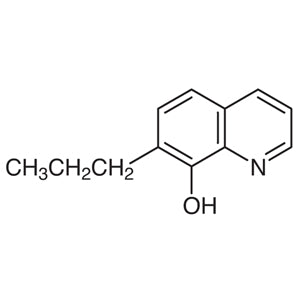
8-Hydroxy-7-propylquinoline TCI P0531
Regular price From Rp 4.877.250,00Regular price -
6-tert-Butylquinoline TCI B2985
Regular price Rp 4.506.600,00Regular price -
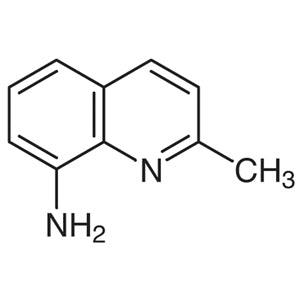
8-Amino-2-methylquinoline TCI A0416
Regular price From Rp 1.273.650,00Regular price -
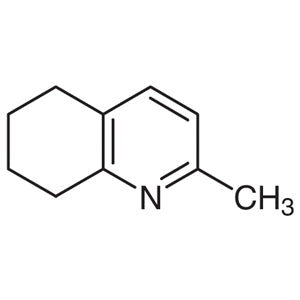
5,6,7,8-Tetrahydro-2-methylquinoline TCI T1408
Regular price Rp 2.016.000,00Regular price -
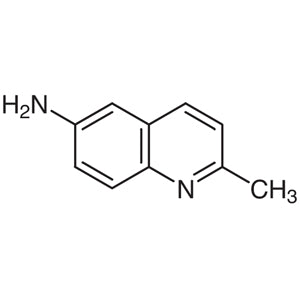
6-Amino-2-methylquinoline TCI A1047
Regular price Rp 3.976.350,00Regular price -
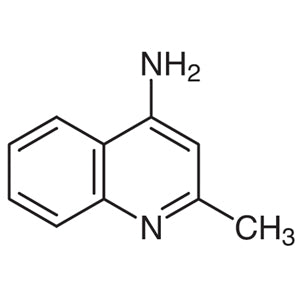
4-Amino-2-methylquinoline TCI A0415
Regular price Rp 3.207.750,00Regular price -
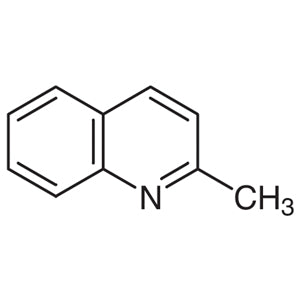
2-Methylquinoline TCI Q0005
Regular price From Rp 452.550,00Regular price -
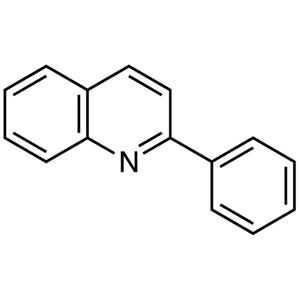
2-Phenylquinoline TCI P2057
Regular price From Rp 1.881.600,00Regular price