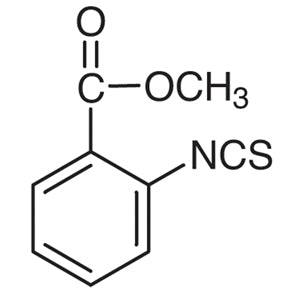
TCI I0574 Methyl 2-Isothiocyanatobenzoate is a bifunctional non-heterocyclic building block that carries two reactive groups on a single benzene ring: an isothiocyanate group and a methyl ester group positioned ortho to one another. This ortho arrangement is precisely what makes the compound so valuable in organic synthesis laboratories. Once the isothiocyanate group reacts with a nitrogen nucleophile, the ester group sitting directly beside it can immediately participate in an intramolecular reaction and close the ring. In this way, a single reagent can deliver a complete heterocyclic framework through simple reactions, often in one pot.
The property that makes this material a preferred choice is the high yet directed reactivity of the isothiocyanate group. The central carbon of the N=C=S group is strongly electrophilic, so it is readily attacked by primary and secondary amines, hydrazines, alcohols, and thiols, producing thioureas, thiosemicarbazides, thiocarbamates, or dithiocarbamates. These reactions generally proceed at mild temperatures without requiring complicated catalysts, and their conversion is easy to monitor. The methyl ester group meanwhile provides an additional handle for hydrolysis and further transformation, giving chemists a second point of control over the molecular scaffold.
In Indonesian laboratories, this building block is typically used in academic and industrial research settings where heterocyclic scaffolds are assembled for exploratory synthesis. It suits university organic chemistry groups, medicinal chemistry research programmes, and contract research laboratories that prepare compound libraries. Because the reactions involved are straightforward and run under mild conditions, the reagent fits well into standard bench-scale workflows supported by common glassware, stirring, and routine reaction monitoring equipment.
Related TCI products
- TCI A3088 1762-95-4 Ammonium Thiocyanate
- TCI G0230 593-84-0 Guanidine Thiocyanate
- TCI T2461 1645-65-4 4-(Trifluoromethyl)phenyl Isothiocyanate
- TCI T2460 1840-19-3 3-(Trifluoromethyl)phenyl Isothiocyanate
- TCI T2459 1743-86-8 2-(Trifluoromethyl)phenyl Isothiocyanate
- TCI B4091 344790-87-0 1-Butyl-3-methylimidazolium Thiocyanate
- Heterocycle construction: the ortho ester allows intramolecular ring closure immediately after the isothiocyanate reacts, delivering complete heterocyclic frameworks from a single reagent.
- Thiourea synthesis: the strongly electrophilic N=C=S carbon reacts readily with primary and secondary amines under mild conditions, giving thioureas without complex catalysts.
- Thiosemicarbazide preparation: hydrazines add cleanly to the isothiocyanate centre, producing thiosemicarbazides that serve as intermediates toward further heterocyclic ring systems.
- Thiocarbamate and dithiocarbamate formation: alcohols and thiols attack the isothiocyanate group directly, generating thiocarbamates or dithiocarbamates in straightforward, easily monitored transformations.
- Medicinal chemistry scaffold building: the two orthogonal reactive handles let researchers vary substituents systematically while assembling compound libraries around a single benzene core.
| Brand | TCI |
|---|---|
| CAS number | 16024-82-1 |
| Molecular formula | — |
| Purity | — |
| Category | Chemistry > Building Blocks > Non-Heterocyclic Building Blocks |
| Pack sizes | available in standard TCI catalogue pack sizes; please confirm the current option when ordering. |
| Physical form | — |
| Storage | keep in a tightly closed original container, protected from moisture, in a cool and well-ventilated area. |
- Catalogue number: I0574
Store the material in its original tightly closed container in a cool, dry, and well-ventilated place, away from direct sunlight and sources of heat or ignition. Isothiocyanates are moisture sensitive and reactive toward nucleophiles, so containers should be kept sealed and handled under dry conditions where possible; avoid contact with amines, alcohols, and other incompatible reagents during storage. All handling should take place in a fume hood using appropriate personal protective equipment, including safety goggles, chemical-resistant gloves, and a laboratory coat. Avoid inhalation of vapours and any contact with skin or eyes. Always consult the manufacturer's safety data sheet before use, and dispose of residues and contaminated materials according to applicable laboratory waste procedures.
—
Produk Terkait
-
AmmoniumThiocyanate TCI A3088
Regular price From Rp 505.050,00Regular price -
GuanidineThiocyanate TCI G0230
Regular price From Rp 505.050,00Regular price -
4-(Trifluoromethyl)phenylIsothiocyanate TCI T2461
Regular price From Rp 689.850,00Regular price -
3-(Trifluoromethyl)phenylIsothiocyanate TCI T2460
Regular price Rp 1.246.350,00Regular price -
2-(Trifluoromethyl)phenylIsothiocyanate TCI T2459
Regular price From Rp 823.200,00Regular price -
1-Butyl-3-methylimidazoliumThiocyanate TCI B4091
Regular price From Rp 1.115.100,00Regular price -
1,3-Bis(2-isocyanato-2-propyl)benzene TCI B1442
Regular price From Rp 1.298.850,00Regular price -
Lead(II)Thiocyanate TCI L0365
Regular price From Rp 1.220.100,00Regular price