

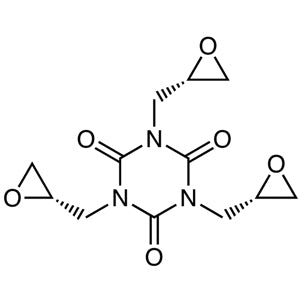
(S,S,S)-Triglycidyl Isocyanurate is a chiral building block widely used in asymmetric synthesis and organic chemistry research. This compound plays a crucial role in the development of optically active molecules, which are essential in pharmaceutical and materials science applications. Its complex molecular structure enables the formation of compounds with high optical activity, making it a valuable tool for chemists seeking to control stereochemistry in synthetic pathways. In the laboratory, it serves as a versatile reagent that supports the creation of complex molecular architectures with precise stereochemical control.
The compound is known for its chemical stability and reactivity under various reaction conditions. Its unique molecular structure, consisting of three glycidyl units and one isocyanate group, allows it to participate in a range of reactions, including Michael additions and asymmetric couplings. These properties make it an ideal choice for researchers aiming to achieve specific stereochemical outcomes in their synthetic processes. Its ability to maintain structural integrity while being reactive under controlled conditions ensures reliable performance in laboratory settings.
In Indonesian laboratories, (S,S,S)-Triglycidyl Isocyanurate is commonly used in organic chemistry research, particularly in the field of asymmetric synthesis. It is a preferred material for studies involving chiral molecule construction and the development of optically active compounds. Its application is widespread in academic and industrial research settings where precise control over molecular structure is required.
TCI brochures (PDF)
- Chiral Building Blocks 2025-04-14 · p. 5
Related TCI products
- TCI I0580 240408-78-0 (R,R,R)-Triglycidyl Isocyanurate
- TCI I0428 2451-62-9 Triglycidyl Isocyanurate
- TCI T0674 839-90-7 Tris(2-hydroxyethyl) Isocyanurate
- TCI I0409 5320-25-2 Diallyl Propyl Isocyanurate (stabilized with BHT)
- TCI I0304 6294-79-7 Diallyl Isocyanurate
- TCI I0279 1025-15-6 Triallyl Isocyanurate (stabilized with BHT)
- Asymmetric Synthesis: This compound is ideal for creating optically active molecules due to its chiral structure and reactivity in asymmetric reactions.
- Organic Chemistry Research: It is widely used in the synthesis of complex organic molecules, supporting the development of new chemical compounds with specific stereochemistry.
- Chiral Building Block Applications: Its molecular framework allows for the construction of diverse chiral compounds, making it a key reagent in synthetic chemistry.
- Pharmaceutical Development: The compound's ability to form optically active products makes it useful in drug synthesis and related research.
- Molecular Structure Studies: It is employed in investigations requiring precise control over molecular configuration and stereochemistry.
| Brand | TCI |
|---|---|
| CAS number | 240408-81-5 |
| Molecular formula | — |
| Purity | — |
| Category | Chemistry > Asymmetric Synthesis > Chiral Building Blocks |
| Pack sizes | Available in standard laboratory quantities |
| Physical form | Solid |
| Storage | Store in a cool, dry place away from direct sunlight |
This compound should be stored in a cool, dry environment to maintain its chemical stability. It is recommended to keep it in a sealed container to prevent exposure to moisture and air. Due to its reactivity, it should be handled in a well-ventilated area, and appropriate personal protective equipment should be worn. Avoid contact with incompatible substances to ensure safe laboratory practices. Proper storage conditions help preserve its structural integrity and reactivity for extended use in research applications.
—
Product Categories
- Asymmetric SynthesisChiral Building BlocksChiral Non-Heterocyclic Building Blocks
- Asymmetric SynthesisChiral Building BlocksChiral Heterocyclic Building Blocks
- Building BlocksChiral Building BlocksChiral Non-Heterocyclic Building Blocks
- Building BlocksChiral Building BlocksChiral Heterocyclic Building Blocks
Produk Terkait
-
(R,R,R)-TriglycidylIsocyanurate TCI I0580
Regular price Rp 1.856.400,00Regular price -
TriglycidylIsocyanurate TCI I0428
Regular price From Rp 795.900,00Regular price -
Tris(2-hydroxyethyl)Isocyanurate TCI T0674
Regular price From Rp 477.750,00Regular price -
DiallylPropylIsocyanurate(stabilizedwithBHT) TCI I0409
Regular price Rp 5.672.100,00Regular price -
DiallylIsocyanurate TCI I0304
Regular price Rp 5.539.800,00Regular price -
TriallylIsocyanurate(stabilizedwithBHT) TCI I0279
Regular price From Rp 689.850,00Regular price -
Tris[2-(3-mercaptopropionyloxy)ethyl]Isocyanurate TCI T3484
Regular price From Rp 955.500,00Regular price -
Tris(2-carboxyethyl)Isocyanurate TCI T0675
Regular price Rp 689.850,00Regular price




![36196-44-8 Tris[2-(3-mercaptopropionyloxy)ethyl] Isocyanurate - AMI Scientific](http://amiscientific.com/cdn/shop/files/TCI2510T3484.jpg?v=1767144153&width=533)
