

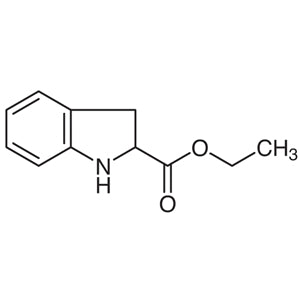
Ethyl Indoline-2-carboxylate is a chemical compound widely used in organic synthesis reactions within laboratory settings. As a heterocyclic building block, it contains a nitrogen atom within its ring structure, making it a valuable component in the development of complex organic molecules. This compound is commonly utilized in research fields such as pharmacology and organic chemistry due to its structural versatility and reactivity. Its unique chemical framework allows it to participate in various synthetic pathways, enabling the creation of bioactive compounds and pharmaceutical intermediates.
The compound is known for its high reactivity, which facilitates reactions such as acylation and substitution. This reactivity, combined with its chemical stability under controlled conditions, makes it a preferred choice for synthetic chemists. However, it is sensitive to moisture and air exposure, which necessitates careful handling and storage. These properties ensure that it remains a reliable and effective reagent in laboratory applications where precision and consistency are essential.
In Indonesian laboratories, Ethyl Indoline-2-carboxylate is extensively used in organic chemistry research, particularly in academic and research institutions. It plays a critical role in the development of new drug compounds and bioactive materials. Its application is widespread in projects aimed at synthesizing pharmaceuticals and exploring the chemical properties of heterocyclic compounds. Researchers in Indonesia rely on this compound for its reliability and effectiveness in complex synthetic processes.
Related TCI products
- TCI B5847 167484-18-6 Benzyl Spiro[indoline-3,4'-piperidine]-1'-carboxylate
- TCI I0033 496-15-1 Indoline
- TCI D6488 138937-28-7 Indoline-5,6-diol Hydrobromide
- TCI B5501 147804-30-6 tert-Butyl 1-Oxa-6-azaspiro[2.5]octane-6-carboxylate
- TCI B5385 114214-49-2 tert-Butyl 6-Oxa-3-azabicyclo[3.1.0]hexane-3-carboxylate
- TCI B5248 122684-34-8 tert-Butyl 3-Carbamoylpyrrolidine-1-carboxylate
- Organic synthesis research benefits from Ethyl Indoline-2-carboxylate due to its reactivity and structural versatility, enabling the creation of complex molecules.
- Pharmaceutical development utilizes this compound as an intermediate in the synthesis of bioactive compounds and drug candidates.
- Heterocyclic compound studies rely on Ethyl Indoline-2-carboxylate for its nitrogen-containing ring structure, which is essential in understanding molecular behavior.
- Academic research institutions use it extensively in teaching and experimental work to demonstrate synthetic pathways and chemical reactivity.
- Drug discovery projects incorporate this compound to explore new therapeutic agents and chemical modifications for improved pharmacological properties.
| Brand | TCI |
|---|---|
| CAS number | 50501-07-0 |
| Molecular formula | — |
| Purity | — |
| Category | Chemistry > Building Blocks > Heterocyclic Building Blocks |
| Pack sizes | — |
| Physical form | — |
| Storage | Requires protection from moisture and air exposure |
Ethyl Indoline-2-carboxylate should be stored in a cool, dry environment to prevent degradation due to moisture and air exposure. It is recommended to use airtight containers made of glass or polyethylene to maintain its chemical integrity. Laboratory personnel should handle the compound with care, using appropriate personal protective equipment such as gloves and goggles. Storage conditions should be controlled to ensure stability and prevent unwanted reactions. Regular monitoring of storage conditions is essential to maintain the compound's effectiveness for research applications. Proper labeling and secure storage are necessary to avoid contamination and ensure safe handling in the laboratory setting.
—
Produk Terkait
-
BenzylSpiro[indoline-3,4'-piperidine]-1'-carboxylate TCI B5847
Regular price Rp 7.526.400,00Regular price -
Indoline TCI I0033
Regular price From Rp 1.035.300,00Regular price -
Indoline-5,6-diolHydrobromide TCI D6488
Regular price Rp 2.889.600,00Regular price -
tert-Butyl1-Oxa-6-azaspiro[2.5]octane-6-carboxylate TCI B5501
Regular price From Rp 3.021.900,00Regular price -
tert-Butyl6-Oxa-3-azabicyclo[3.1.0]hexane-3-carboxylate TCI B5385
Regular price From Rp 689.850,00Regular price -
tert-Butyl3-Carbamoylpyrrolidine-1-carboxylate TCI B5248
Regular price From Rp 1.060.500,00Regular price -
tert-Butyl2,6-Diazaspiro[3.3]heptane-2-carboxylate TCI B5032
Regular price Rp 3.232.950,00Regular price -
tert-Butyl4-[4-(4,4,5,5-Tetramethyl-1,3,2-dioxaborolan-2-yl)pyrazol-1-yl]piperidine-1-carboxylate TCI B5002
Regular price From Rp 1.696.800,00Regular price
![Benzyl Spiro[indoline-3,4'-piperidine]-1'-carboxylate (CAS 167484-18-6) - TCI B5847 - AMI Scientific](http://amiscientific.com/cdn/shop/files/TCI2510B5847.jpg?v=1767092839&width=533)


![147804-30-6 tert-Butyl 1-Oxa-6-azaspiro[2.5]octane-6-carboxylate - AMI Scientific](http://amiscientific.com/cdn/shop/files/TCI2510B5501_08674994-ba62-46fc-acd1-54c812460ed8.jpg?v=1767862194&width=533)
![114214-49-2 tert-Butyl 6-Oxa-3-azabicyclo[3.1.0]hexane-3-carboxylate - AMI Scientific](http://amiscientific.com/cdn/shop/files/TCI2510B5385_5494a0f2-ca27-4c7c-b2aa-345805a88f08.jpg?v=1767861794&width=533)

![1041026-70-3 tert-Butyl 2,6-Diazaspiro[3.3]heptane-2-carboxylate - AMI Scientific](http://amiscientific.com/cdn/shop/files/TCI2510B5032.jpg?v=1767091949&width=533)
![877399-74-1 tert-Butyl 4-[4-(4,4,5,5-Tetramethyl-1,3,2-dioxaborolan-2-yl)pyrazol-1-yl]piperidine-1-carboxylate - AMI Scientific](http://amiscientific.com/cdn/shop/files/TCI2510B5002_79e00c7c-6778-4604-beae-188e01d7ad50.jpg?v=1767854889&width=533)