

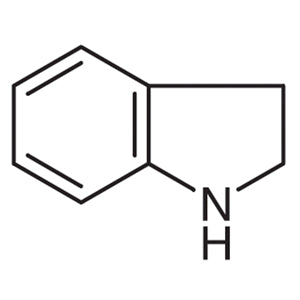
Indoline is a chemical compound classified under the heterocyclic category, commonly used in various chemical reactions for the synthesis of complex compounds. It serves as a fundamental building block in organic chemistry, particularly in the creation of heterocyclic structures. As an aromatic compound, indoline possesses a stable ring structure, making it a key core for the development of numerous pharmaceutical and organic molecules. Its role in the laboratory is essential for researchers aiming to explore chemical reactivity and structural diversity.
Indoline is valued for its chemical stability under specific conditions and its high reactivity in substitution and cyclic reactions. Its ability to form bonds with various functional groups makes it highly versatile in creating new compounds with diverse applications. The compound’s reactivity and structural adaptability make it a preferred choice for organic chemists and synthetic chemists. Its stability and reactivity balance enable it to be a reliable component in both academic and industrial research settings.
In Indonesian laboratories, indoline is widely used in scientific research and educational settings to introduce students and researchers to organic chemical reactions. It plays a crucial role in the development of new compounds for pharmaceutical and chemical industries. Its presence in laboratory workflows supports innovation and experimentation, making it an essential material for both teaching and applied research.
Related TCI products
- TCI I0595 50501-07-0 Ethyl Indoline-2-carboxylate
- TCI D6488 138937-28-7 Indoline-5,6-diol Hydrobromide
- TCI B5847 167484-18-6 Benzyl Spiro[indoline-3,4'-piperidine]-1'-carboxylate
- TCI T0113 635-46-1 1,2,3,4-Tetrahydroquinoline
- TCI P2907 1006-64-0 2-Phenylpyrrolidine
- TCI I0395 79815-20-6 (S)-(-)-Indoline-2-carboxylic Acid
- Organic Synthesis: Indoline is widely used in the synthesis of complex organic molecules due to its stable ring structure and reactivity in substitution reactions.
- Pharmaceutical Research: Its role as a core structure in drug development makes it valuable for creating new pharmaceutical compounds with therapeutic potential.
- Educational Purposes: It is commonly used in academic settings to teach students about heterocyclic chemistry and functional group reactivity.
- Industrial Chemistry: Its versatility allows it to be used in the production of various chemical products, including dyes and specialty chemicals.
- Analytical Chemistry: It serves as a reference compound for analytical techniques such as spectroscopy and chromatography.
| Brand | TCI |
|---|---|
| CAS number | 496-15-1 |
| Molecular formula | — |
| Purity | — |
| Category | Chemistry > Building Blocks > Heterocyclic Building Blocks |
| Pack sizes | Available in various quantities as per standard laboratory supply |
| Physical form | Solid or liquid, depending on the specific product variant |
| Storage | Store in a cool, dry place away from direct sunlight and moisture |
Indoline should be stored in a cool, dry environment to maintain its chemical stability. It is recommended to keep it in a tightly sealed container to prevent exposure to moisture and air. Due to its reactivity, it should be handled in a well-ventilated area, preferably under a fume hood. Avoid contact with incompatible substances such as strong oxidizers. Always use appropriate personal protective equipment, including gloves and safety goggles, when handling this compound. Proper storage and handling ensure the compound's integrity and safety in laboratory settings.
—
Produk Terkait
-
EthylIndoline-2-carboxylate TCI I0595
Regular price Rp 5.274.150,00Regular price -
Indoline-5,6-diolHydrobromide TCI D6488
Regular price Rp 2.889.600,00Regular price -
BenzylSpiro[indoline-3,4'-piperidine]-1'-carboxylate TCI B5847
Regular price Rp 7.526.400,00Regular price -
1,2,3,4-Tetrahydroquinoline TCI T0113
Regular price From Rp 664.650,00Regular price -
2-Phenylpyrrolidine TCI P2907
Regular price From Rp 2.094.750,00Regular price -
(S)-(-)-Indoline-2-carboxylicAcid TCI I0395
Regular price From Rp 557.550,00Regular price -
2-Amino-N-[3-(benzyloxy)-1-[1-(methylsulfonyl)spiro[indoline-3,4'-piperidin]-1'-yl]-1-oxopropan-2-yl]-2-methylpropanamideMethanesulfonate TCI I1134
Regular price From Rp 6.070.050,00Regular price -
(+/-)-Indoline-2-carboxylicAcid TCI I0394
Regular price From Rp 1.246.350,00Regular price


![Benzyl Spiro[indoline-3,4'-piperidine]-1'-carboxylate (CAS 167484-18-6) - TCI B5847 - AMI Scientific](http://amiscientific.com/cdn/shop/files/TCI2510B5847.jpg?v=1767092839&width=533)


![191487-52-2 2-Amino-N-[3-(benzyloxy)-1-[1-(methylsulfonyl)spiro[indoline-3,4'-piperidin]-1'-yl]-1-oxopropan-2-yl]-2-methylpropanamide Methanesulfonate - AMI Scientific](http://amiscientific.com/cdn/shop/files/TCI2510I1134.jpg?v=1768819135&width=533)
![191487-52-2 2-Amino-N-[3-(benzyloxy)-1-[1-(methylsulfonyl)spiro[indoline-3,4'-piperidin]-1'-yl]-1-oxopropan-2-yl]-2-methylpropanamide Methanesulfonate - AMI Scientific](http://amiscientific.com/cdn/shop/files/TCI2510I1134_3e6b20fe-68bf-4c75-ba95-bca0108b1cb6.jpg?v=1769056567&width=533)
